
The Intermediate Spanish Plateau: Why Progress Feels So Slow


You're ordering lunch at a Mexican restaurant, chatting with your in-laws, or trying to answer a question while traveling. You know exactly what you want to say, but the words won't come.
It's a common experience for those who have reached a certain level but find themselves stuck on the intermediate Spanish plateau. You can follow a podcast or read a news site with ease, yet your speaking ability feels stuck in slow motion. This happens because understanding a language and speaking it are two entirely different skills that require different types of practice.
At Amidon Studios, we know how it feels to master complex grammar rules only to struggle with a simple "me gustaría" in a real conversation. In this article, you'll learn why your progress has stalled and discover practical, teacher-led strategies to move from passive understanding to active conversation.
We'll show you how to build a clear plan that prioritizes real-world retrieval speed over repetitive app lessons. And you'll discover why live conversation and personalized feedback are the keys to moving past this stage without relying on more flashcards.
Table of Contents
What is the Intermediate Spanish Plateau?
Early on, learning Spanish feels like a series of rapid victories. You learn to say hola and gracias, and suddenly you can survive a trip to a local market.
But as you move into the middle stages, that momentum often vanishes. This is the intermediate Spanish plateau. It's the point where the 80/20 rule of language learning shifts.
While your first 20% of effort helped you understand 80% of daily interactions, you now have to put in 80% more effort just to gain that final 20% of conversational nuance. It's a period of diminishing returns where your hard work does not seem to translate into visible progress.
This phase is often explained by the linguistic theory of interlanguage, which describes the evolving language system a student creates as they learn. During this stage, your brain might start fossilizing certain errors because they are good enough to get your point across.
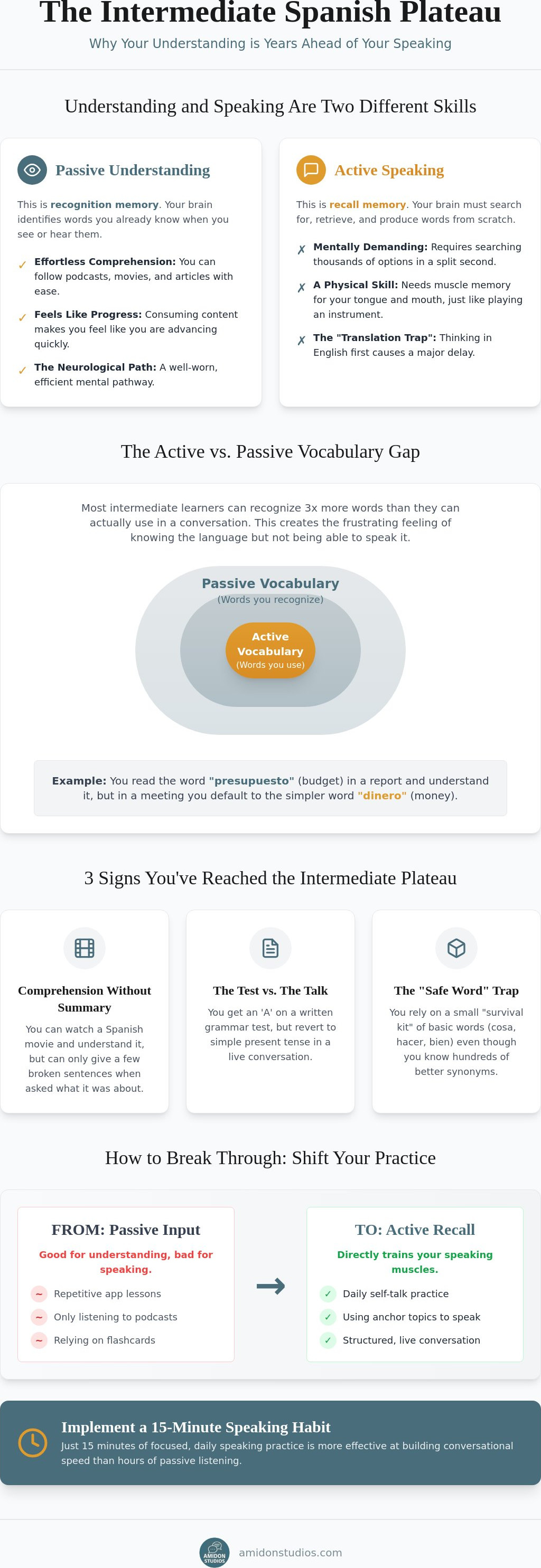
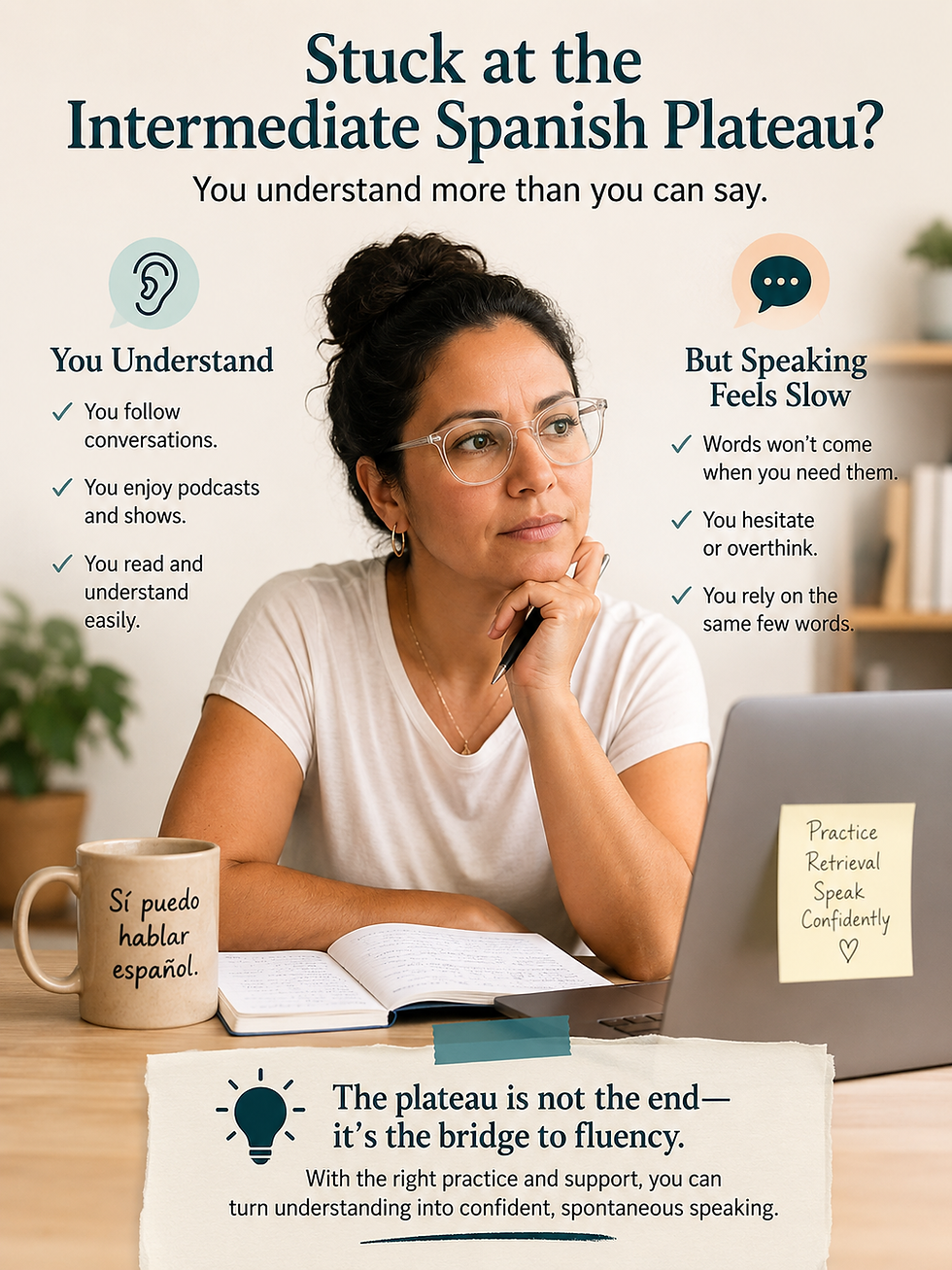
You have reached a level of functional competence where you can survive, but you are not yet thriving in real-time speech. The core issue is the gap between your receptive skills, like listening and reading, and your productive skills, including speaking and writing.
Put simply, the intermediate Spanish plateau is a discrepancy between what your ears understand and what your mouth can execute.
Signs You've Reached the Plateau
Comprehension without summary: You can watch a movie like "Roma " and understand most of the dialogue, but when a native Spanish-speaking friend asks what happened, you can only offer a few broken sentences.
The Test vs. The Talk: You score an A on a written grammar exam about the imperfecto, yet you revert to the present tense the moment you enter a live conversation.
The Safe Word Trap: You rely on a small survival kit of about 50 words, like cosa, hacer, or bien, even though you technically know hundreds of more precise synonyms.
The Adult Learner Challenge
Adults naturally rely on communication strategies that help them get their point across efficiently. Once simple Spanish starts working, it becomes easy to stop pushing yourself toward more complex language.
This is why immersion alone often fails for adults. You have already developed clever coping mechanisms, like gesturing or using English-sounding cognates, to bypass the hard work of speaking correctly.
Your high expectations as an intelligent professional also play a role. You want to sound as smart in Spanish as you do in English, and that gap creates a hesitation that keeps you stuck. Moving past this requires a shift in strategy.
You need to move beyond passive recognition and focus on the physical mechanics of speech. At Amidon Studios, we call this the Amidon Method. The Amidon Method focuses on helping students retrieve Spanish quickly in real conversations through structured speaking practice, targeted feedback, and active recall.
Heritage Speakers Experience This Plateau, Too
Many heritage Spanish speakers and "no sabo kids" experience this plateau, too. Because they grew up hearing Spanish at home, they often understand conversations easily but struggle to respond quickly.
The challenge isn't learning Spanish from scratch—it's turning years of passive understanding into confident, spontaneous speaking. Like many intermediate learners, heritage speakers often need structured speaking practice that helps them retrieve the Spanish they already know more quickly and confidently.
Why Understanding Spanish Does Not Equal Speaking It
Many learners believe that if they just listen to more podcasts or read more books, their speaking will eventually catch up. This is a common misconception that keeps people stuck on the intermediate Spanish plateau. Speaking requires repeated retrieval and response, much like learning a musical instrument.
When you read a word like aprovechar in an email, your brain recognizes it has two meanings: to take advantage of and to make the most of. When you're speaking, your brain has to search through thousands of options to find that specific word for that specific meaning in a split second. These are two separate mental muscles.
Speaking is also a physical act. We often treat Spanish like a history lesson, but it's actually more like learning to play the piano. Your mouth muscles need physical training through repeated speaking habits.
If you haven't practiced physically moving your tongue, lips, and jaw to make the double R in words like perro or the soft D in cada, you'll hesitate even if you know the word perfectly. This physical delay is often mistaken for a lack of knowledge, but it is actually a lack of muscle coordination.
Then there's the translation trap. Many intermediate students build a mental bridge between English and Spanish. You think of an English sentence, translate it, and then try to say it. This creates a massive delay that kills the rhythm of a conversation.
To move forward, you must learn to associate concepts directly with Spanish sounds. Separating these skills is the core of the Amidon Method at Amidon Spanish, where we train speaking as a standalone motor skill rather than a byproduct of grammar study.
The Passive Vocabulary vs. Active Vocabulary Gap
Most intermediate learners recognize far more words than they can quickly use in conversation.
For example, you might understand the word presupuesto (budget) when reading a business contract, but when you're actually in a meeting, you default to saying the simpler word *dinero *(money).
This gap occurs when words are recognized but not yet retrieved quickly enough for live use. Identifying these words and intentionally pulling them into your active speech is a vital step in your progress.
Cognitive Load and Speaking Anxiety
When you're constantly worrying about whether to use por or para, you're using up the mental bandwidth needed for actual communication. Your brain only has so much processing power.
If the cognitive load of grammar rules is too high, your brain defaults to English as a survival mechanism. The solution is automating basic phrases so they require zero thought. While apps are useful for building passive vocabulary, they cannot replace live conversation and personalized feedback.
If you want to see where your current retrieval speed stands, you can schedule a speaking assessment with us at Amidon Spanish to identify your specific bottlenecks.
Strategy 1: Transitioning to Active Recall Practice
Most language apps treat Spanish like a multiple-choice quiz. You see a picture of an apple, select "manzana" from a list, and receive a satisfying "ding." While this builds recognition, it doesn't prepare you for the dynamic nature of a real conversation.
In a cafe in Mexico City, there are no buttons to click. You have to pull the right word out of thin air while a waiter waits for your order. This shift from recognition to production is essential for anyone stuck on the intermediate Spanish plateau. You must move away from passive input and toward active recall practice.
A simple way to start is through "Self-Talk." This involves narrating your day in Spanish as if you were giving a play-by-play of your life. While you're making breakfast, say aloud, "Ahora estoy hirviendo el agua para mi cafecito" (I'm boiling water for my coffee).
It feels strange at first, but it creates a low-stakes environment where you can practice retrieval without the pressure of a listener judging your speed. It allows you to find the gaps in your vocabulary before you actually need those words in public.
For more ways to integrate these habits, you can check out our 11 conversational Spanish practice methods to keep your daily routine focused on production.
Another powerful tool is shadowing. This is the process of listening to a native speaker and repeating exactly what they say with a one-second delay.
Don't worry about analyzing the grammar in the moment. Focus on the melody, the pauses, and the physical rhythm of the sentences. This builds the muscle memory required to group words together naturally rather than speaking in a staccato, word-by-word fashion.
The Power of Scripting Your Life
Adult learners often struggle because they try to learn everything at once. Instead, identify the 10 scenarios you actually encounter in your real life. If you work in finance, your "script" should focus on explaining market trends or discussing a budget. If you are a parent, focus on the phrases you use with your children.
Write these scripts down, then record yourself saying them. When you listen back, you will hear exactly where your word retrieval fails. Focus on learning high-frequency connector or filler words like "entonces," "así que," or "por lo tanto."
These small words act as mental bridges, buying you a few extra seconds to think without breaking the flow of the conversation.
Audio-Only Challenges
Text is often a crutch for intermediate learners. If you can only understand a Spanish video when the subtitles are on, your brain isn't truly processing the sounds. Try removing all visual cues.
Listen to a short audio clip and try to summarize it out loud in your own words. This forces your brain to contextualize meaning rather than just translating individual words.
Use voice memos on your phone to track your progress. Recording a one-minute summary of your day once a week provides concrete evidence of your improvement in speed and pronunciation over time.
Strategy 2: Implementing a 15-Minute Speaking Habit
Living in an area where Spanish isn't the primary language makes it difficult (but not impossible) to find natural opportunities to talk. Many people try to compensate by binge-studying or playing Duolingo on weekends, but this rarely helps you overcome the intermediate Spanish plateau.
Speaking is a motor skill, much like playing an instrument. You wouldn't practice piano for five hours once a month and expect to play a concerto. You need short, daily bursts of activity to keep your retrieval speed sharp.
This 15-minute routine is designed to fit into a busy schedule while forcing your brain to move from passive recognition to active production.
Step 1: Choose an anchor topic. Pick one specific subject for the day. It could be what you did this morning, your goals for the week, or a summary of a news story you read. Keeping the topic narrow prevents you from feeling overwhelmed.
Step 2: Speak aloud for 5 minutes. Set a timer and talk non-stop. Don't worry about perfect grammar or sophisticated vocabulary. If you get stuck, use filler words like este, pues, or o sea to keep the sound moving. The goal is to reduce the silence between your thoughts and your speech.
Step 3: Identify 3 specific gaps. After the timer goes off, think back to the moments you struggled. What were three words or phrases you wanted to use but could not find? Perhaps you did not know the word for catching up, which is ponerse al día, or the word for postponing, which is postergar.
Step 4: Apply the new words immediately. Look up those three missing pieces. If you learned the word reprogramar, use it in five different sentences right away. Say five different things you might need to reschedule. This moves the word from your passive memory into your active motor skills.
Step 5: Record a 2-minute version. Now that you have the missing vocabulary, record a shorter, more polished version of your initial talk. This second pass reinforces the new speaking patterns and builds your confidence.
Why Consistency Trumps Intensity
Micro-sessions are far more effective than long, infrequent study blocks because they leverage the power of spaced repetition. When you speak for 15 minutes every day, you are constantly reminding your brain that Spanish is a tool it needs to keep ready.
This prevents the brain stall where you feel like you've forgotten everything since your last lesson. Your focus should be on interactional competence. This means prioritizing your ability to carry out a back-and-forth exchange rather than obsessing over every minor conjugation error.
Perfection often leads to hesitation, while consistent, messy practice leads to speed. Think "massive, imperfect action" when you feel your perfectionist tendencies coming on. It's more important to be messy than it is to be perfect.
Replacing Apps with Action
It's easy to spend 30 minutes on a language app and feel productive, but checking boxes does not train your brain to handle the unpredictability of a real conversation.
Language apps are excellent for building a foundation, but they can't provide the live, personalized feedback needed to correct fossilized errors.
These are the mistakes that have become permanent habits because no one pointed them out early on. While digital toolkits are great supplements, they should never replace the experience of talking to another human.
If you're ready to see how a structured roadmap can change your daily progress, you can book a trial lesson at Amidon Spanish to get professional feedback on your current speaking level.
Moving Toward Conversational Confidence
Many students wait until they feel confident before they start speaking in real-world settings. They believe that once they memorize enough vocabulary, the hesitation will simply vanish. But confidence isn't a prerequisite for speaking; it is a byproduct of consistent practice.
To move past the intermediate Spanish plateau, you have to accept that your Spanish will be imperfect for a while. The goal isn't to never ever make a mistake. The goal is to recover quickly when you do.
This is where structured guidance becomes essential. Personalized coaching targets your specific plateau triggers, whether that is a struggle with past tense conjugations or a tendency to stall when asked an open-ended question.
By identifying your unique speaking gap through a Spanish speaking assessment, you can stop guessing which app to use and start following a plan designed for your specific needs.
Your Personalized Speaking Path to Fluency
Our Spanish Star Program provides a structured 90-day roadmap that moves you away from academic lists and toward real-talk scenarios.
Instead of practicing sentences you'll never use, you'll practice explaining your professional background or navigating a complex travel delay. This approach provides the psychological safety needed to make mistakes in a controlled environment before you take them into the real world.
Your Spanish teacher acts as a strategist who helps you transition from thinking in English to responding in Spanish. When you no longer have to consciously translate every word, your mental bandwidth is freed up for actual connection.
This shift allows you to move from hesitation to organized ease in your conversations. You begin to trust that the words will arrive when you need them.
Next Steps for the Intermediate Learner
It's time to stop studying Spanish and start performing Spanish. If you've been stuck at the same level for months, more of the same study habits won't yield different results.
The intermediate Spanish plateau is actually a positive sign.
It means you have already built a strong foundation of grammar and vocabulary. Now, you simply need to build the house on top of it. This requires a shift in focus from the "what" of the language to the "how" of the delivery.
We invite you to experience this shift firsthand by scheduling trial Spanish lessons. You'll see how the Amidon Method prioritizes your retrieval speed and speaking habits over static memorization.
The path to conversational confidence isn't found in a textbook or language app; it's built one conversation at a time. Take the first step today and turn your passive knowledge into an active skill you can use with pride.
Taking the Next Step Toward Conversational Ease
Reaching the intermediate Spanish plateau is actually a sign of success. It means you have already built a solid foundation of grammar and vocabulary.
Now, the challenge is shifting your focus from academic study to physical performance. By treating speaking as a motor skill and prioritizing active recall over passive apps, you can finally close the gap between what you understand and what you can actually say in the moment.
Real progress happens when you move from simply learning the language to performing it. Our approach at Amidon Studios centers on this transition. We provide personalized coaching for adult learners that targets your specific bottlenecks. Whether you need to increase your retrieval speed or fix long-standing grammar habits, we offer a structured path forward that fits into your daily life.
Whether you've been studying Spanish for years or you understand far more than you can speak, a Spanish Speaking Assessment will show you exactly what's keeping you stuck—and how to move forward.
Frequently Asked Questions
Is the intermediate plateau normal for every Spanish learner?
Yes, the intermediate Spanish plateau is a universal stage for almost every language student. It marks the transition from survival Spanish to nuanced communication. While initial progress feels fast because you're learning high-frequency words, the middle stage requires more specific effort to see the same results. It's not a sign that you've stopped learning; it's a sign that your brain is reorganizing how it processes the language.
How long does it typically take to move past the intermediate stage in Spanish?
For many learners, the intermediate stage lasts much longer than the beginner stage because progress becomes less noticeable. Consistency is more important than the total number of hours. You're training a skill, not just memorizing facts.
Can I overcome the plateau by just watching more Spanish movies with subtitles?
Passive listening alone won't bridge the gap to active conversation. While movies help with comprehension, they don't train your mouth muscles or your retrieval speed. To see real change, you must switch from watching to performing. This means summarizing what you saw aloud or practicing shadowing without the crutch of text. You need to force your brain to generate the language, not just recognize it.
What is the difference between B1 and B2 Spanish levels?
A lower intermediate B1 learner can handle most travel situations and talk about familiar topics with some hesitation. An upper intermediate B2 learner can interact with native speakers with a degree of spontaneity that makes regular conversation possible without strain for either party. The shift is primarily about your ability to handle complex arguments and abstract topics in real-time. It's the difference between surviving a conversation and actually enjoying one.
Why do I forget all my Spanish grammar as soon as I start talking to a native speaker?
This happens because your brain only has a limited amount of bandwidth. When you're focused on the person in front of you, your cognitive load increases. If grammar rules aren't automated through conversational fluency, they're the first things your brain discards to keep the conversation going. You don't need more grammar study. You need more physical repetition to make those structures a natural reflex rather than a mental calculation.
Do I need to move to a Spanish-speaking country to become conversationally confident?
You don't need to move abroad to achieve conversational confidence. Many people live in Spanish-speaking countries for years without moving past the intermediate stage because they rely on English-speaking social circles. You can create an immersive environment anywhere by prioritizing daily speaking habits and working with a coach. Targeted practice at home is often more effective than undirected immersion in a foreign country.
How much daily practice is needed to see improvement in speaking speed?
Aim for at least 15 to 20 minutes of active speaking practice each day. Short, focused sessions are better for building speaking skills than long, occasional study blocks. If you consistently narrate your day or engage in active recall exercises, you'll notice an improvement in your retrieval speed within a few weeks. The key is making sure you're actually speaking aloud rather than just thinking in Spanish.


Comments