
How to Think in Spanish Instead of Translating Every Sentence


Most people believe that if they just memorize more vocabulary, they'll eventually stop translating in their head. The truth is that the ability to think in Spanish is a specific skill that has very little to do with the size of your dictionary. It's about shortening the distance between an idea and the words you use to express it, bypassing the English middleman entirely.
You probably know the feeling of being three sentences behind in a conversation because you were still mentally conjugating a verb from the first sentence. It's exhausting, and it often makes you feel like your Spanish personality is a dull shadow of your true self.
We understand how frustrating it is to have the knowledge but lack the retrieval speed to use it when it actually matters. You don't need more grammar drills; you need a strategy to stop the internal translation loop that slows you down.
In this article, you'll learn the cognitive strategies and speaking habits required to stop translating and start responding naturally. We'll show you how to move away from academic rules and adopt practical methods that reduce your mental load during live conversations.
By shifting your focus from passive memorization to active retrieval, you can finally enjoy a fluid, real-time connection with the people you're talking to.
Table of Contents
What Does It Actually Mean to Think in Spanish?
Many students look up the word pensar in a dictionary and assume that's the end of the story. However, to think in Spanish is a cognitive state, not just a verb to conjugate. It's the ability to bypass the English middleman entirely. When you achieve this, you aren't just reciting a memorized list of rules; you're connecting an idea directly to its Spanish label.
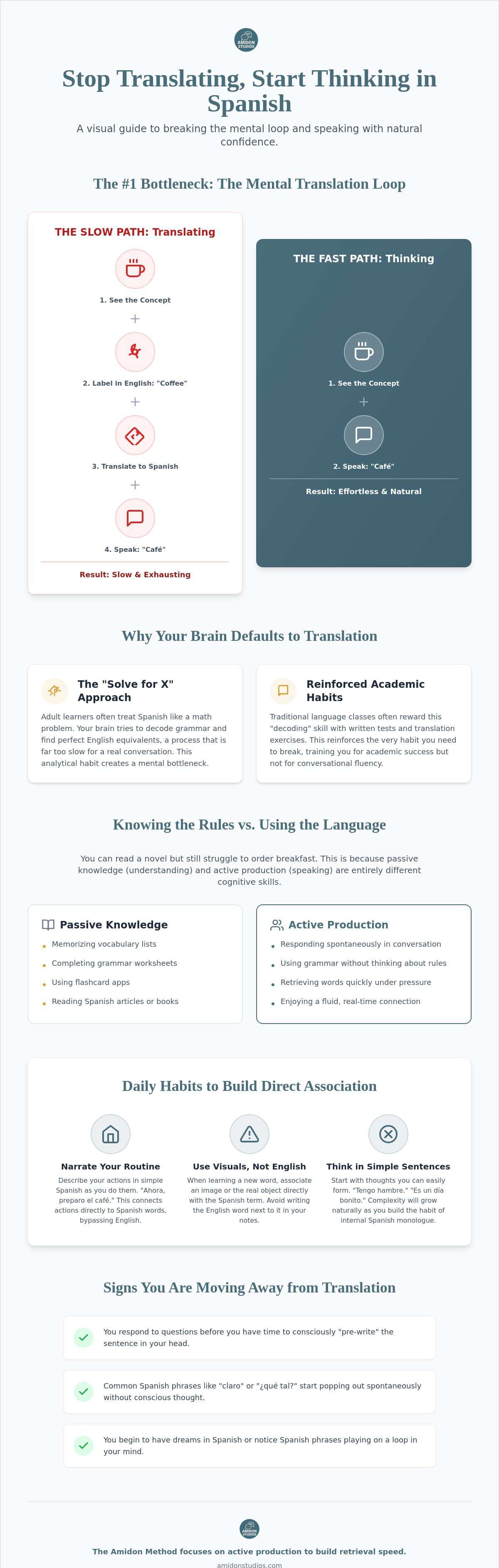
Most learners start stuck in what we call the Translation Loop. Imagine you see a cup of coffee. Your brain identifies the concept. It then labels it in English as "coffee." Finally, it translates to Spanish, "cafecito."
This three-step process is exactly what causes that awkward three-second pause in the middle of a conversation. Thinking in Spanish means jumping straight from the concept to the Spanish word. It's the difference between solving a math problem and simply knowing that two plus two is four.
This skill is primarily a result of high response speed rather than just having a massive vocabulary. You can know 5,000 words and still translate every single one of them, which leads to exhaustion.
Real fluency happens when you can grab the words you need without stumbling over your native language first. While advanced learners might still translate complex legal or philosophical thoughts, the goal for most students is to reach automaticity for daily interactions.
The Difference Between Knowing Spanish and Thinking in It
There's a massive gap between passive knowledge and active production. You might be able to read a Spanish novel but still struggle to order a simple breakfast. This happens because reading is a passive skill, while speaking requires your brain to use different cognitive processes in language learning.
When you develop automaticity, you significantly reduce the mental load of speaking. You stop viewing Spanish as a puzzle to be solved and start using it as a natural tool for connection. This transition is a core part of the Amidon Method, which focuses on moving you from understanding to active speaking.
Why Thinking in Spanish Feels Impossible at First
If you're translating everything in your head, you're not doing anything wrong. Most adult learners were taught to memorize grammar and vocabulary instead of using Spanish in real conversations. Thinking in Spanish is a skill that develops gradually through repeated exposure and speaking practice.
Signs You Are Moving Away from Translation
How do you know you're making progress? One clear sign is when you stop pre-writing your sentences in your head. If you find yourself responding to a question before you've had time to check your mental English notes, you're succeeding. You might notice Spanish phrases like "claro que sí" or "¿qué tal?" popping out spontaneously.
Some students even report dreaming in Spanish or having earworm phrases that play on a loop in their mind. These are all indicators that your reaction time is improving, especially during live 1:1 interactions where you don't have the luxury of a slow translation process.
The Cognitive Gap: Why Your Brain Defaults to Translation
Adult learners often approach Spanish like a puzzle. We have decades of experience using English logic to solve problems, so when we encounter a Spanish sentence, our first instinct is to decode it.
This analytical habit is exactly what research refers to as the Cognitive Gap. While this approach works for reading a manual or passing a written test, it fails during a fast-paced conversation where every second counts.
In natural language acquisition, there is a concept known as the silent period. Children spend months absorbing sounds and patterns before they ever try to produce them.
Adults, however, often feel pressure to speak perfectly from day one. We skip the listening phase and jump straight into translating our English thoughts.
Traditional academic settings make this worse; they often test your knowledge by asking you to translate written sentences, which reinforces the habit of looking for an English equivalent for every Spanish word. This creates a decoding skill rather than a motor skill.
The Problem with the "Solve for X" Approach
"Wait, was that the right past tense?" This is the internal question that stops many learners mid-sentence.
Treating Spanish like a math equation creates a massive bottleneck in your speech. If you're trying to calculate the correct subjunctive ending while someone is asking you how your weekend was, the moment has already passed.
The fear of being incorrect forces your brain back into English mode because it feels safer and more logical. High-stress environments, like a busy restaurant or a professional meeting, only make this worse.
Your response speed drops because your brain is working too hard on the language's logic rather than the flow of the interaction.
Building New Neural Pathways
The good news is that your brain is capable of neuroplasticity at any age. You can build new pathways that bypass the translation center entirely.
Instead of memorizing individual words like "bread" or "water," focus on repeating full phrases like "me das un..." or "quiero pedir..."
This builds muscle memory. Speaking is a motor skill, much like playing an instrument or riding a bike; it requires physical practice, not just mental decoding.
Live Spanish instruction is essential because it forces your brain to find shortcuts. When a real person is waiting for an answer, you don't have time to build a perfect English-to-Spanish bridge.
You're forced to use the Spanish you have available in the moment. Over time, these shortcuts become your primary route, helping you think in Spanish more frequently and with less effort.
If you're tired of the mental gymnastics, you might find it helpful to schedule a conversation assessment to see where your personal bottlenecks are.
Daily Habits to Build Direct Spanish Associations
Building the ability to think in Spanish doesn't happen during a once-a-week study session. It happens in the small, quiet moments of your day. To stop translating, you must intentionally create a direct link between an object or action and its Spanish name.
If you see a cat and think "cat" then "gato," you've already lost the battle for speed. The goal is to see the feline and have the word "gato" surface immediately.
One of the most effective ways to do this is by narrating your day. As you move through your morning routine, describe your actions in simple Spanish sentences. "Abro la puerta," "Preparo mi cafecito," or "Busco las llaves." By speaking these thoughts aloud as you perform the actions, you're tying the physical movement to the language.
You can also practice mental labeling. Instead of putting physical sticky notes on your furniture, look at an object and label it in your mind. When you see your car, don't just recognize it; identify it as "mi auto" before your English brain can intervene.
When you hit a wall and don't know a specific word, use the Substitution Game. Instead of stopping to look up a word in a dictionary, describe it using the Spanish you already know. If you forget the word for "colander," call it "la cosa para sacar el agua de la pasta."
This habit teaches your brain to stay in Spanish mode even when your vocabulary is limited. To make this smoother, focus on "chunking" your language.
Chunking is the practice of learning fixed expressions like "me gustaría" or "por si acaso" as a single, unbreakable unit rather than a string of individual words.
The Power of Self-Talk
Your internal monologue is a private practice ground where mistakes don't matter. Try setting a five-minute daily timer where you commit to only having "Spanish-only" thoughts. If you're wondering what to make for dinner, try to weigh your options in Spanish.
Moving from "I am eating" to "Estoy comiendo" without the English thought occurring first is a major milestone. This low-pressure environment helps you build the stamina needed for real-world conversations.
Using Visuals Instead of English Prompts
Traditional flashcards often reinforce translation because they have English on one side. Switch to image-based cards instead. When you see a picture of a red apple, your brain should produce "manzana," not the word "apple."
You can also start using a Spanish-only dictionary to define new terms. This forces you to use the language to learn the language. Practicing concept mapping, where you draw lines between related Spanish verbs and nouns visually, helps create a web of associations that doesn't rely on an English foundation.
Why Passive Learning Tools Can’t Teach You to Think on Your Feet
Dictionaries and apps are excellent for building a foundation, but they are fundamentally static resources. A Spanish-English dictionary is designed for translation, which is the exact habit we are trying to break.
When you rely on a screen that shows you an English word and asks for the Spanish equivalent, you are reinforcing the translation loop. To think in Spanish, you need to move away from these decoding exercises and toward dynamic, unpredictable interactions.
The problem with many digital tools is that they focus on recognition rather than recall. Recognition is seeing the word "manzana" on a screen and knowing it means apple. Recall is being at a fruit stand, wanting an apple, and having the word "manzana" surface in your mind without any English prompt.
Language apps rarely train the latter. While they are useful for expanding your vocabulary, they cannot replace the personalized feedback and spontaneous nature of a live conversation.
The Illusion of Competence in Language Apps
Many intermediate learners feel a sense of accomplishment when they maintain a long streak or get a high score on a grammar quiz. However, this often leads to an illusion of competence.
You might know the rules of the subjunctive on paper, but that doesn't mean you can use them while telling a story to a friend. This is what we call the App Gap. When an app provides hints or multiple-choice options, it prevents your brain from doing the heavy lifting of retrieval.
It's better to use Spanish Digital Courses & Toolkits as a supplement to your learning rather than the main event. These tools can help you review concepts, but they won't build the muscle memory needed for real-time talk.
If you find yourself passing Duolingo levels but failing to hold a five-minute conversation, it's a sign that your brain is becoming a master of recognition but not a master of production.
The Necessity of Real-Time Feedback
A human instructor does something an algorithm cannot: they identify the specific hang-ups that trigger your translation loop. Perhaps you always pause before using "por" or "para," or maybe you struggle with reflexive verbs.
A Spanish teacher at Amidon Spanish notices these patterns and pushes you to stay in the Spanish zone for longer periods. This pressure is actually healthy. It forces your brain to find shortcuts and use the Spanish you already know to solve communication problems.
Live interaction also helps correct fossilized habits. These are the translation shortcuts you've used for so long that they feel natural, even if they're grammatically awkward. Professional instruction provides a safe space to break these habits and replace them with natural phrasing.
If you want to see how this works in practice, you can schedule a trial Spanish lesson to experience the difference between static study and active production.
The Road to Speaking Naturally: Professional Instruction and the Amidon Method
Speaking naturally requires a fundamental shift in how you spend your time. If you want to think in Spanish, you have to spend more time producing the language than simply consuming it. This is where the Amidon Method comes in.
We help you move from understanding Spanish to using it comfortably in real conversations. By prioritizing active speaking practice, you gradually build the habit of responding naturally instead of translating every sentence first.
Our live 1:1 Spanish lessons are designed to be the primary catalyst for this change. Unlike self-paced study, these sessions simulate the speed and pressure of real-world interactions. You don't have the luxury of looking up a word or pausing for ten seconds to conjugate a verb.
Instead, you are encouraged to use the Spanish you have to get your point across. This consistent forcing of the brain to find shortcuts is exactly what eventually eliminates the need for mental translation.
To ensure this progress is sustainable, we use a personalized path to conversational confidence. This structure provides the consistency needed for long-term neural shifts.
It is not a generic curriculum; it is a personalized plan that addresses the specific vocabulary and scenarios relevant to your real life.
Whether you need to speak with colleagues or connect with family, your practice remains grounded in the situations you actually face.
The Amidon Method: Bypassing the Translation Loop
We focus on high-frequency chunks that allow for immediate communication. Instead of building every sentence from scratch using complex grammar rules, you learn to use pre-built phrases that native speakers use every day.
This approach allows you to stay in the flow of a conversation without getting caught up in the mechanics of the language. We use real-life scenarios, like navigating a business meeting or handling a social gathering, to simulate the pressure of natural talk.
Read more about the Amidon Method and how it differs from traditional, academic-style schooling.
Your Next Steps Toward Conversational Confidence
The transition away from translation starts with a clear understanding of your current level.
A professional assessment is the first step in identifying your specific speaking barriers and retrieval bottlenecks. Many adults worry about fitting coaching into a busy schedule, but our sessions are designed to be flexible and efficient.
For those looking for a dedicated, high-impact path, the Spanish Star Program offers a structured way to start thinking in the language and responding with natural ease.
Start Your Path to Conversational Ease
The ability to think in Spanish isn't a mysterious gift; it's a skill you build by choosing active production over passive study.
We've explored how moving away from the translation loop requires a combination of daily habits, like narrating your routine, and the courage to stop treating the language like a logic puzzle. While language apps help you recognize words on a screen, only live interaction trains your brain to retrieve those words in the heat of a real conversation.
With over a decade of language education experience, Amidon Spanish focuses on real-world conversational application. We provide a personalized 90-day roadmap to confidence so you can stop decoding and start connecting with the people around you.
If you're ready to see exactly where your speaking barriers are, we're here to help. If you're tired of translating every sentence before you speak, schedule a free speaking assessment. We'll identify what's slowing you down and create a personalized plan to
help you start thinking in Spanish naturally.
You've already done the hard work of learning the grammar and vocabulary. Now it's time to let the language flow. We look forward to helping you reach your goals.
Frequently Asked Questions
How long does it take to start thinking in Spanish?
It isn't a single moment where you suddenly flip a switch; it's a gradual process of shortening your reaction time. Many intermediate learners begin to notice they can think in Spanish for simple phrases within thirty days of consistent, conversation-heavy practice. The more you force yourself to use the language in real-time talk, the faster those neural connections become permanent and automatic.
Is it possible for adults to stop translating in their heads?
Adults can certainly stop translating, though it requires a different approach than the logic-based learning we're used to in school. Your brain is highly adaptable, and by practicing direct association, you can build new pathways. This means connecting the image of a chair directly to the word "silla" rather than passing through the English word first. It's about building motor skills, not just memorizing facts.
Why do I still think in English even though I have been studying for years?
If your study history is mostly reading and grammar exercises, you've trained your brain to decode but not to produce. This passive knowledge is safe and slow, which is why your brain defaults to English logic when the pressure of a real conversation starts. To break this habit, you need to shift your focus to active speaking drills that prioritize speed over perfect grammatical analysis.
Can I learn to think in Spanish using only apps?
Apps are useful for building basic vocabulary, but they often reinforce translation by showing you English prompts on the screen. To truly think in Spanish, you need the unpredictability of a real person. Conversation is dynamic and requires you to adapt in the moment, a skill that a static algorithm simply cannot teach or simulate effectively during your daily study routine.
What is the fastest way to improve my retrieval speed?
High-intensity, one-on-one conversation is the most effective way to boost your retrieval speed. When you're in a live session, your brain is forced to find shortcuts to keep the dialogue moving. This healthy pressure helps you move words from your long-term storage into your active speaking center, making them much easier to grab without hesitation during your next interaction.
Does knowing more grammar help me think in Spanish faster?
Not necessarily; in fact, over-studying grammar can actually become a bottleneck for many learners. If you're mentally checking a conjugation chart before you speak, you're not thinking in the language; you're calculating it. It's better to learn high-frequency chunks of language that you can use automatically without having to analyze the underlying mechanics every time you want to say something simple.
What should I do when my brain freezes and I cannot find the Spanish word?
Practice circumlocution, which is the art of describing a word you don't know using the words you already have. If you forget the word for fridge, you might say "la cosa fría en la cocina." This technique keeps your brain in Spanish mode and prevents you from falling back into the English translation loop that causes those long, awkward pauses in conversation.
How does the Amidon Method help with thinking in Spanish?
The Amidon Method focuses on moving you from passive understanding to active speaking through a personalized learning plan. By emphasizing active production and personalized scenarios, we help you build the muscle memory needed for automaticity. This approach ensures you aren't just learning about the language, but actually using it as your primary tool for thought and real-world connection.


Comments