
How to Transition from Passive to Active Spanish: A Practical Speaking Guide


You might follow a fast-paced Spanish podcast or read a news article with ease, yet the moment a Spanish-speaking neighbor asks you a simple question in the hallway, the words often fail to surface.
This is a common experience for intermediate learners who have spent years studying grammar only to find that their speaking skills don't match their reading level. This happens because understanding Spanish and speaking Spanish are two different skills.
To transition from passive to active Spanish, you must move your focus from collecting new information to practicing the specific skill of word retrieval.
In this guide, we will look at practical strategies to build real-world conversational skills that translate to actual speaking. You'll learn how to speed up your recall and find a clear path to becoming an active participant in any discussion.
And we're going to explore how you can hold a 15-minute conversation without those long, painful pauses, moving you beyond the limitations of vocabulary apps.
It's time to turn your years of study into the ability to speak with confidence through consistent, targeted practice.
Table of Contents
Understanding Recognition vs. Responding
Many students come to me with a common frustration. They can watch a film in Spanish and follow the plot, or they can read a news article and understand the main points. But when they try to order a coffee or explain a weekend plan, their mind goes blank.
This isn't a lack of intelligence or even a lack of vocabulary. It's the result of a gap between understanding and responding naturally. While many resources focus on the grammatical passive voice, such as how to form sentences where the subject receives the action, we are talking about your cognitive performance.
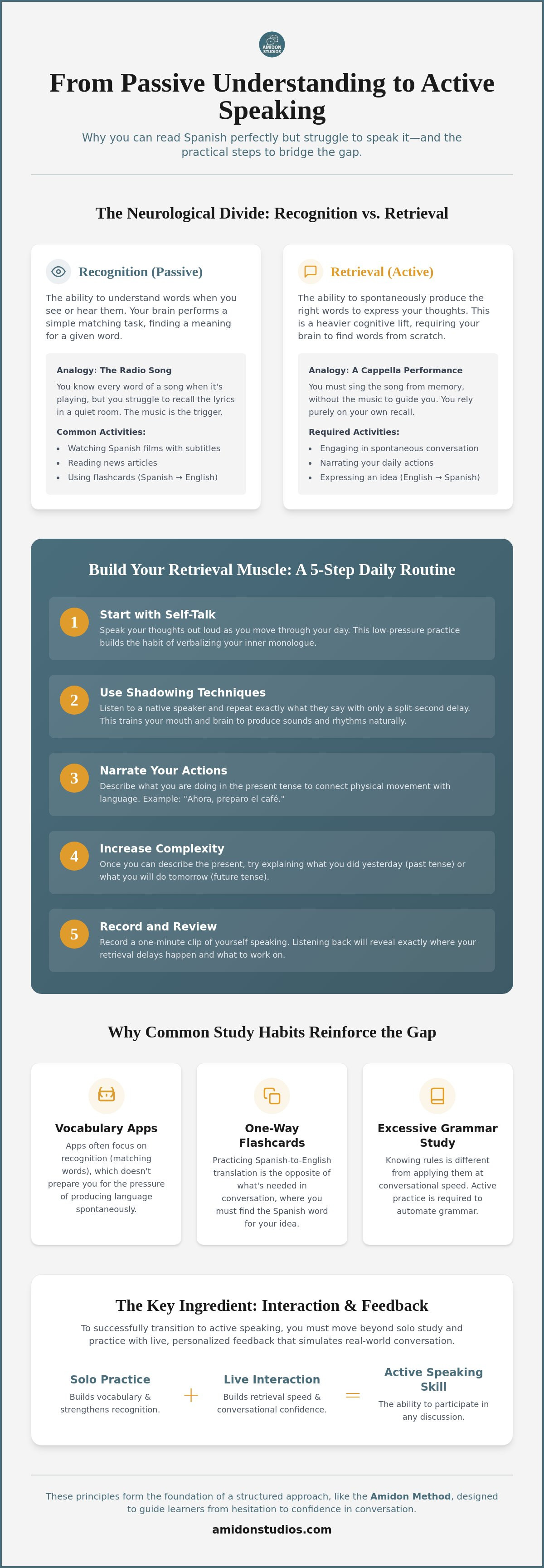
Passive Spanish is the ability to recognize words when you hear or see them. Active Spanish is the ability to produce those same words spontaneously in a real-world context.
The reason recognition feels so much easier is that your brain is performing a simple matching task. You hear a word, and your brain finds the corresponding meaning in its database.
Speaking quickly is a much heavier lift. It requires your brain to find the right word from scratch, conjugate it correctly, and place it in a sentence, all while maintaining the rhythm of a conversation.
Most Spanish learners get stuck in a long silent period because they have over-trained their comprehension skills and neglected the specific muscle of responding quickly.
The Science of Passive Bilingualism
In the process of second-language acquisition, the brain uses different neural pathways for input and output. Think of it like a popular song. You might know every word when it plays on the radio because the music triggers your memory.
However, if I asked you to sing that same song in a quiet room without any background track, you would likely struggle to remember the second verse. That background track is the context that aids recognition. Without it, you are forced to rely on retrieval.
To successfully transition from passive to active Spanish, you have to build pathways that don't rely on outside triggers to function.
Why Traditional Study Methods Fail Active Skills
Standard study habits often reinforce this gap without the student realizing it. When you use a translation app or a textbook, you are usually looking at Spanish and translating it back to English. This strengthens your recognition.
Even flashcards can be misleading. If you see the Spanish word and think of the English meaning, you aren't practicing the skill you need for a conversation. In a real talk, you start with a thought or a feeling and have to find the Spanish word to express it.
To transition from passive to active Spanish, you must flip your practice. You have to start with the concept and force your brain to find the Spanish label for it. This is a separate discipline that requires its own dedicated routine, far beyond what a passive app can provide.
Building a Speaking-First Practice Routine
Knowing a word is only half the battle. To effectively transition from passive to active Spanish, you must move beyond the safety of your study desk and begin training your brain to perform under pressure.
This requires a shift in how you spend your time. Instead of another hour on a vocabulary app, you need to prioritize retrieval drills that force your mind to find words without a prompt. This kind of practice is often less comfortable than reading, but it is exactly what builds the muscle memory required for a real conversation.
A structured approach to building this skill involves several specific steps:
Step 1: Start by talking to yourself in Spanish during everyday activities. Say your thoughts out loud as you move through your day.
Step 2: Use shadowing techniques. Listen to a native speaker and repeat exactly what they say with only a split-second delay.
Step 3: Narrate your current actions in the present tense to connect physical movement with language.
Step 4: Increase complexity. Once you can describe what you are doing, try explaining what you did yesterday or what you will do tomorrow.
Step 5: Record yourself. Listening back to a one-minute clip of your own speech will reveal exactly where your retrieval delays happen.
The Power of Daily Self-Narration
Think about your morning routine. As you make your coffee, describe the process. "Estoy haciendo un cafecito y ahora necesito ponerle leche." I'm making coffee, and now I need to add milk.
This might feel repetitive, but it is incredibly effective. By narrating simple tasks, you are automating the most common sentence structures. You're training your brain to associate the physical act of pouring milk with the Spanish verb poner (to put in).
For instance, "Le pongo la leche al cafecito." I add milk to the coffee.
This reduces the time your brain spends translating from English to Spanish. Over time, these phrases become "pre-loaded," allowing you to use them in a real conversation without hesitation.
This is one of the most practical strategies for language acquisition because it moves you out of the receptive stage and into active production.
Shadowing: Moving from Ear to Tongue
Shadowing is a technique where you mimic a native speaker's prosody, speed, and rhythm.
Choose a 30-second clip from a podcast or news segment. Don't worry about understanding every single word at first. Your focus should be on the physical mechanics of the sounds.
Are you hitting the "r" correctly? Are you linking your vowels the way a native speaker does?
Shadowing forces your brain to keep up with active processing speeds. It breaks the habit of stopping to analyze grammar mid-sentence.
If you find that you are consistently falling behind the speaker, it is a clear sign that your skills for expressing yourself and speaking comfortably in Spanish need more work.
If you're curious about how your current speaking skills compare to real-life Spanish conversational standards, you can schedule a speaking assessment to get a professional baseline.
Prioritizing High-Frequency Vocabulary for Immediate Use
One of the biggest mistakes intermediate Spanish learners make is trying to learn too many words at once. When you look at a dictionary or a massive flashcard deck, it feels like you need thousands of words to be conversational.
The reality is quite different. In everyday Spanish, the 80/20 rule applies: about 20% of the words you know will account for 80% of what you actually say. To transition from passive to active Spanish, you have to stop collecting rare nouns and start mastering the high-frequency verbs that drive every sentence.
Consider the verbs tener (to have), hacer (to do/make), and poder (to be able to). These are functional workhorses. If you can conjugate these three verbs instantly in the present, past, and future, you can navigate almost any basic situation.
Instead of struggling to find a specific, academic verb for "to construct," you can simply use hacer. This isn't being lazy with the language; it's being efficient. By narrowing your focus, you reduce the mental clutter that slows down your ability to respond naturally.
Focus on the Spanish You'll Actually Use
One of the biggest mistakes learners make is trying to memorize as much vocabulary as possible. While having a large vocabulary can be helpful, it doesn't automatically make speaking easier.
Instead, focus on becoming comfortable with the words and phrases you'll actually use in your daily life.
If you're learning Spanish to travel, practice ordering food, asking for directions, and talking with hotel staff. If your goal is to speak with family, practice the conversations you want to have around the dinner table. If you need Spanish for work, spend your time learning the vocabulary and situations you'll encounter on the job.
The goal isn't to know every Spanish word but to confidently use the words that matter most to you. As your confidence grows, your vocabulary will naturally continue expanding through conversation and real-life experience.
Build Around Real Conversations
Instead of memorizing long vocabulary lists, think about the conversations you want to have.
What questions do people usually ask you?
What stories do you tell most often?
What topics come up with your friends, coworkers, or family?
Those are the conversations worth practicing first. When your practice reflects your real life, speaking becomes much more natural because you're rehearsing language you'll actually use instead of vocabulary you'll probably forget.
Using Fillers and Connectors to Sound Natural
Even native speakers don't always have the perfect word ready. They use fillers and connectors to keep the conversation moving while their brain processes the next thought.
If you want to transition from passive to active Spanish, you should adopt these same filler words. They buy you precious seconds of response time without creating an awkward silence.
"Lo que pasa es que..." (The thing is...) - Use this to start an explanation.
"O sea..." (I mean... / In other words...) - Use this to clarify a point you just made.
"A ver..." (Let's see...) - Use this while you are literally thinking of what to say next.
"Entonces..." (So... / Then...) - Use this to link two ideas together.
Imagine you are at a restaurant and the server asks if you want dessert. Instead of a long pause while you think of the word for "full," you can say, "A ver... la comida estuvo muy buena, pero o sea, ya no tengo hambre."
These small connectors make you sound more like a participant and less like a student reciting a script. If you are ready to put these functional tools into practice, you can explore how we structure these drills in our Spanish Star Program.
The Role of Interaction and Feedback in Skill Development
You can practice self-talk in your kitchen and memorize functional verbs for hours, but eventually, you have to test those skills against another human being. This is where the real work happens.
Live interaction introduces a level of cognitive pressure that solitary study simply cannot replicate. In a conversation, you don't have the luxury of pausing for thirty seconds to look up a conjugation. You have to respond in the moment.
This social pressure is actually a good thing. It forces your brain to prioritize retrieval over analysis, which is the final step to transitioning from passive to active Spanish.
Making mistakes in a controlled, safe environment is the fastest way to build this skill. When you speak with a professional, they don't just hear your words; they identify the specific patterns of receptive bilingualism that are holding you back.
For instance, you might consistently use estoy when you should use soy because you can't quite quickly remember the distinction in real-time.
A Spanish language coach or teacher provides the immediate, personalized feedback on pronunciation and syntax that allows you to correct these errors before they become permanent habits.
Moving Beyond the App Plateau
Many Spanish learners find themselves stuck on an app plateau. Platforms like Duolingo or Babbel are excellent for building a foundation, but they often keep you trapped in a passive recognition loop. These apps are mostly choice-based; you select the right word from a list or translate a sentence that is already written for you.
Real life is fast, and responding quickly is key to good communication. In the real world, nobody hands you a Spanish word bank when you are trying to clearly explain a medical issue or negotiate a contract.
To break this cycle, you need to step up to live 1:1 Spanish lessons. This shift from tapping buttons on an app to generating original thoughts is essential for any Spanish learner who wants to move beyond basic recognition.
Personalized Coaching vs. Language Exchanges
You might think a casual language exchange with a friend is enough. While these can be fun, they often lack the structure needed for significant improvement.
A casual partner will usually ignore your small errors to keep the conversation flowing. While this feels good, it doesn't help you refine your retrieval speed or accuracy. A professional coach or teacher understands the psychology of Spanish learners like you.
They know when to push you and when to provide filler words to help you find your way. This structured approach builds the specific confidence required for real-world interaction.
If you feel like your progress has stalled despite your best efforts, you can book a trial lesson to experience the difference that personalized feedback makes.
From Understanding to Speaking: Amanda's Story

One student, Amanda, came to us after trying several different ways to learn Spanish, including college classes, language apps, and studying on her own.
Her mom is a native Spanish speaker from Puerto Rico, so Amanda understood much more Spanish than she felt comfortable speaking. But conversations still felt slow and uncertain. Past tenses were especially frustrating, and she often hesitated because she wanted to say everything correctly before speaking.
As we worked together, something began to change. Amanda started speaking in longer sentences, connecting her ideas more naturally, and correcting herself without stopping the conversation. She became more comfortable talking about work, travel, and family, even when she wasn't completely sure every word or verb tense was perfect.
Her progress didn't come from memorizing hundreds of new vocabulary words. It came from using Spanish regularly in real conversations, receiving personalized feedback, and becoming more comfortable communicating through uncertainty. Today, she uses Spanish more confidently because she trusts herself to keep the conversation going.
Implementing the Amidon Method for Conversational Confidence
At Amidon Spanish, our approach is built on the reality that speaking is a separate skill requiring its own specific set of tools.
You can spend years listening to podcasts or doing grammar drills without ever developing the ability to respond quickly in a real conversation. This is because speaking requires retrieval strategies that traditional academic methods often ignore.
To successfully transition from passive to active Spanish, you need a structured environment where you can practice the mechanics of output until they become second nature.
Our method synthesizes the retrieval drills and high-frequency focus discussed in previous sections into a cohesive system. The 90-day roadmap is designed specifically for adult learners in the US who are tired of being observers.
We move you through a sequence of increasingly complex interactions, starting with basic descriptions and moving toward professional scenarios or travel-specific needs.
This isn't about reaching an abstract goal of perfection. It's about ensuring that when you are in a team meeting or at a dinner with friends, you have the tools to contribute meaningfully to the discussion.
What to Expect in the Spanish Star Program
The Spanish Star Program is our signature targeted approach for adults. Every student begins with a speaking assessment to identify their specific retrieval delays.
From there, we create a personalized plan that combines live 1:1 instruction with digital toolkits. These toolkits are available 24/7, allowing you to practice shadowing and self-narration between your sessions.
This combination ensures that you are constantly building muscle memory, even when you aren't in a live lesson. You won't just learn about the language; you will learn how to use it in the situations that matter most to you.
Your Next Steps to Active Fluency
The most important step you can take is to move from the role of a passive listener to an active participant. If you have spent months or years feeling like an imposter despite your study time, it is likely because you haven't yet trained your brain for retrieval speed.
You can learn more about our approach and how I developed these strategies to help learners overcome the plateau of passive understanding. Taking a speaking assessment is the first step toward a clear roadmap. It provides the data you need to stop guessing and start practicing with purpose.
We're here to guide you through this transition with the structure and support you need to finally speak with ease.
Moving Toward Conversational Confidence
Developing the ability to speak Spanish isn't about memorizing more grammar rules; it's about training your brain to retrieve what you already know. By prioritizing high-frequency verbs and implementing a daily routine of self-narration, you shift your focus from input to output.
This change in strategy is the most effective way to transition from passive to active Spanish. Consistent practice, combined with live interaction, ensures that your retrieval speed keeps up with the pace of a real conversation.
You don't have to navigate this shift alone. Our 90-day roadmap to conversational confidence provides a structured path for adult learners who are ready to participate in the world around them.
Through expert coaching by our native Spanish-speaking teachers and personalized plans that fit your schedule, you can move beyond the limitations of apps and start using your skills in real-life scenarios.
The first step is understanding where you currently stand. Book your free Spanish Speaking Assessment today to receive a clear evaluation of your skills and a plan for your next steps. We look forward to helping you find your place in the conversation.
Frequently Asked Questions
Why can I understand Spanish but not speak it?
Understanding and speaking are separate neurological skills that use different neural pathways. Recognition is a matching task where your brain identifies a word it already knows, whereas responding is a task that requires building a sentence from scratch. If you have spent most of your time listening or reading, you have trained your recognition muscles but not the specific pathways needed for spontaneous speech.
How long does it take to move from passive to active Spanish?
The time required depends on your starting point and the consistency of your practice, but many learners experience a significant shift in retrieval speed within 90 days. This transition isn't about reaching a specific finish line of fluency. Instead, it is about shifting your daily habits from passive consumption to active production through targeted drills and consistent live interaction with a coach.
Are Spanish language apps useful for active speaking skills?
Language apps help build your Spanish vocabulary database, but they rarely help with your confidence and response time in a real conversation. Most apps rely on multiple-choice questions or translation exercises that don't force you to generate original thoughts. To successfully transition from passive to active Spanish, you must move beyond these choice-based tools and engage in production-based practice with a live interlocutor.
Do I need to live in a Spanish-speaking country to become active?
You do not need to live abroad to build conversational skills as long as you create a speaking-focused environment at home. Many people live in Spanish-speaking countries for years and remain passive listeners because they don't practice actively responding in Spanish. By using techniques like shadowing and self-narration, you can simulate the pressure of immersion and build the necessary muscle memory regardless of your physical location.
What is the best way to practice speaking Spanish alone?
The most effective solo practice involves narrating your daily actions and using shadowing techniques. When you describe what you are doing out loud, you connect physical actions with Spanish verbs, which reduces your internal translation time. Shadowing a native speaker for 30 seconds at a time helps you mimic natural rhythm and speed, training your tongue to keep up with the pace of real-world talk.
Can heritage Spanish speakers benefit from an active speaking program?
Heritage speakers often have the largest gap between what they understand and what they can say. They might grow up hearing Spanish at home but rely on English for their responses, which keeps their Spanish skills in a passive state. An active speaking program helps these learners by providing a structured toolkit to practice conjugations and formal structures, allowing them to participate fully in family conversations.
What is the difference between active and passive vocabulary?
Passive vocabulary includes all the words you recognize when you hear them, while active vocabulary consists only of the words you can retrieve spontaneously. To transition from passive to active Spanish, you should prioritize the depth of your knowledge over the breadth of your list. Mastering a smaller set of high-frequency functional verbs allows you to speak more fluidly than knowing thousands of nouns you cannot use.
Why do I freeze even though I know the words?
Many Spanish learners understand far more than they can comfortably say. During a conversation, your brain has to retrieve vocabulary, choose verb forms, and respond in real time. That takes practice. The more you use Spanish in meaningful conversations, the easier it becomes to find the words you already know without stopping to translate every sentence.
How does the Amidon Method help with retrieval speed?
The Amidon Method treats speaking as a separate discipline that requires its own set of drills. We use a 90-day roadmap that moves you through specific stages of speech emergence, focusing on the Core 500 words that drive most daily interactions. By combining digital toolkits with live coaching, we identify your specific retrieval delays and provide the personalized feedback needed to build conversational confidence.


Comments