
How Heritage Speakers Can Become More Confident in Spanish Conversation


Imagine sitting at a Sunday dinner where you follow every joke and understand every story your relatives tell in Spanish. When someone turns to you with a direct question, you know exactly what they said, but the Spanish words don't come to your lips quickly enough.
Instead of joining the rhythm of the room, you find yourself responding in English just to keep the momentum going. This specific experience is a frequent hurdle in heritage Spanish conversation, where the ability to understand far outpaces the ability to speak spontaneously in social settings.
It's a common misconception that if you can understand a language, you should be able to speak it with ease. In reality, speaking is a distinct physical and mental skill that requires its own specific practice separate from listening.
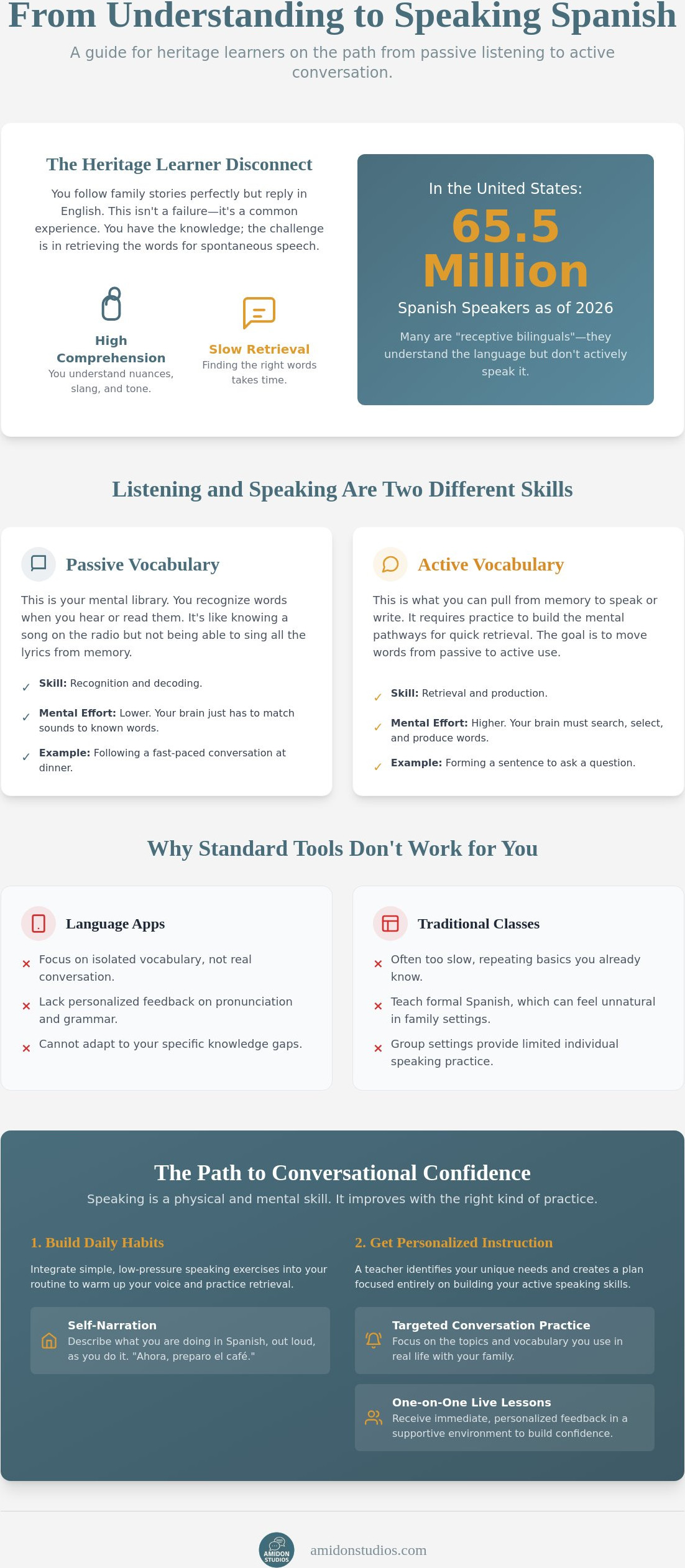
With over 65.5 million Spanish speakers in the United States as of 2026, many adults identify as heritage speakers who understand Spanish well but struggle to speak it spontaneously. You don't lack the knowledge; you're likely struggling with language retrieval.
This article explains why digital apps often fail to help with real-world talking and how personalized instruction from a teacher can help you respond naturally. You'll discover practical strategies to move from passive listening to active participation, ensuring you're prepared for your next family gathering.
Table of Contents
Defining Heritage Spanish Conversation and Receptive Bilingualism
If you grew up hearing Spanish at home but find yourself answering in English, you're a heritage learner. This term describes individuals who have a cultural or familial connection to a language and have some level of proficiency in it. In a national context, this is becoming increasingly common.
The United States now has the second-largest Spanish-speaking population in the world, with approximately 65.5 million speakers as of 2026. Many people in this group fall into the category of Defining Heritage Spanish as receptive bilinguals.
Receptive bilingualism is the ability to understand a language without the current ability to speak it fluently. It's a common experience for those who heard Spanish spoken by parents or grandparents but didn't have many opportunities to practice speaking it themselves.
You might feel like you're failing the language, but the opposite is true. You already possess a massive amount of linguistic expertise. You understand slang, tone, and cultural nuances that a traditional student would take years to learn. Your brain has already done the hard work of building a library of words. You just need to practice taking them off the shelf.
The Spectrum of Heritage Language Skills
Exposure to Spanish varies for everyone. Some heritage learners grew up in fully immersed communities, while others only heard the language during holiday visits. Regardless of where you fall on this spectrum, your understanding is a foundation for speaking, not a separate failure.
For example, you might follow your grandmother's stories perfectly but respond in English to avoid searching for words. This isn't because you don't know the Spanish words. It's because your brain hasn't practiced the specific path of pulling those words into active conversation. Listening and speaking are two different skills, and you've simply had more practice with one than the other.
Why Many "No Sabo Kids" Struggle to Speak Spanish
If you've ever been called a "no sabo kid," you're not alone. The phrase is often used—sometimes jokingly and sometimes critically—to describe heritage speakers who understand Spanish but make mistakes when speaking it.
Despite the name, being a "no sabo kid" doesn't mean you're bad at Spanish. It usually means you grew up hearing the language at home but had fewer opportunities to practice speaking it yourself.
Many heritage speakers have an impressive understanding of everyday conversation, family expressions, humor, and cultural references. The challenge isn't a lack of knowledge—it's retrieving the words quickly enough during a real conversation. That gap can make you feel self-conscious, especially when speaking with relatives or native speakers.
The good news is that this is a skill you can strengthen through consistent conversation practice. Speaking becomes easier as your brain builds faster, more reliable retrieval pathways for the Spanish you already know.
Why Conversational Spanish Feels Different for You
Traditional beginner classes often feel too slow or repetitive. You don't need to spend weeks learning colors or basic greetings. You already know them. Most academic courses focus on formal Spanish, which can feel stiff compared to the informal, warm Spanish used in your family.
This mismatch is why heritage Spanish conversation requires a different approach. Reclaiming your voice through conversation practice isn't just about grammar. It's about the cultural importance of maintaining your roots and ensuring the language continues with the next generation.
At Amidon Studios, we use the Amidon Method to focus on these specific conversational needs rather than repeating what you already know.
Why Knowing Spanish Words Does Not Always Mean You Can Say Them
Many heritage learners feel a specific disconnect when they try to speak. You might follow a rapid family debate or understand a complex news broadcast, yet struggle to explain what you had for lunch. This happens because language retrieval is a distinct mental process that works independently from listening comprehension.
Understanding is a passive skill; your brain simply needs to recognize a word when it hears it. Speaking, however, is an active skill. Your brain must locate a word in your memory and physically produce it in a split second.
Think of it like a popular song you've heard many times. You recognize the melody and the chorus immediately when it plays on the radio. But if someone asked you to recite the second verse from memory without the music, you might stumble. You know the song, but you haven't practiced the active retrieval of the lyrics.
In a heritage Spanish conversation, your brain is often searching for lyrics it hasn't used in years, even if it recognizes the melody perfectly when others speak.
Passive vs Active Vocabulary Retrieval
This explains why you can often read a news article in Spanish but feel stuck when trying to order at a restaurant. When you read, the words are provided for you. Your job is only to decode them. When you speak, you have to do the heavy lifting of selecting the right word from thousands of options while simultaneously managing grammar and pronunciation.
This mental effort is significant. To move words from your passive memory into your active vocabulary, you need targeted speaking practice. Engaging in live Spanish lessons helps create a reliable path between your thoughts and your speech, making those words easier to reach when you need them most.
The Role of Hesitation in Conversation
If you find yourself translating from English in your head before you speak, you aren't alone. This internal translation is a common habit for heritage speakers who primarily use English in their daily lives. This extra step creates a delay that disrupts the natural flow of a heritage Spanish conversation.
By the time you've constructed the perfect sentence in your mind, the topic has often changed. Consistent conversation practice with a teacher helps reduce this hesitation. The goal isn't to memorize rules, but to build the habit of direct retrieval. If you want to see where your current retrieval skills stand, you can schedule a speaking assessment to identify which words are stuck in your passive memory.
The pressure of real-time interaction often causes heritage speakers to default to English because it feels more efficient in the moment. However, the more you rely on English as a crutch, the more those Spanish retrieval paths weaken.
To gain confidence, you must practice producing speech in a low-pressure environment where you receive personalized feedback. This shifts your focus from just knowing Spanish to actually using it.
Why Traditional Lessons and Apps Often Fall Short for Heritage Learners
Many heritage speakers turn to popular language apps when they want to improve. It makes sense. They're convenient and low-pressure. However, most apps rely almost entirely on multiple-choice questions. This tests your ability to recognize a word, not your ability to produce it.
In a real heritage Spanish conversation, there are no buttons to click or hints to follow. You have to pull the words from your own mind under the pressure of a live interaction. Recognition is a different mental task than production, and apps simply don't train the latter.
Standard textbooks and classroom settings often present another hurdle. They focus on academic scenarios or tourist interactions, like checking into a hotel or ordering at a cafe in Spain. These lessons often feel irrelevant to your life.
You don't need to learn how to ask where the bathroom is; you need to know how to discuss your career or share a specific memory with your family. This lack of practical relevance is why many intelligent adults find traditional methods unhelpful for their specific needs.
The Limitation of One-Way Learning
Listening to podcasts or watching videos can help with your comprehension, but it remains a passive activity. You're consuming the language rather than creating it. Speaking is a physical skill, much like playing an instrument. You can't learn to play the guitar by only listening to concerts. You have to physically practice the chords.
Live Spanish lessons provide the interactive environment you need to move from listening to doing. Without personalized feedback from an experienced teacher, it's difficult to identify the specific gaps in your vocabulary. A one-on-one Spanish lesson ensures you're the one doing the talking, which is the only way to build the muscle memory required for speech.
Why You Do Not Need More Grammar Rules
Most heritage learners already have an intuitive grasp of Spanish grammar. You know how the language should sound because you've heard it your entire life. Taking a class focused on repetitive grammar drills is often a waste of your time.
In fact, over-analyzing rules can actually lead to frequent pausing when you try to talk. If you're constantly worried about the technical name of a verb tense, you'll hesitate and lose the rhythm of the interaction.
Imagine you're at a family gathering. It's much more important to tell a story about your week than to conjugate fifty verbs on a worksheet. Conversation practice focuses on your ability to communicate ideas clearly.
Through personalized instruction, you can refine your natural speech patterns without the pressure of academic testing. This approach is a core part of the Amidon Method. We focus on your personalized path to conversational confidence by building on the intuitive knowledge you already have rather than starting from zero with dry rules.
Practical Habits to Improve Heritage Spanish Speaking Skills
Building confidence in a heritage Spanish conversation doesn't happen during a three-hour study session once a week. It happens in the small, five-minute windows of your daily life. Because speaking is a physical skill, your brain needs frequent, short bursts of activity to keep retrieval paths open. If you only practice occasionally, your brain treats Spanish as secondary information rather than a tool for immediate use. Aim for ten minutes of active speaking every day rather than one long session on the weekend.
One of the most effective ways to do this is by narrating your daily activities. While you're doing household chores or driving to work, describe what you're doing out loud in Spanish. You might say, Estoy doblando la ropa y buscando los calcetines.
If you realize you don't know the word for fabric softener (suavizante de telas), you've just identified a specific vocabulary gap in a real-world context. This type of self-talk is a practical way to practice pulling words from your passive memory into your active speech without any external pressure.
Creating a Low-Pressure Practice Environment
You don't need an audience to start improving. Speaking aloud when you're alone removes the pressure of real-time correction from others. To make this habit even more effective, try focusing on one specific topic each week.
For example, spend seven days focusing on household items, then switch to work or hobbies the following week. This prevents you from pausing too often and allows you to build usable knowledge in one area at a time.
Once you're comfortable with these simple phrases, you'll find it much easier to contribute to a live heritage Spanish conversation with family members.
Transitioning to Live Interaction
While self-practice is a great start, you eventually need the dynamics of a real interaction to reach your goals. This is where one-on-one Spanish lessons become essential.
A teacher can provide the personalized feedback you can't get from a recording or an app. In a live Spanish lesson, an instructor will notice if you're over-relying on English structures and help you find the natural Spanish equivalent. This targeted speaking practice ensures you aren't just repeating what you know, but actually expanding your capabilities.
To stay focused, it helps to set a clear 90-day goal. Whether it's participating in an upcoming family event or being able to call a relative without pausing for words, a specific timeline keeps your practice intentional.
At Amidon Studios, we use a personalized learning plan to track these goals, ensuring every conversation practice session moves you closer to the results you want. This structured approach helps you move past the plateau of understanding and into the world of active talking.
Finding Your Personalized Path with Amidon Studios
Traditional university courses often treat heritage learners as a single group with identical needs. In reality, your history with the language is unique. You don't need a standardized curriculum that forces you through writing drills or basic grammar you already intuitively understand.
Instead, you need a method that respects the knowledge you already have while addressing the specific hurdle of language retrieval. This is the foundation of the Amidon Method. It focuses entirely on building conversational confidence through interaction rather than academic testing.
Personalized instruction is the most effective way for an adult to improve their heritage Spanish conversation. Unlike a generic classroom where the teacher must divide attention among twenty students, one-on-one Spanish lessons allow you to focus on the specific scenarios that matter to you.
If you need to speak with relatives or lead a meeting in Spanish at work, your instructor can tailor every session to those goals. This flexibility is essential for busy adults who don't have time for irrelevant lessons.
The Spanish Star Program for Heritage Learners
We designed the Spanish Star Program specifically for adults who understand the language but struggle to respond. The core of this experience is 1:1 live Spanish lessons where you receive immediate, personalized feedback.
This isn't about memorizing lists; it's about active speaking practice in a supportive environment. Your teacher acts as a guide, helping you identify which words are stuck in your passive memory and giving you the tools to pull them into active use.
Over a 90-day period, this structured approach helps you build the habit of speaking without the constant need for internal translation.
Taking the First Step Toward Confidence
The journey to feeling self-assured in a heritage Spanish conversation starts with understanding exactly where you are today. A free speaking assessment is the best way to identify your current level and see how we build your personalized path to conversational confidence.
During this session, an instructor will evaluate your retrieval speed and comprehension, helping you see the clear steps forward. Reclaiming your heritage through speech is a powerful way to connect with your roots and ensure the language stays alive in your family.
It doesn't require years of dry study; it requires consistent, meaningful interaction with a teacher who understands your unique profile as a heritage learner.
Start Participating in Your Family Conversations
You've already done the hard work of learning to understand Spanish. Now, it's about training your brain to retrieve those words in the middle of a live interaction. Moving from a passive listener to an active speaker requires more than just vocabulary apps; it requires the type of focused speaking practice that builds real self-assurance.
By incorporating simple daily habits and seeking personalized instruction, you can transition into a natural heritage Spanish conversation without the constant hesitation.
Amidon Studios brings over a decade of experience in language education to help you reach this goal. Our one-on-one Spanish lessons provide a personalized learning plan tailored specifically to your background and the real-world scenarios you face every day. We focus on meaningful interaction so you can stop over-analyzing rules and start talking with ease.
You have the knowledge inside you. With consistent practice and the right guidance, you'll be ready to join the conversation at your next family gathering with confidence. It's time to reclaim your language and share your stories in Spanish.
Frequently Asked Questions
Why can I understand Spanish but not speak it?
Understanding is a passive skill while speaking is an active one. Your brain has spent years recognizing Spanish sounds, but it hasn't practiced the physical act of producing them. This gap exists because language retrieval is a separate mental process. You possess the knowledge; you just haven't built the reliable paths needed to pull those words into a live interaction quickly enough to keep up with a conversation.
How long does it take for a heritage speaker to become fluent?
Every heritage speaker's journey is different. Because you already understand much of the language, your progress may look different from that of a traditional beginner. Rather than learning every word from scratch, you'll spend much of your time strengthening your ability to retrieve and use the Spanish you already know through consistent speaking practice and personalized instruction.
Are heritage Spanish classes different from regular Spanish classes?
Heritage-focused instruction bypasses the basic introductory material found in standard beginner classes. You don't need to spend weeks learning colors or greetings because you already know them. These lessons target your specific vocabulary gaps and cultural context instead. A heritage Spanish conversation class focuses on real-world interaction and the informal language used within families rather than dry, academic textbook scenarios that feel irrelevant to your life.
Can I improve my Spanish speaking skills without moving to another country?
You can absolutely build fluency at home through targeted speaking practice. Immersion doesn't require a plane ticket; it requires meaningful interaction with a live teacher who can provide personalized feedback. Consistent, daily use of the language in your own environment is often more effective than a short-term trip. You need to build the habit of speaking Spanish in your actual daily life to see lasting results.
What is the best way to practice Spanish conversation as an adult?
The most effective method is engaging in one-on-one Spanish lessons with an instructor who focuses on your specific goals. While apps and podcasts are helpful for vocabulary, they can't replace the feedback loop of a real conversation. Practicing with a teacher ensures you're challenged to produce speech spontaneously in a supportive, low-pressure setting. This interaction is the only way to move words from your passive memory into active use.
Is it common for heritage learners to feel nervous when speaking Spanish?
Nervousness is extremely common among heritage speakers. It often stems from the fear of making mistakes in front of native-speaking relatives or feeling disconnected from your roots. This anxiety usually decreases once you realize that speaking is a mechanical skill that improves with repetition. Consistent conversation practice helps normalize the act of talking, making it feel like a natural part of your identity rather than a source of stress.
Do I need to study grammar if I already understand the language?
You likely don't need traditional grammar drills because you already have an intuitive sense of how the language sounds. Focusing too much on technical rules can actually slow you down and increase hesitation. It's better to refine your grammar through natural conversation and personalized feedback from a teacher. This approach allows you to correct specific errors without the pressure of memorizing conjugation charts or academic terminology.
How do live lessons help more than using a language app?
Live lessons provide the real-time interaction and personalized feedback that apps cannot offer. Apps usually rely on multiple-choice questions, which only test your ability to recognize words. A live teacher forces you to engage in active language retrieval. This is the exact skill you need for a successful heritage Spanish conversation. This interactive feedback loop is essential for building the muscle memory required for spontaneous, real-world speech.


Comments