
Real-Life Spanish Conversation Practice: The Fastest Way to Build Fluency

Updated: Jul 22

You’ve spent months, maybe even years, learning Spanish. You can read a news article from a Mexican newspaper, follow along with a podcast from Spain, and understand most of your favorite Netflix series.
Yet, when a native speaker asks you a simple question like, “¿Qué hiciste el fin de semana?” (What did you do this weekend?), your mind goes blank. All that vocabulary you memorized vanishes.
This experience is incredibly common among adult learners. It’s not a sign of failure; it’s a sign that you’ve successfully trained your passive skills (listening and reading) but haven’t yet built the separate, active skill of speaking.
Real-life Spanish conversation is not a knowledge quiz. It’s a performance skill, much like playing a sport or a musical instrument. You can’t learn to play the guitar by only reading sheet music, and you can’t learn to speak Spanish by only consuming it.
This guide will explain why speaking is a distinct skill, how to train it effectively, and what practical exercises you can use to start building real conversational ability today.
We'll move beyond simply finding a practice partner and focus on the specific drills that build the speed and muscle memory required for spontaneous, real-life conversation.
Table of Contents
Why Passive Study Fails Real-Life Spanish Conversation Practice
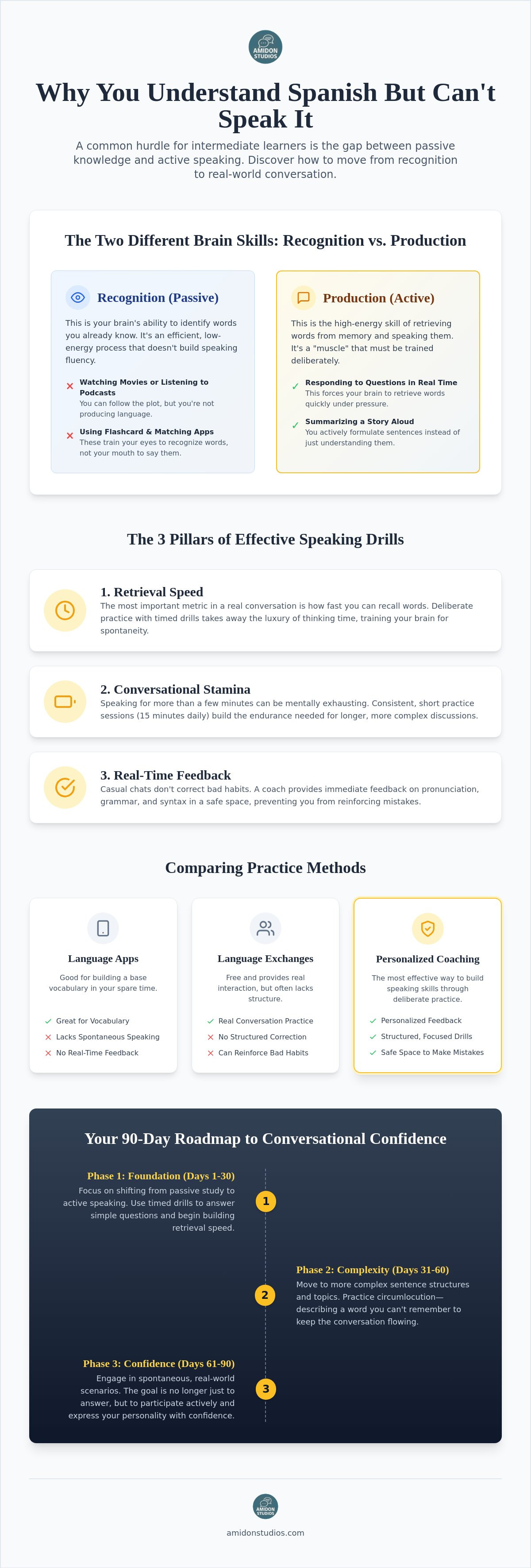
The gap between understanding and speaking is a normal stage in language acquisition. Your brain is designed for efficiency, and it’s far easier to recognize information than it is to produce it from scratch. This is the core reason why you can understand a word when you hear it but can’t seem to find it when you need it.
Passive learning methods—like watching movies, listening to music, and using popular language apps—primarily train your recognition skills. They strengthen your ability to see or hear a Spanish word and connect it to its English meaning.
However, real conversation requires the opposite process: starting with a thought and retrieving the correct Spanish words to express it. This is an active, production-based skill called active recall or retrieval.
The Understanding-Speaking Gap: This is the natural delay between when you can comprehend a language and when you can speak it comfortably. It’s not a plateau, but a specific skill gap that requires targeted training.
Recognition vs. Retrieval: Your brain prioritizes recognition (passive skill) because it’s less energy-intensive. Retrieval (active skill) must be deliberately practiced to become faster and more automatic.
Apps Train Your Eyes, Not Your Mouth: Most app-based exercises involve tapping, matching, or multiple-choice questions. These actions don’t build the phonetic muscle memory or the quick-fire retrieval needed for a live conversation.
Speaking Becomes Easier: In conversation, success isn't just about knowing the right word; it's about finding it quickly. Speaking becomes easier as your brain gets faster at finding the words you already know.
The Difference Between Recognition and Production
Imagine you love watching professional basketball. You recognize every play, understand the strategy, and can predict what a player will do next. Does that mean you can step onto the court and perform a perfect three-point shot? Of course not. Watching is a cognitive skill; playing is a physical one.
Language works the same way. Recognizing a word in a book is like watching the game. Producing it in a conversation—coordinating your breath, tongue, and vocal cords to form the right sounds in the right order—is playing the game. This production requires building physical muscle memory in your mouth and throat, something no amount of passive listening can accomplish on its own.
Why Your Current Routine Might Be Stalling Your Progress
Many well-intentioned learners fall into practice habits that inadvertently widen the understanding-speaking gap. If you feel stuck, your routine may be the culprit.
The Immersion Trap: Many learners believe that simply surrounding themselves with Spanish audio is enough. While listening is crucial for improving comprehension, listening to podcasts or watching TV without ever pausing to respond or summarize what you heard only reinforces your passive skills.
Limitations of Grammar Drills: Completing multiple-choice grammar exercises helps you understand sentence structure, but it doesn’t prepare you for the pressure of forming a sentence spontaneously in real time. Conversation is messy and rarely follows the perfect patterns found in a textbook.
Waiting Until You're Ready: The single biggest mistake is waiting to speak until you feel you have enough vocabulary or have mastered every verb conjugation. Speaking is what makes you ready. Waiting to speak is like waiting for your muscles to grow before you go to the gym.
The Three Pillars of Effective Spanish Speaking Drills
To move from understanding to speaking, you need to shift from a passive learning model to active, deliberate practice. Unlike casual chatting, deliberate practice involves structured exercises designed to improve a specific aspect of your speaking ability. This type of practice is built on three essential pillars: Retrieval, Stamina, and Feedback.
Effective speaking practice requires a safe space where you can make mistakes without the social pressure or embarrassment that often comes with talking to strangers. It's about quality, not just quantity. Consistent practice in short, focused bursts is far more effective than occasional, long, unstructured conversations.
Building Retrieval Speed through Spontaneity
Retrieval speed is the time it takes to move a thought from your mind to your tongue. The goal of these drills is to shorten that delay by forcing your brain to access vocabulary and grammar under light pressure, making the process more automatic over time.
Timed Response Drills: Set a timer for 15 seconds. Ask yourself a simple question in Spanish (e.g., “¿Qué comiste hoy?” or “¿Cuál es tu película favorita y por qué?”) and answer out loud before the timer runs out. The goal isn't a perfect answer, but a complete one.
Picture Description Drills: Open a random image on your phone or computer. Give yourself 60 seconds to describe everything you see out loud. This exercise forces you to access a wide range of vocabulary (nouns, adjectives, verbs) and to practice describing things, a common conversational task.
Phonetic Muscle Memory and Pronunciation
Speaking is a physical act. Your mouth, tongue, and jaw need to learn new movements to produce Spanish sounds accurately and clearly. These exercises build the "muscle memory" needed to make your pronunciation more natural.
Shadowing: Find a short audio clip of a native speaker (a podcast segment or a line from a show works well). Play the audio and repeat what they say in real-time, with a slight delay of one or two seconds. Focus on mimicking their rhythm, intonation, and pronunciation exactly. Don't worry about understanding every word at first; the goal is to train your mouth to move like a native speaker's.
Exaggerate Vowel Sounds: Spanish vowels are pure, short, and crisp compared to English vowels. During practice, consciously exaggerate them (A, E, I, O, U). This may feel silly, but it trains your mouth to avoid the common English habit of turning them into diphthongs, which significantly improves your clarity in real conversations.
Practice Connector Words: Fluent speech is full of small connector or filler words and phrases that link ideas. Practice saying words like entonces (so/then), o sea (I mean/in other words), pues (well), and así que (so) out loud until they feel natural. Using these makes you sound more fluid and buys you time to think.
Comparing Practice Methods: Apps, Exchanges, and Personalized Instruction
Once you have a framework for deliberate practice, the next step is to find the right environment to apply it. Adult learners have many options, but not all are equally effective for developing speaking skills.
The Limitations of Language Learning Apps
Apps like Duolingo are excellent tools for building foundational vocabulary and getting exposure to grammar. However, they are fundamentally limited when it comes to developing conversational ability. AI can't replicate the dynamic, unpredictable nature of human interaction.
Lack of Nuanced Feedback: While some apps have voice recognition, they can't tell you why your pronunciation is off. AI can't explain that you're not rolling your 'r' correctly or that your Spanish 'd' sounds too much like an English 'd'. This is the kind of personalized feedback that prevents bad habits from becoming permanent.
The Scripted Environment Problem: Apps train you to respond to specific, pre-programmed prompts. Real conversation is unscripted. You need practice handling questions you didn't expect and navigating topics that aren't in a pre-made lesson. For more on this, see our guide on why private 1-on-1 lessons outperform apps for conversation.
The Reality of Language Exchanges
Free language exchanges, where you practice Spanish with a native speaker who wants to practice English with you, can seem like an ideal solution. While they can be beneficial, they come with hidden costs that often stall progress for serious learners.
The 50/50 Split: In a typical one-hour exchange, you only get 30 minutes of Spanish practice. The other 30 minutes are spent acting as an unpaid English teacher, which takes time and energy away from your own learning goals.
Risk of Incorrect Feedback: A native speaker is not necessarily a trained teacher. Your partner may not be able to explain a grammar rule correctly or may even teach you slang or regionalisms that are inappropriate for your goals. You risk reinforcing mistakes without a professional to guide you.
Lack of Structure: Unstructured conversation often defaults to the same "safe" topics (hobbies, family, weekend plans). This prevents you from pushing past your comfort zone to discuss more complex ideas and expand your functional vocabulary.
For learners with limited time, the most efficient path is working with a professional instructor. An experienced teacher provides structured practice, immediate and accurate feedback, and a personalized plan designed to target your specific weaknesses.
How to Simulate Real-World Scenarios in Your Practice
The ultimate goal of real-life Spanish conversation practice is to prepare you for high-stakes situations: a doctor's appointment, a job interview, or a dinner with your partner's family. Simulating these scenarios in a low-stakes practice environment is one of the best ways to build confidence and competence.
Keep the Conversation Moving with Follow-Up Questions
One of the easiest ways to become a more confident Spanish speaker is to stop thinking of conversation as answering questions. Great conversations happen when you ask questions too.
Instead of giving a short answer and waiting for the next question, practice keeping the conversation going.
For example:
Person:¿Qué hiciste este fin de semana? (What did you do this weekend?)
You: Déjame pensar... Fui al mercado. ¿Y tú? (Let me think...I went to the market. And you?)
Or:
Person:Me gusta viajar a México. (I like to travel to Mexico.)
You:¡Qué bien! ¿Qué ciudad te gustó más? (How nice! What city do you like the most?)
Asking follow-up questions takes the pressure off you to keep talking constantly while making conversations feel more natural. It also gives you extra time to think about what you want to say next.
Practicing circumlocution, meaning describing words you don't know yet, prevents the panic that sets in when your mind goes blank. It turns a vocabulary gap into an opportunity to be creative and keep the conversation moving. It's a key part of transitioning from a passive to an active Spanish speaker.
Practice Recovering from Mistakes
One of the biggest differences between intermediate learners and confident speakers isn't that they make fewer mistakes—it's that they recover from them quickly.
If you say something incorrectly, simply correct yourself and continue speaking.
For example: Mi hermana tiene veinte... perdón, treinta años. (My sister is 20...I mean, 30 years old.)
Or: Fuimos a la playa... mejor dicho, al lago. (We went to the beach...I mean, the lake.)
Native speakers correct themselves all the time. Learning to keep going instead of stopping helps conversations feel much more natural.
Handling Unpredictability
Real-life conversation is 50% speaking and 50% managing the gaps in your knowledge. You can't predict what someone will say or ask, but you can practice the skills needed to handle that unpredictability.
Practice Follow-Up Questions: Instead of just practicing your answers, practice your questions. After you answer a practice question, challenge yourself to ask two or three relevant follow-up questions. This shifts you from a passive respondent to an active participant in the dialogue.
Use Filler Words Strategically: Native speakers use filler words like este, pues, and bueno to buy a moment to think. Practice inserting these naturally into your speech when you need to pause and retrieve a word. It sounds much more fluent than a silent, awkward pause or an English "um."
Your Path to Conversational Confidence
Improving your speaking skills requires a structured, consistent approach focused on active production. At Amidon Studios, we use the Amidon Method, a system designed specifically for adult learners who understand Spanish but need to build their conversational output skills.
Our approach is built on personalized 1-on-1 instruction that provides the safe space, deliberate practice, and expert feedback necessary to make real progress. The process is broken down into manageable phases:
Phase 1: Foundation. In the beginning, the focus is on building the habit of daily vocalization with high-frequency vocabulary and verbs. The primary goal is to become comfortable speaking and making mistakes in a controlled, supportive setting.
Phase 2 & 3: Expansion and Integration. As you progress, you move from short, simple sentences to expressing complex thoughts, telling stories, and debating ideas. Your instructor identifies and helps you correct "fossilized errors"—long-standing mistakes that have become habit—before they become permanent.
Practice These Skills in Spanish Star
Spanish Star is our conversation-focused program for adults who understand some Spanish but want to speak it more comfortably. Each lesson provides guided conversation practice, personalized feedback, and practical activities that help you use Spanish in real-life situations. Instead of memorizing more information, you'll spend your time building the speaking skills that lead to smoother, more natural conversations.
Signs Your Speaking Skills Are Improving
Progress isn't always linear, but there are clear signs that your deliberate practice is paying off:
You start using Spanish filler words (pues, este...) instead of English ones (um, uh...).
When you forget a word, you automatically try to describe it (circumlocution) instead of stopping.
The pauses between thinking and speaking become shorter and less frequent.
You begin to catch and correct your own grammar or pronunciation mistakes mid-sentence.
Native speakers ask you to repeat yourself less often.
You feel less mentally exhausted after a conversation.
If you're ready to stop just studying Spanish and start speaking it, the first step is to get a clear picture of your current speaking level and identify the specific areas that need work.
We invite you to book a free Spanish speaking assessment with one of our experienced instructors. We’ll provide you with a personalized plan and show you how targeted, one-on-one practice can help you finally speak with the confidence you’ve been working toward.
Frequently Asked Questions (FAQs)
Is it possible to practice Spanish conversation if I live alone? Absolutely. You can practice many speaking drills by yourself. Techniques like shadowing, timed-response drills, and describing pictures out loud are all highly effective ways to build retrieval speed and phonetic muscle memory without a partner.
How many hours a week should I practice speaking to see real results? Consistency is more important than duration. Practicing for 15-20 minutes every day is far more effective than one long, two-hour session on the weekend. The goal is to make speaking a daily habit to keep the active parts of your brain engaged.
Why do I forget all my Spanish vocabulary as soon as I try to talk to a native speaker? This happens because of the difference between recognition and retrieval. You have the vocabulary stored in your brain (recognition), but you haven't practiced retrieving it under pressure. The stress of a live conversation makes it even harder to access. Targeted retrieval practice helps make this process faster and more automatic.
Can I learn to speak Spanish fluently using only apps like Duolingo?
Language pps are a great supplement for vocabulary and grammar but are insufficient on their own for developing conversational fluency. They lack the two most critical components for speaking practice: personalized feedback from a human expert and the experience of navigating a spontaneous, unscripted conversation.
How do I overcome the fear of making grammar mistakes when speaking Spanish? The best way is to practice in a low-stakes, supportive environment, like in one-on-one lessons with a professional instructor. This allows you to make mistakes, receive gentle correction, and build confidence before you try out your skills in the real world. Remember that communication is the goal, not perfection.
Should I focus on a specific accent, like Mexican or Spanish from Spain, during practice? For intermediate learners, the primary focus should be on clear, neutral pronunciation. Unless you have a specific reason to learn a certain accent (e.g., you are moving to that country), it's best to work on general clarity first. Exposure to various accents through listening is always beneficial, but your speaking goal should be clear communication above all.
What are some good filler words to use in Spanish conversation? Using filler words can make your speech sound more natural and give you time to think. Some of the most common ones are: pues (well), bueno (well/okay), este (um), o sea (I mean/in other words), and a ver (let's see).


Comments