
Spanish for First Responders: Essential Language Skills
- Jackie Amidon Donaldson

- Aug 1
- 12 min read

You arrive on the scene and ask a patient where they feel pain in Spanish. You've memorized the phrase perfectly. However, when they respond with a rapid-fire explanation of their symptoms, the communication stops.
If you find yourself reaching for a translation app while seconds are ticking away, you aren't alone. Learning Spanish for first responders often focuses on memorizing a list of commands, yet real emergencies require two-way conversations that help you gather critical information, build trust, and respond more effectively in fast-moving situations.
Most responders find that memorization only goes so far when a patient provides unexpected details about their medical history or the incident. You want to provide the best care possible without waiting for a translator or an app to load.
In this article, we'll show you how to move past memorized scripts so you can understand patient responses and give clear instructions in real time. We'll explore practical techniques for active listening, ways to calm a chaotic scene, and how personalized instruction can help you stay composed during critical moments.
Table of Contents
Beyond the Phrasebook: Why First Responders Need Conversational Spanish
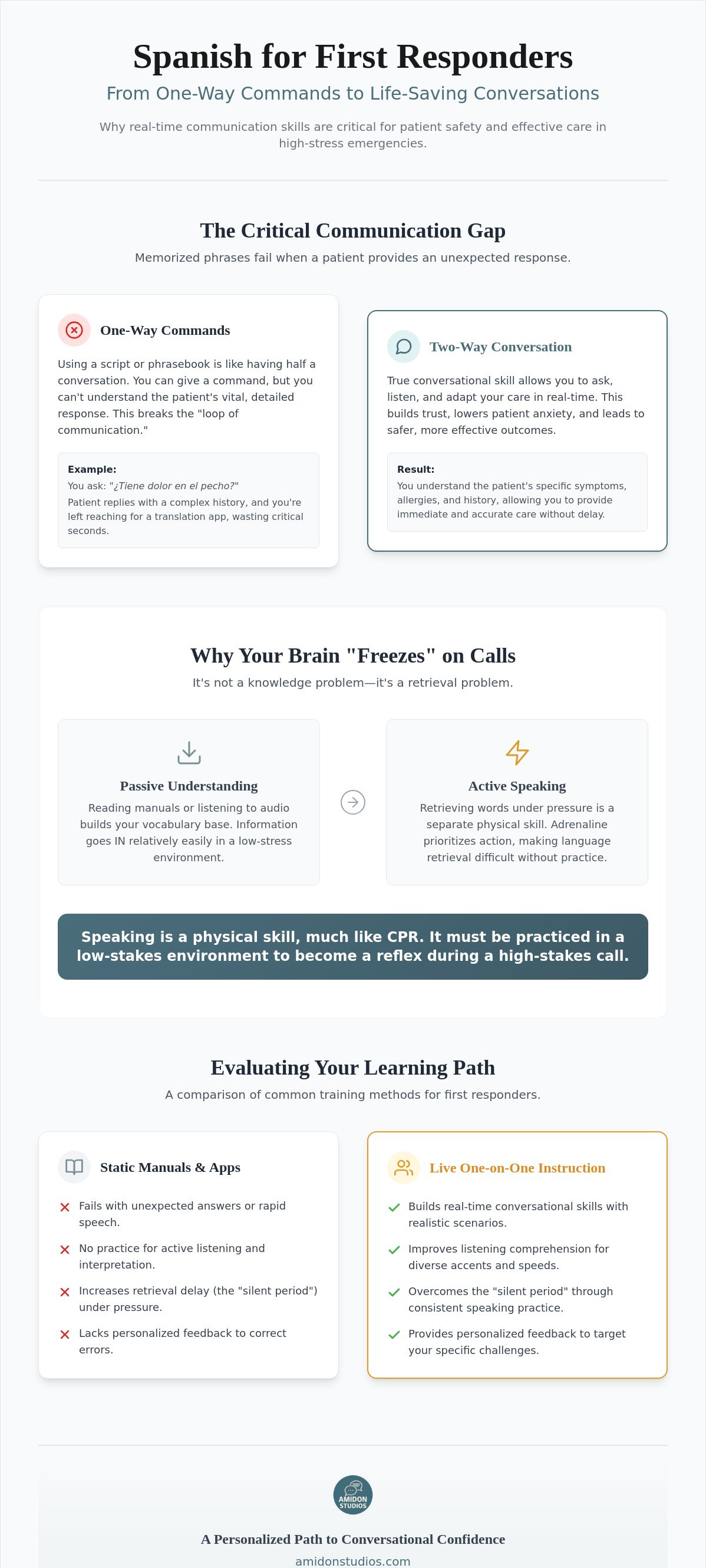
Many responders start their journey with a stack of flashcards or a phonetic manual. While these tools provide a starting point, they often fail the moment a patient speaks back. In an emergency, conversational Spanish isn't about perfect grammar or a massive vocabulary. It's the functional ability to exchange vital information in real time.
We define this as the "loop of communication." You ask a question, you interpret the specific details of the answer, and you adjust your care accordingly. Without this loop, you are essentially working with a one-way script that breaks during the first unpredictable moment of a call.
There is a common struggle known as the silent period. This is where you understand what a patient is saying, but you find yourself unable to produce a response under pressure. This isn't a lack of intelligence or even a lack of knowledge. It's a retrieval issue.
When you're on a scene, your brain is already managing high-stress variables. If you haven't practiced the physical skill of speaking through the Amidon Method, those memorized phrases often disappear. Real-world Spanish for first responders requires moving past the academic "classroom" feel and focusing on the verbal tools you need for patient extraction and assessment.
The Limitation of One-Way Commands
Commands like "no se mueva" (don't move) or "siéntese" (sit down) are useful for initial scene control. However, they don't help you identify a chief complaint. Imagine asking a patient if they have chest pain. If they respond by describing a specific radiating sensation or a history of recent surgery, a one-way command list leaves you stuck.
Translation apps can be helpful in certain situations, but they can't always keep pace with a rapidly evolving emergency. In time-sensitive situations like a stroke or a trauma call, you need to understand the clarification a patient is offering in real time so you can respond appropriately as the situation unfolds.
Building Trust on the Scene
Communication is a clinical tool just like a stethoscope or a monitor. When a patient is in distress, hearing their native language can actually help lower their heart rate and reduce scene anxiety. This connection is vital for gaining consent for medical procedures. It's also essential when you need to gather a medical history from family members who may be the only ones able to provide a list of allergies or medications.
By looking at how Emergency Medical Services in Spain and other regions prioritize clear verbal protocols, we see that language is a standard of care. Moving from a phrasebook to real conversation ensures you stay in control of the scene and provide the safest possible outcome for your patient.
Speaking as a Distinct Skill: Why Your Brain Freezes on Calls
Many responders experience a frustrating phenomenon: they can understand what a patient says, but they can't find the words to reply. This brain freeze usually happens during the most critical moments of a call. It's not a sign that you haven't studied enough.
Instead, it's a natural result of how the brain handles language under stress. When adrenaline spikes, your mind prioritizes immediate action over complex language retrieval. If your training relied on memorizing long lists of vocabulary, those words are often the first things to disappear when the pressure is on.
Effective Spanish for first responders requires treating speaking as a physical skill, much like performing CPR or using a specialized extraction tool. You wouldn't expect to master a physical procedure just by reading about it; you need hands-on practice. Language works the same way.
Retrieval must be practiced in a low-stakes environment so that the words become a reflex rather than a memory exercise. Developing functional Spanish for first responders isn't about passing a written test; it's about being able to speak when it matters most.
Passive Understanding vs. Active Speaking
There's a massive difference between passive listening and active production. You might listen to Spanish audiobooks or podcasts during your shift, which is great for building vocabulary. However, listening is a different mental process than answering a patient's question about their allergies.
This gap is what we call the silent period. Moving through it requires a shift in how you study. Using the Amidon Method, we focus on shortening the time it takes for your brain to grab the right word and get it out of your mouth. Personalized instruction targets this specific gap, helping you transition from a passive observer to an active communicator.
The Importance of Personalized Feedback
In emergency medicine, the stakes for mispronunciation are high. A small error in how you say a medication name or a symptom can lead to confusion. While programs like the University of Texas Permian Basin's Certificate in Spanish for First Responders provide a strong academic foundation, you still need a live instructor to catch these nuances in real time.
A teacher provides the personalized feedback necessary to correct your pronunciation before it becomes a habit. They also act as a partner to simulate high-pressure interactions, allowing you to practice staying calm and clear. Getting a professional speaking assessment is a great way to see exactly where your retrieval is sticking.
Evaluating Your Learning Path: Manuals vs. Live Instruction
Choosing how to learn Spanish for first responders often comes down to a choice between convenience and competence. Many agencies provide phonetic manuals or phrasebooks as a quick fix. These toolkits are helpful for one-way commands, such as telling someone to remain still or show their hands.
However, they lack the flexibility needed for a true medical or legal assessment. A book cannot listen to a patient's description of their symptoms and offer a follow-up question. While manuals are a good reference, they don't build the retrieval skills you need when the clock is ticking.
Apps and digital courses are popular because they fit into a busy shift schedule. They're great for learning nouns like 'medication' or 'allergy,' but they often fail at building conversational confidence. You might spend months clicking through grammar drills without ever actually saying a word out loud to another human.
This creates a gap where you know the words but can't use them in a sentence. Rote memorization is a slow path to communication because it treats language like a history fact rather than a living skill. In contrast, the Amidon Method focuses on moving you from passive understanding to active speaking in a fraction of the time by prioritizing interaction over abstract rules.
When to Use a Digital Toolkit
Digital toolkits and reference guides have a specific place in your learning. They're excellent for reviewing niche emergency vocabulary while you're posted or between calls. You can use these self-paced materials to reinforce the concepts you've covered in your live Spanish lessons.
Think of a toolkit as your equipment bag; it's great to have the tools ready, but you still need the training to know how to use them effectively during a high-stakes encounter. Having a reference guide in the rig is perfect for those uncommon terms you don't use every day.
The Case for Personalized Learning Plans
One-size-fits-all courses often include content that isn't relevant to your specific role. A police officer conducting a traffic stop needs a completely different set of phrases than a paramedic managing a multi-vehicle trauma.
This is where a personalized learning plan becomes essential. An instructor can tailor your lessons to the exact types of calls you handle most frequently. Beyond the curriculum, a teacher provides the accountability that apps lack.
Having a scheduled session with a live person ensures you stay consistent with your speaking practice. This one-on-one Spanish lessons environment allows you to ask questions and receive personalized feedback on your pronunciation, ensuring you're understood clearly on every scene.
Essential Spanish Categories for Effective Emergency Response
To communicate effectively on a scene, you need more than a list of nouns. We organize Spanish for first responders into four essential pillars: Assessment, Safety, Consent, and Comfort. This structure allows you to move through a call logically while maintaining control. While previous sections discussed why the brain freezes, having a categorized framework helps you retrieve the right words when you need them. It moves you away from trying to remember everything at once and lets you focus on the specific needs of the moment.
One of the most effective tools for rapid assessment is the Yes/No strategy. If a patient is experiencing shortness of breath or severe trauma, they can't provide long explanations. Asking, "¿Tiene dolor de pecho?" (Do you have chest pain?) allows for a clear "Sí" or "No."
This keeps the dialogue moving and provides you with actionable clinical data without overwhelming the patient. It's a simple way to maintain a two-way dialogue even when the patient is in significant distress.
Patient Assessment and Medical History
Gathering a medical history requires a mix of direct questions and the ability to interpret short, common responses. You need to know if the patient has underlying conditions or allergies that could complicate treatment.
Use these foundational questions to start the dialogue:
¿Dónde le duele? (Where does it hurt?)
¿Tiene alergias a medicamentos? (Do you have allergies to medications?)
¿Qué medicinas toma? (What medicines do you take?)
¿Qué pasó? (What happened?)
When asking about the mechanism of injury, listen for key verbs like "me caí" (I fell) or "me chocaron" (they hit me or my car). Understanding these common replies is just as important as asking the question itself.
In our live Spanish lessons, we practice these specific exchanges so you can recognize the answers as quickly as you ask the questions. This speaking practice ensures that you aren't just reciting a script, but actually listening to the patient's needs.
Scene Safety and Public Order
Your safety and the safety of the public often depend on clear, authoritative commands. Managing a perimeter or directing traffic requires phrases that are short and impossible to misinterpret.
If you're working fire suppression or an extraction, you must be able to clear an area immediately. Use phrases like "¡Atrás!" (Back up!) or "¡Salga del edificio!" (Get out of the building!) to maintain order. These aren't just words; they are tools for scene control.
Calming family members or distraught bystanders is another critical skill for Spanish for first responders. A scene can quickly become chaotic if people don't understand your instructions.
Simple phrases like "Estamos aquí para ayudarle" (We are here to help you) or "Respire profundo" (Breathe deeply) can lower the emotional temperature. This allows you to focus on the patient while ensuring that bystanders don't interfere with your work.
An instructor can help you practice the right tone for these situations, ensuring your voice carries both authority and empathy.
Building Conversational Confidence with the Amidon Method
We've explored why memorized phrases fail under the pressure of a call and why passive tools like apps can't replace the physical skill of speaking. If you want to move from silent understanding to verbal confidence, you need a different approach.
The Spanish Star Program was created specifically for busy adults who need to use their skills in the real world. Instead of spending hours on abstract grammar rules that you'll never use in the back of an ambulance, we focus on the interactions that actually happen on your shift. Our goal is to help you reach a level where you can think and speak simultaneously, even when the scene is chaotic.
This program follows a specific 90-day transition. We start by identifying exactly where your language retrieval is sticking and then build your speaking practice around those specific gaps. By focusing on real-world application, you can move from hesitation to clear, confident communication.
The process begins with a low-pressure speaking assessment. This isn't a graded exam; it's a helpful conversation with an instructor to see what you already know and what you need to master to stay safe on the job. This baseline allows us to build a path that is efficient and relevant to your daily duties.
Your Personalized Path to Confidence
First responders often work rotating shifts that make traditional classroom attendance impossible. A personalized learning plan solves this by offering flexibility that fits your schedule. When you engage in one-on-one Spanish lessons, you get the teacher's full attention to practice the professional conversations most relevant to your role.
Whether you're responding to medical emergencies, managing a fire scene, or interacting with the public, your lessons are tailored to the situations you encounter most often. You receive personalized feedback on every conversation, helping you improve your pronunciation, listening comprehension, and speaking confidence so you can communicate more clearly when every second counts.
Next Steps for First Responders
The best way to start is by identifying your current baseline. We invite you to schedule a free speaking assessment to see how your current skills hold up in a live conversation.
From there, you can explore private 1:1 Spanish lessons that are tailored to your specific field, whether you're in fire, EMS, or law enforcement. This ensures your conversation practice is always practical and useful.
Consistent speaking practice with a live instructor is the most effective way to build lasting confidence in Spanish for first responders. You don't have to wait until you've memorized a dictionary to start helping your community.
Schedule a trial lesson today to experience the Amidon Method firsthand and see how personalized instruction can change the way you handle your next Spanish-speaking call.
Take Control of Every Call
Effective communication is a clinical tool just as vital as any medical equipment in your rig. By prioritizing active speaking practice over rote memorization, you ensure that you can provide accurate care and maintain scene safety when it matters most.
Focus on the core pillars of assessment and safety to build a personalized path to conversational confidence. Mastering Spanish for first responders isn't about perfect grammar; it's about being prepared to handle real-world emergency scenarios with clarity and composure.
Our instructors provide personalized instruction tailored to the specific calls you handle every day. Through live interaction and targeted feedback, you can transition from silent understanding to active speaking in 90 days. We focus on the high-frequency language that moves the needle on your shift, giving you the tools to help your patients immediately.
We're here to support you as you move from understanding to speaking. You have the ability to make a meaningful difference on every scene, and we look forward to helping you get there.
Frequently Asked Questions
Do I need to know a lot of Spanish before starting a program for first responders?
You can start your training as a complete beginner. Many students begin with zero prior knowledge and focus on mastering the most critical assessment phrases first. Starting from the ground up allows you to build correct pronunciation habits through personalized instruction. This ensures that when you eventually speak on a call, you are understood the first time without any confusion.
How long does it take to become functional in Spanish for emergency calls?
Most responders reach functional conversational confidence in about 90 days with consistent practice. This timeframe focuses on moving from passive understanding to active speaking. By training with a teacher in simulated real-world scenarios, you develop the retrieval skills needed to handle common calls. This targeted approach helps you avoid the brain freeze that often happens during high-pressure interactions.
Can I learn Spanish for first responders using only an app like Duolingo?
Apps are useful for reviewing basic vocabulary between shifts, but they cannot replace live Spanish lessons. You can't practice the physical skill of retrieval with a screen. To effectively use Spanish for first responders, you need conversation practice with a live instructor who provides personalized feedback. This real-time correction is essential for mastering high-stakes medical and legal terminology.
Will I learn specific medical or legal terminology in these lessons?
Your personalized learning plan is tailored to the specific terminology you use daily in your role. Paramedics and EMTS might focus on symptom descriptions and allergies, while police officers prioritize scene control and legal commands. This ensures every lesson is relevant to your actual work. You won't waste time on academic grammar that doesn't help you during a patient assessment or extraction.
What is the difference between a phrasebook and a personalized learning plan?
A phrasebook is a static list of commands, while a personalized learning plan focuses on the physical skill of speaking. Phrasebooks often fail when a patient gives an unexpected answer you haven't memorized. A personalized plan uses one-on-one Spanish lessons to help you understand those responses. This allows you to engage in a two-way dialogue, which is vital for accurate care.
Is it better to take a group class or one-on-one Spanish lessons for this field?
One-on-one Spanish lessons are significantly more effective for high-stakes fields like emergency response. In a group setting, you might only get a few minutes of speaking time. Private sessions provide 100% of the teacher's attention, allowing for intensive speaking practice. This individual focus ensures that the instruction is paced correctly for your specific level and professional needs.
How do I handle a situation where the patient speaks a different dialect of Spanish?
Stick to clear, standard Spanish and utilize the "Yes/No" strategy to avoid confusion. While regional slang varies, core medical and safety terms remain largely consistent across different cultures. Your instructor can help you recognize common regionalisms in your specific service area. Building a strong conversational foundation allows you to bridge these gaps and maintain control of the scene regardless of the patient's background.


Comments