
How Reconnecting with Your Heritage Language Can Strengthen Family Connections


What if the difficulty you face when speaking Spanish isn't a lack of knowledge, but a lack of retrieval practice? Many heritage learners understand rapid-fire conversation at the dinner table but find that the specific words needed for a response don't arrive quickly enough.
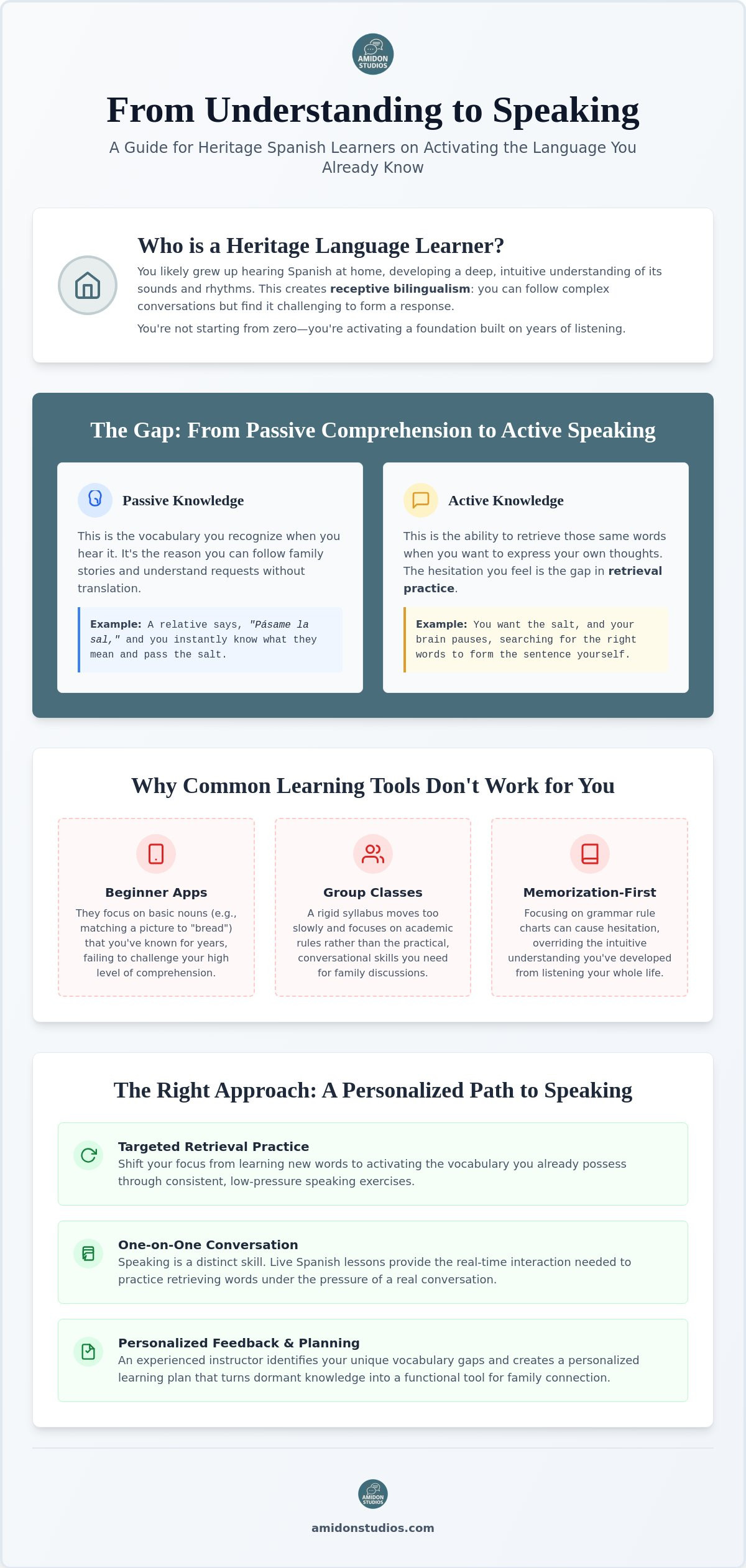
When you decide to reconnect with your heritage language, you aren't starting from zero. You already have an ear for the sounds and a deep understanding of the rhythm. The challenge lies in activating the vocabulary you already recognize when others speak.
We agree that the distance between comprehension and conversation is a result of how you practiced the language growing up. This article explores how to move from passive understanding to active speaking by focusing on retrieval skills.
By the end, you'll have a clear understanding of how to pass the language on to your children through consistent, meaningful interaction.
Table of Contents
What It Means to Be a Heritage Language Learner
A heritage learner typically grows up in a household where a language other than the dominant one is spoken. To understand the broader context of this background, it's helpful to look at what a heritage language is and how it develops within families.
This environment often results in receptive bilingualism, where you can follow a complex story in Spanish but find it difficult to construct a response. This occurs because English usually becomes the primary language for social and academic use during childhood, while Spanish remains reserved for specific home interactions. When you decide to reconnect with your heritage language, you're working with a foundation built on years of listening.
Why You Aren't Starting From Zero
You have a significant advantage over a second language learner because you already understand the phonemes and the natural cadence of the language. While a new student might struggle to distinguish between the 'b' and 'v' sounds or master the trilled 'r,' those sounds are already familiar to your ear.
The goal is activation, which means training your brain to retrieve the information it already holds. Through personalized instruction and targeted speaking practice, you can turn that dormant knowledge into a functional tool for family connection. You're simply learning to use the vocabulary that is already present in your mind.
If you'd like to understand why heritage speakers often understand more Spanish than they can speak, read our guide to Heritage Spanish conversation.
Reconnecting With More Than Just a Language
Learning Spanish isn't only about vocabulary or grammar. For many heritage speakers, it's about reclaiming conversations that have always felt just out of reach.
It might mean understanding your grandparents' stories without someone translating, participating more naturally during family gatherings, or preserving traditions you want to pass on to your own children.
Reconnecting with your heritage language often means reconnecting with your family's history, culture, and identity.
Overcoming the Emotional Barriers of Language Reconnection
Perfectionism is often the most significant hurdle when you decide to reconnect with your heritage language. You might feel a heavy internal pressure to speak flawlessly because of your cultural ties. This expectation can make a simple conversation with a relative feel like a high-stakes test.
When you stumble over a word, it feels like a personal failure rather than a normal part of learning. To move forward, you must reframe these mistakes. Every time you struggle to find a word, you are actually identifying a specific data point for your personalized learning plan. It is not a sign of a lack of connection; it is simply a guide for what to practice next.
Managing expectations with fluent family members is equally important. Many relatives correct your speech because they want to help, but constant interruptions can hinder your confidence. You can handle these moments by clearly stating that you are in the process of practicing.
If a relative corrects your grammar, you might respond by thanking them and asking them to repeat the correct version so you can hear the rhythm. Finding a non-judgmental instructor who understands heritage culture is vital.
A teacher who recognizes the difference between a new learner and a heritage speaker will provide personalized feedback that respects your background while pushing you to improve your retrieval skills.
Dealing With Language Shame
It is common for heritage learners to feel a sense of loss regarding their family's native tongue. This often happens because society prioritizes a single dominant language for school and professional life. You didn't choose to lose the language; your environment simply didn't require you to use it for a long time.
It's never too late to reclaim your ability to speak and participate in your culture. When a relative points out a mistake, remember that your value as a family member isn't tied to your verb conjugations. Shifting your focus from being perfect to being present in the conversation allows you to build stronger connections without the weight of shame.
Why the "No Sabo Kid" Label Can Feel So Personal
If you've been called a "no sabo kid," you already know the label can bring up complicated emotions. Although the phrase is often used humorously online, many heritage speakers experience it as criticism or a reminder that they don't speak Spanish the way other family members expect them to.
It can leave people feeling caught between two cultures—too American to feel fluent in Spanish, yet too connected to their heritage to simply let the language go.
The reality is that being a "no sabo kid" says very little about your intelligence, your identity, or your connection to your culture. It usually reflects the environment in which you grew up. If Spanish wasn't the language you needed at school, with friends, or at work, it's natural that speaking became less automatic over time.
Reconnecting with your heritage language isn't about proving yourself to anyone else. It's about creating new opportunities to communicate with the people and traditions that matter most to you.
Building Confidence Through Meaningful Interaction
Many people wait until they feel confident before they start speaking, but confidence is actually the result of consistent practice. You gain self-assurance by successfully navigating small interactions over time.
This is why practicing with an instructor in a low-pressure environment is so effective. It allows you to build a foundation of successful speaking practice before you enter high-pressure family events like holiday dinners or weddings.
Learn more about the Amidon Method to see how we use live Spanish lessons to help you move from passive understanding to active conversation.
Passing Spanish to the Next Generation
Many adults begin improving their Spanish because they don't want the language to end with them. Whether you have young children or hope to someday, becoming more confident speaking Spanish creates opportunities to build a bilingual home through everyday conversations, books, traditions, and family stories. Even small, consistent interactions can help strengthen your family's connection to its cultural heritage.
Finding the Right Path: The Spanish Star Program for Heritage Learners
Amidon Spanish offers the Spanish Star Program specifically for adults who have spent their lives understanding Spanish but finding it difficult to speak. We don't start with a textbook or a generic placement test. Instead, we begin with a free speaking assessment.
This conversation allows us to see exactly which words are in your passive memory and which ones you struggle to retrieve in the moment. It provides a clear starting point that respects your history with the language while identifying the specific skills you need to build. To reconnect with your heritage language effectively, you need a plan that focuses on your actual performance rather than just your knowledge.
Personalized feedback is the tool that moves you from being a silent observer to an active participant. In our program, we focus on the retrieval process, helping you pull words from your memory faster and with more accuracy. This targeted approach is designed to help you reach a new level of conversational confidence in 90 days.
By practicing in a low-stakes environment with an instructor, you prepare yourself for the high-stakes moments of real family life. You'll find that the distance between what you want to say and what you can actually say begins to shrink with every session.
What to Expect in Live Spanish Lessons
Our live Spanish lessons prioritize real-life conversation over theoretical scenarios. You won't spend your time practicing phrases that don't matter to you. Instead, you might practice describing a family tradition or sharing a recent life update.
One-on-one Spanish lessons are essential here because they allow the teacher to focus entirely on your specific speech patterns. Your instructor helps you connect your existing understanding to your spoken words, providing the immediate corrections you need to improve your flow. This focused time ensures that you aren't just learning Spanish; you are learning how to use your Spanish.
Your Personalized Path to Confidence
A one-size-fits-all curriculum often feels like a waste of time for heritage learners. You don't need to relearn the sounds of the alphabet or basic greetings you've used since you were a child. We integrate your cultural background into your personalized learning plan, making the instruction relevant to your specific family and community.
You can explore our Spanish programs for adults and families to see how we adapt our methods to fit your goals. The Amidon Method is about more than just vocabulary; it's about giving you the tools to participate fully in your own culture.
When you're ready to take the next step, we invite you to schedule a trial Spanish lesson to experience this personalized approach for yourself.
Take the Next Step Toward Cultural Connection
You've spent years as a listener, absorbing the sounds and rhythms of your family's native tongue. It is time to become an active participant in those conversations. To reconnect with your heritage language is to honor your family's history and secure its future for the next generation. You don't need to start from zero; you simply need the right tools to activate the knowledge you already possess.
At Amidon Spanish, we don't treat you like a beginner. Our instructors focus on the specific retrieval skills needed for conversational confidence within 90 days. Every personalized learning plan begins with a free initial assessment to map your existing knowledge and identify your specific goals. Through specialized instruction and consistent speaking practice, you can move past the hesitation and start engaging deeply with the people who matter most.
The foundation is already there. We are here to help you build upon it with live Spanish lessons that respect your background and your time. We look forward to supporting you as you reclaim your voice and strengthen your family connections.
Frequently Asked Questions
Why can I understand Spanish but I can't speak it?
Many heritage speakers grow up hearing Spanish at home but have fewer opportunities to use it themselves. As a result, understanding often develops before speaking. With regular conversation practice, you can become more comfortable participating in family conversations instead of only listening.
Is it too late to learn my heritage language as an adult?
No. Many adults reconnect with Spanish later in life because they want stronger relationships with family members, a deeper connection to their culture, or the ability to pass the language on to their own children. Your previous exposure to Spanish provides a valuable foundation to build on.
Will learning Spanish help me connect more with my family?
For many heritage speakers, yes. Becoming more confident speaking Spanish makes it easier to participate in family gatherings, understand stories, ask questions, and share your own experiences. Language often becomes a bridge to stronger relationships and a deeper appreciation of your family's history and traditions.
What does "no sabo kid" mean?
"No sabo kid" is an informal nickname sometimes used for heritage speakers who understand Spanish but make mistakes when speaking it. Although the phrase is often used humorously, it can feel discouraging. In reality, it usually reflects limited opportunities to practice speaking rather than a lack of intelligence or cultural identity.
Do I need beginner Spanish classes if I already understand the language?
Not necessarily. Many heritage speakers already understand everyday Spanish and benefit more from conversation-focused lessons that help them build confidence speaking rather than starting over with basic vocabulary and grammar.
Can I pass Spanish on to my children even if I'm still learning?
Absolutely. You don't have to be perfectly fluent to create a bilingual environment at home. Reading books together, using simple Spanish during daily routines, and continuing to improve your own speaking skills can all help your children develop a connection to the language. If your goal is to build a bilingual home as a family, our Spanish for Family program provides live, personalized lessons that help parents and children grow their confidence speaking Spanish together.
How do I overcome the fear of making mistakes with my family?
Remember that reconnecting with your heritage language is about communication, not perfection. Practicing with a supportive instructor before speaking with family can help build confidence, making it easier to focus on enjoying the conversation instead of worrying about every mistake.
What is the best way to reconnect with my heritage language?
The most effective approach combines regular conversation practice with personalized feedback. Working one-on-one with a native-speaking teacher allows you to practice the conversations that matter most to your family, your experiences, and your goals while building confidence one interaction at a time.


Comments