
Online Spanish Classes for Families: How to Build a Bilingual Home Together

Updated: Jul 2
What if learning a new language didn't feel like another chore on your child's to-do list, but the highlight of your family's week?

Many parents start with high hopes and a few colorful apps, only to find their kids bored and the house still silent. It's hard to lead the way when you feel behind or just can't find the time for real-world practice.
This is where online Spanish classes for families change the dynamic. By moving beyond the screen and into live interaction, you can replace frustration with a sense of genuine possibility.
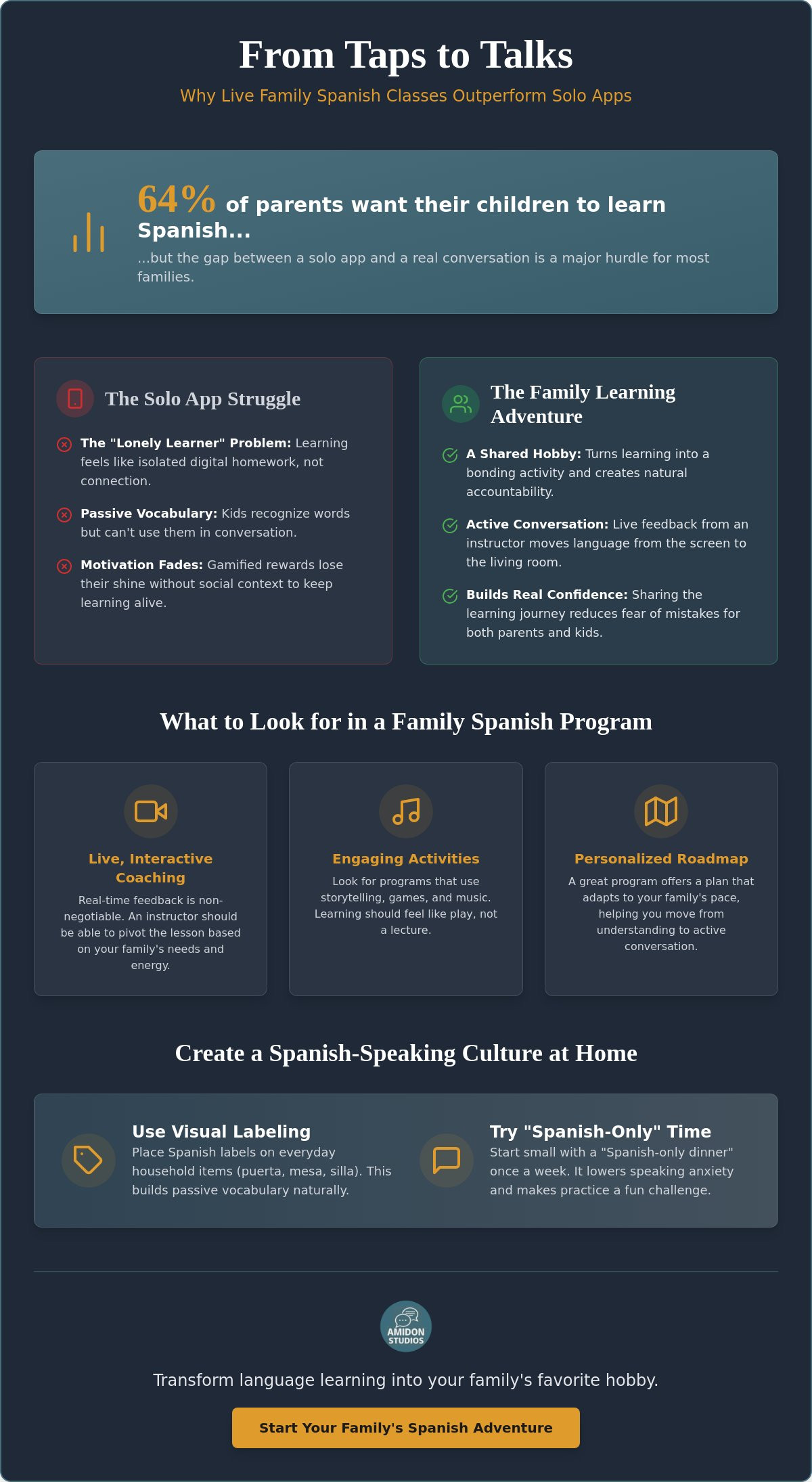
Recent data shows that 64% of parents want their children to learn Spanish, yet the gap between tapping a screen and actually holding a conversation remains a major hurdle.
We believe language isn't just a subject to study; it's a connection to be shared. In this article, you'll discover how to transform learning into a bonding hobby that gets everyone talking.
We'll provide a clear roadmap to help your kids speak Spanish naturally at home while solving the scheduling conflicts and the lack of confidence that usually hold families back.
Table of Contents
Why Online Spanish Classes for Families Outperform Solo Apps
It starts with a download and a streak, but it usually ends in a drawer. If you have tried to teach your children Spanish using only mobile apps, you know the cycle. The "lonely learner" problem is real. Apps are designed for solo consumption, turning a vibrant, living language into a series of repetitive clicks.
For a child, if a language only exists within a tablet, it doesn't feel like a tool for connection. It feels like digital homework. When the gamified rewards lose their shine, the motivation disappears because there is no social context to keep it alive.
Choosing online Spanish classes for families flips this script. Instead of sending your child off to learn in a corner, you are building a shared hobby. This creates a natural system of accountability. When the whole family is involved, you aren't just a supervisor; you're a teammate. You stay motivated longer because you are moving toward a goal together.
There is a specific kind of magic that happens when you hear a human response to your words. Real-time feedback from a live instructor provides the nuance and encouragement that a "correct" chime from an app simply can't match.
The Power of Shared Language Experiences
Think of your home as a "language island." When you learn as a unit, Spanish becomes the default setting for specific parts of your day. You don't need to be an expert to make this work. In fact, when parents model curiosity and struggle through a new sentence, it profoundly reduces a child's fear of making mistakes.
It shows them that learning is a journey, not a test. This shared vulnerability builds an emotional bond that goes far beyond grammar. You are creating memories of laughter and breakthrough that stick much longer than a vocabulary list.
Moving Beyond Passive Vocabulary
There is a massive difference between recognizing a word and being able to use it in a conversation. Apps often trap learners in a state of passive understanding. You might know the word for "bread," but can you ask for it at the dinner table?
Understanding how children acquire a second language shows us that verbal interaction is the primary driver of fluency. Live coaching helps both kids and adults break through the "silent period" by providing a safe space to practice.
Online Spanish classes for families help you transition from translating in your head to thinking naturally in Spanish, moving the language from the screen and directly into your living room.
What to Look for in a Family Spanish Program
Choosing the right path for your household shouldn't feel like a second job. You want results, but you also want to enjoy the process. When you start searching for online Spanish classes for families, it's easy to get lost in a sea of academic syllabuses that feel like a return to high school. The key is to look for a program that prioritizes connection over curriculum. You aren't just looking for a teacher; you are looking for a partner in your family's growth.
Is the program live? This is the most critical question you can ask. Pre-recorded videos have their place, but they can't correct your child's pronunciation or laugh at your jokes. Real-time interaction is non-negotiable for fluency. You need a space where an instructor can pivot the lesson based on your child's energy level or your own questions.
This flexibility allows the program to tap into the cognitive benefits of bilingualism, such as improved working memory and flexible thinking, by keeping the brain actively engaged rather than passively watching a screen.
Engagement strategies also matter. If a program relies solely on slides and repetition, your kids will tune out within minutes. Look for storytelling, games, and music. These tools lower the stress of learning and make the language feel like a natural part of play. Finally, check for parental support. You need resources to lead at home between sessions. A program that ignores the parent's role is missing half the equation.
Live Coaching vs. Self-Paced Toolkits
Sometimes you need the intensity of private lessons to tackle specific hurdles. Other times, you just need a gentle nudge to stay on track. Digital toolkits are excellent for daily practice, but they should supplement live coaching rather than replace it. A personalized plan is what turns a generic course into a true transformation for your family. It ensures the content remains relevant to your daily lives.
Evaluating Instructor Empathy and Style
The "stiff professor" persona often creates a wall of anxiety that stops people from speaking. For families, a "trusted coach" is far more effective. This person acts as both a strategist and a cheerleader. They understand the psychological barriers, especially for heritage learners who might feel hesitant about their skills.
Finding that chemistry is vital. If you're ready to see how this looks for your unique household, exploring a customized learning path can help you find the right fit. A free assessment is often the best way to gauge if the teacher's style matches your family's personality.
Overcoming Engagement Hurdles and Speaking Anxiety
Does your child freeze up the moment you ask them to say a word in Spanish? It's a common frustration. You've signed up for online Spanish classes for families, you've got the materials ready, but when the moment comes, there's only silence. This isn't a sign that they aren't learning.
In fact, it's often a necessary phase called the "Silent Period." During this time, the brain is busy processing sounds and structures before it's ready to produce them.
Forcing speech too early can actually raise what linguists call the affective filter. This is a psychological barrier that goes up when a learner feels stressed or judged. When the filter is high, information simply doesn't get through.
To lower this barrier, you have to shift the focus from performance to play. Gamification works best when it bypasses the fear of being "wrong." When your family is racing to find a "manzana" in the kitchen, the brain is too busy having fun to worry about perfect pronunciation.
This approach taps into the cognitive benefits of bilingualism, which include improved executive function and flexible thinking. Instead of being a corrector who points out every missed "o" or "a," try being a co-adventurer. When you make mistakes and laugh about them, you show your child that the goal is connection, not a grade. This is a core part of our Spanish for Family Program.
Managing Screen Time and Focus
Maintaining attention in a digital environment requires strategy. For younger children, ideal class lengths usually fall between 25 and 30 minutes. Anything longer often leads to diminishing returns. We've found that short, high-frequency sessions are much more effective than long, weekly marathons.
The key is to include interactive elements that keep kids moving. If they are standing up, pointing to objects, or acting out verbs, they aren't just staring at a screen. They are living the language. This physical movement helps cement new vocabulary in a way that passive watching never will.
Addressing the 'I Understand But Can't Speak' Plateau
Many heritage learners struggle with a specific hurdle where they understand everything but feel "stuck" when trying to reply. Receptive bilingualism is the state of understanding a language without the ability to produce it fluently.
To move past this plateau, you need to create "low-stakes" speaking opportunities. Start by asking for one-word answers or using Spanish for routine tasks like setting the table. By slowly increasing the demand for active conversation in a supportive environment, you can help your family reclaim their voice and move toward true fluency.
Creating a Spanish-Speaking Culture at Home
You've finished your weekly session and closed the laptop. Now what? If the Spanish stops the moment the screen goes dark, your progress will likely feel like a slow climb. The real magic happens when you take the sparks from your online Spanish classes for families and turn them into a steady fire in your living room. Building a bilingual home isn't about being a perfect grammarian. It is about making the language a natural, messy, and joyful part of your daily rhythm.
One of the easiest ways to start is by labeling your world. Grab a pack of post-its and turn your home into a visual dictionary. When you see the word "espejo" on the mirror or "refrigerador" on the fridge, your brain begins to skip the translation step. You stop thinking of the English word first. To take it further, try the "Spanish-Only Dinner" challenge. Set a timer for just 15 minutes. No English allowed. It sounds intimidating, but it usually turns into a hilarious game of charades as you try to ask for the salt. These low-stakes moments are where real confidence is born.
Don't forget about the media your kids already love. Most streaming services allow you to swap the audio track on cartoons to Spanish. Since your children likely already know the plot of their favorite show, they can focus on the sounds and context without getting frustrated. Pair this with routine integration. Use Spanish for small, repetitive tasks like "laváte las manos" (wash your hands) or "ponte los zapatos" (put on your shoes). This is how https://amidonstudios.my.canva.site/spanishforfamily move from being a "subject" you study to a lifestyle you lead.
Practical Home Immersion Strategies
You don't have to do this alone between sessions. Using a Spanish Digital Toolkit can help bridge the gap and keep the momentum going. Set small, achievable daily goals. Maybe today you only learn three new verbs. That's a win. Most importantly, celebrate your "Epic Fails." When you or your child messes up a conjugation, laugh about it. Making mistakes a fun part of the family learning curve removes the fear that often stunts growth.
The 90-Day Confidence Roadmap
Transformation doesn't happen overnight, but it does happen with consistency. In the first 30 days, focus entirely on building the habit. Don't worry about perfect sentences; just show up.
By days 31 to 60, you'll notice the silence breaking. Your kids will start forming basic sentences and maybe even correcting your pronunciation.
Finally, by days 61 to 90, you'll reach real-world application. This is the stage where the conversational flow begins to feel natural and the language belongs to your family.
The Amidon Studios Approach: The Spanish for Family Program
Most language providers treat children as passive students and parents as mere chauffeurs. We see things differently. At Amidon Studios, we believe that the most effective online Spanish classes for families are those that treat the household as a single, powerful learning unit. We don't believe in a one-size-fits-all syllabus that forces your family into a rigid box. Instead, we build personalized plans that respect your unique schedule, your current level of understanding, and your specific goals for the future. This isn't just about passing a test. It is about giving your family a new way to connect.
Our Spanish for Family Program is built specifically for parent-child synergy. We've seen that when a parent participates, the child's anxiety drops and their engagement skyrockets. You aren't just watching from the sidelines; you are practicing together. Our focus is on conversational fluency from day one. We want you to leave every session with something you can actually use at the dinner table. To make this happen, our expert coaches act as mentors. They are seasoned guides who understand the psychological hurdles of learning and know how to keep the momentum going even when things feel challenging.
Why Families Choose Our Live Instruction
Success in a new language requires more than just vocabulary. It requires social context. Our small group dynamics mirror real-life interactions, providing a safe space to test out new phrases and ideas. We apply our signature Spanish Star methodology to the whole family, ensuring that every member feels supported and challenged. This approach is particularly powerful for building a bridge between heritage understanding and active speaking. We help you take that passive knowledge you might already have and turn it into a confident, verbal tool for daily life.
Getting Started with Your Free Assessment
The journey begins with a conversation. During our initial family consultation, we take the time to understand your current frustrations and your long-term dreams. We don't just guess where you should start. We conduct an assessment to see exactly what your family needs. From there, we map out your 90-day transformation, breaking down the massive goal of fluency into small, manageable phases that feel achievable and fun.
Ready to start your family's journey? Book your free assessment today.
Start Your Family’s Bilingual Adventure Today
Imagine your next family dinner filled with the sounds of Spanish and laughter instead of silent screens. We have explored how live interaction creates the social context kids need to stay engaged and why a low-stress environment is the final key to breaking through speaking anxiety. By integrating simple habits like labeling your home and swapping media tracks, you can move from passive understanding to natural conversation. Choosing online Spanish classes for families is the first step toward making these moments a daily reality.
At Amidon Studios, we bring 15 years of language education experience directly to your home. We don't believe in generic lessons; we create personalized plans for every family dynamic to ensure your progress is steady and meaningful.
Unlock Your Family's Speaking Potential with a Free Assessment and see how quickly your household can transform. You have the tools and the roadmap. Now, it's time to take that first step together.
Frequently Asked Questions
Are online Spanish classes for families effective for all ages?
Yes, live instruction is adaptable for everyone from toddlers to grandparents. The key is adjusting the delivery method to fit the learner. For kids, it's about play and movement. For adults, it's about logical structure and practical application. This multi-generational approach is a core strength of online Spanish classes for families. It allows each person to contribute according to their ability while everyone moves toward the same goal.
How much time do we need to commit each week for real results?
We recommend at least one live session per week paired with 10 to 15 minutes of daily home practice. Consistency is more important than the total number of hours you spend. Small, daily interactions like the "Spanish-only dinner" help solidify what you learn in class without feeling like a burden. This rhythm builds momentum and keeps the language fresh in everyone's mind.
What if the parents don't speak any Spanish at all?
You don't need any prior knowledge to start learning alongside your children. In fact, being a beginner allows you to model curiosity and resilience for your kids. Our instructors guide the whole family through the basics together. This ensures no one feels left behind or overwhelmed. You'll find that learning the basics together actually creates a stronger bond and a lot of shared laughter.
Do we need special software or equipment for the classes?
All you need is a reliable internet connection and a device with a camera and microphone. We typically use Zoom for our live sessions, which is easy to set up on a laptop, tablet, or desktop. There is no need for expensive specialized hardware or complex software installations to get started. We want the technology to be invisible so you can focus on the connection.
How do these classes compare to using an app like Duolingo?
Unlike solo apps, these classes provide live human interaction and real-time feedback. Apps are great for building a basic vocabulary, but they can't help you navigate a real conversation or correct your specific pronunciation. Our online Spanish classes for families focus on social context, which is the missing piece in most digital tools. You get the benefit of a mentor who can pivot the lesson based on your family's energy.
Can we customize the curriculum to focus on specific topics like travel or heritage?
Yes, we specialize in building personalized plans that reflect your family's specific goals. Whether you are preparing for an upcoming trip or want to reconnect with your heritage, we can tailor the vocabulary we cover. This ensures the lessons feel relevant and immediately useful in your real life. We believe that if the content doesn't matter to you, it won't stick.
What happens if one family member progresses faster than others?
Our instructors are trained to manage different levels within the same session by using tiered activities. We might ask a child to identify a color while asking a parent to use that color in a full sentence. This ensures everyone stays challenged at their own pace. Nobody feels frustrated or bored because the lesson is designed to meet each person exactly where they are.
How do you keep younger children engaged during a virtual session?
We use a mix of storytelling, physical movement, and interactive games to keep high energy levels. Younger kids learn best when they are moving rather than just sitting. By acting out verbs or finding objects around the house, we turn the screen into a gateway for active play. This physical engagement helps cement new vocabulary in a way that passive watching never will. We also offer shorter lesson times for the littles to keep them engaged. Just ask us about a flexible schedule that work for you and your family.


Comments