
Spanish for Work: Build Confidence in Professional Conversations
- Jackie Amidon Donaldson

- Jul 28
- 12 min read

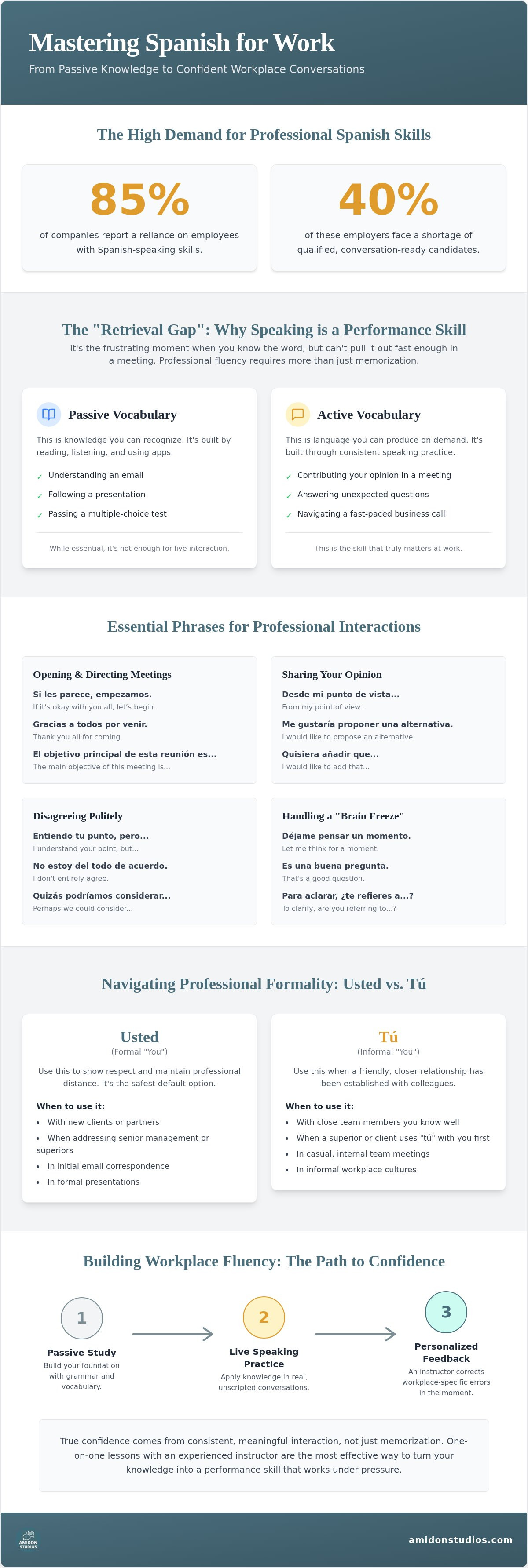
Did you know that 85% of companies report a reliance on employees with Spanish-speaking skills, yet nearly 40% of these employers face a shortage of qualified candidates?
You might have the grammar basics down, but when it comes to real-world Spanish for work conversations, the words just don't come fast enough. It's a common struggle for many professionals who understand the language but feel stuck when a meeting moves at a native pace. You want to sound professional and capable, not robotic or overly formal.
At Amidon Spanish, we understand that knowing the rules is different from using them in a high-stakes environment. You need more than just another vocabulary list; you need a method that prioritizes active speaking and real-life interaction.
In this article, you'll learn how to move beyond simply understanding Spanish and start contributing confidently to your workplace interactions. We'll show you how to build professional relationships with your colleagues by focusing on retrieval skills and personalized feedback.
We will explore practical strategies to help you transition from a silent listener to an active participant. You'll discover why live speaking practice with an experienced instructor is the most effective way to turn your knowledge into action.
True confidence comes from consistent, meaningful interaction rather than memorization, and a personalized learning plan can help you reach that goal.
Table of Contents
Why Spanish for Work Conversations Requires More Than a Vocabulary List
Essential Phrases for Professional Meetings and Interactions
Navigating Formal vs. Informal Language in a Business Setting
How to Handle Professional "Brain Freeze" During a Spanish Call
Building Workplace Fluency with Personalized Live Spanish Lessons
Why Spanish for Work Conversations Requires More Than a Vocabulary List
Many professionals treat language learning like a knowledge-based subject, similar to history or math. They memorize long lists of industry terms and study grammar rules until they can pass a written test. But in a professional meeting, your brain doesn't need to recall a definition; it needs to perform a task. This is why Spanish for work conversations feels so much harder than reading a textbook. It's a performance skill that requires real-time retrieval, not just recognition.
The retrieval gap is that frustrating moment when you know the word exists in your mind, but you can't pull it out fast enough to use it. You might recognize the term in an email, but when a colleague asks for your input, your brain hits a wall. This happens because workplace settings increase the pressure on language production. You aren't just trying to be understood; you're trying to be precise, professional, and persuasive. That extra layer of social and professional expectation makes the gap between what you know and what you can say feel even wider.
The Difference Between Knowing and Speaking
Most intermediate learners have a large passive vocabulary. You can follow a presentation or understand the general gist of a conversation. However, active vocabulary is much smaller. Reading a phrase like "Me gustaría proponer una alternativa" is easy because your brain only has to recognize the shapes of the words.
Producing that same phrase in response to a sudden question requires a different set of mental muscles. It's the difference between watching a professional sport and actually playing it. You need consistent speaking practice to turn that passive knowledge into a reflex that works under pressure.
Social nuances also play a role in this performance. For example, understanding the historical context of formal titles in Spanish is helpful, but knowing how to naturally integrate that level of respect during a fast-paced introduction is a separate skill altogether. You have to balance grammar, tone, and professional etiquette all at once.
Why Apps Often Fail Professionals
Apps are excellent tools for building a foundation of nouns and basic verbs. They use multiple-choice exercises and flashcards that are great for memorization. But work isn't a multiple-choice test. Your client won't give you four options for how to respond to their concern. Digital tools lack the live interaction and personalized feedback required to handle open-ended questions. They can't simulate the unpredictable nature of a business call.
This is why we created the Amidon Method. We focus on moving you from passive understanding to active speaking by simulating real-world scenarios in a supportive environment. True confidence in Spanish for work conversations comes from interacting with a teacher who can correct your workplace-specific errors in the moment.
Essential Phrases for Professional Meetings and Interactions
Relying on a few well-practiced phrases can significantly lower your anxiety during Spanish for work conversations. When you don't have to build every sentence from scratch, your brain has more space to focus on the actual business at hand. These expressions act as functional tools that signal both competence and cultural awareness. Think of them as the building blocks of your professional presence.
Many academic programs, such as those focusing on essential skills for business Spanish, highlight that effective communication often relies on these functional building blocks. They allow you to manage the flow of a meeting without getting lost in complex grammar.
If you want to see how these phrases feel in a live setting, you can schedule a free speaking assessment with one of our native-speaking teachers to get immediate feedback.
Opening and Directing the Conversation
The start of a meeting often sets the tone for the entire interaction. Instead of waiting for someone to call on you, use these phrases to take initiative or transition between topics naturally. They help you sound organized and authoritative.
Para empezar, me gustaría revisar los objetivos de hoy. (To start, I would like to review today's objectives.)
Pasemos al siguiente punto de la agenda. (Let's move to the next point on the agenda.)
Como mencionamos anteriormente... (As we mentioned previously...)
Me gustaría retomar lo que dijo [Nombre]. (I would like to go back to what [Name] said.)
Using these transitions shows that you're following the logic of the discussion. It allows you to direct the room's attention without needing a perfect grasp of every single verb tense.
Sharing Opinions and Handling Disagreement
In a professional setting, how you say something is often as important as what you say. Using collaborative language helps maintain strong relationships with your colleagues.
For instance, using Me parece que... (It seems to me that...) sounds much more professional and less aggressive than a blunt Yo creo que... (I think that...).
When you need to disagree, acknowledge the other person's perspective first. This is a key part of Spanish for work conversations in a Hispanic business context, where maintaining harmony is often prioritized.
Try these variations:
Entiendo tu punto, pero me preocupa el plazo. (I see your point, but I'm concerned about the deadline.)
Desde mi perspectiva, los datos sugieren algo diferente. (From my perspective, the data suggests something different.)
¿Podríamos considerar otra alternativa? (Could we consider another alternative?)
If you lose the thread of the conversation, don't stay silent. Use a professional clarification phrase like, Lo siento, no le seguí. ¿Podría explicarlo de otra manera? (I'm sorry, I didn't follow. Could you explain it another way?). This shows you're engaged and committed to understanding the details correctly.
Navigating Formal vs. Informal Language in a Business Setting
In many Spanish-speaking professional environments, hierarchy and respect are woven directly into the grammar. While English relies on tone and word choice to show deference, Spanish for work conversations uses specific pronoun structures to define relationships.
Understanding these nuances helps you build rapport without inadvertently causing offense or appearing overly stiff. It isn't just about being polite; it's about demonstrating that you understand the professional culture of your colleagues or clients.
Etiquette varies significantly by region. For instance, in Spain, the workplace is often more informal, and colleagues frequently use tú even with managers. In contrast, businesses in Mexico or Colombia often maintain a higher level of formality, where usted remains the standard for quite some time.
The safest strategy is always to mirror the person you are speaking with. If they address you with usted, continue doing the same until they explicitly invite you to use the informal form by saying, puedes hablarme de tú.
The Usted vs. Tú Decision Framework
Choosing the right level of formality doesn't have to be a guessing game. You should almost always stick to usted when speaking with clients, senior executives, or anyone you are meeting for the first time. This shows a baseline of professional respect that is highly valued.
As you build a relationship, you might notice signals that it is safe to transition. These signals include your colleague using your first name or adopting a more relaxed tone in their emails.
However, be careful not to rush into tú. While you want to be approachable, moving to informal language too quickly can sometimes feel presumptuous in a corporate setting. Our Spanish Star Program provides a structured way to practice these transitions with a teacher so you feel natural when the time comes to switch.
Professional Greetings and Closings
Your written and verbal introductions act as a digital handshake. In a formal email or a first-time call, start with Estimado or Estimada followed by their last name. Using Hola is generally reserved for colleagues you work with daily or environments with a very flat hierarchy.
When closing a conversation, professional warmth goes a long way. A phrase like Quedo a su disposición (I remain at your disposal) is a sophisticated way to end a meeting or email, signaling that you are ready to help with next steps.
You may also encounter Spanglish in modern corporate settings, especially in tech or global logistics. Phrases like forwardear un mail or hacer un call are common, but they should be used sparingly.
Relying too heavily on these terms can make you sound less proficient. It's better to use the correct Spanish terms, such as reenviar or programar una reunión, to maintain a high level of professional credibility.
Consistent conversation practice allows you to hear how native speakers balance these terms so you can adapt your own speech accordingly.
How to Handle Professional "Brain Freeze" During a Spanish Call
Forgetting a word during a high-stakes call can feel like a major setback, but it's actually a normal part of the language retrieval process. Even native speakers sometimes pause to find the right term. In Spanish for work conversations, the goal isn't to be a walking dictionary; it's to keep the communication moving. When your mind goes blank, the most important thing is to stay calm and use the tools you have to recover the flow of the conversation.
Many intermediate learners put immense pressure on themselves to be perfect. However, professional communication is about clarity and connection. If you can't find a specific word, it's better to keep talking than to stop entirely. This is where having a set of conversational safety nets becomes essential for your professional presence.
Stalling for Time Naturally
Instead of filling the silence with fillers like "um" or "uh," you can use professional stalling phrases. These buy you a few seconds to organize your next sentence without losing the floor.
For example, saying Déjame pensar un momento (Let me think for a moment) or Es una buena pregunta (That is a good question) signals to your colleagues that you're preparing a thoughtful response.
In a workplace setting, a brief pause is often perceived as a sign of preparation rather than a lack of knowledge. It shows you're being deliberate with your contribution. Using these phrases allows you to navigate the space between a question and your answer with professional poise.
If you find yourself frequently hitting these walls, one-on-one Spanish lessons can help you practice these transitions in a low-pressure environment.
The Art of Circumlocution
Circumlocution is the skill of describing a concept when you cannot remember the specific noun. It's a vital technique for maintaining momentum in Spanish for work conversations. For instance, if you forget the word for spreadsheet (hoja de cálculo), you could describe it as el documento con las filas y columnas para organizar los datos (the document with rows and columns to organize data). Your colleagues will understand exactly what you mean, and the conversation will continue without interruption.
By focusing on the function of an object or idea, you ensure that the meeting doesn't grind to a halt. This approach keeps the interaction productive and shows your ability to adapt. Our Spanish Star Program emphasizes these practical speaking strategies, helping you move beyond memorization to real-world application. You'll learn to rely on your existing vocabulary to navigate complex topics.
Active listening also plays a huge role in reducing speaking anxiety. When you focus intensely on what your colleagues are saying, you often pick up the very vocabulary or context clues you need for your response.
If you're ready to test these strategies and see where you currently stand, we invite you to schedule a free speaking assessment with an experienced instructor today.
Building Workplace Fluency with Personalized Live Spanish Lessons
While we've discussed phrases and strategies to handle "brain freeze," applying these tools consistently requires a specific environment. This is where many professionals find that generic apps or crowded group classes reach their limit.
To truly master Spanish for work conversations, you need an environment where you are the primary speaker. Private one-on-one Spanish lessons provide the personalized instruction and focus necessary to move from a state of hesitation to a place of organized ease.
At Amidon Spanish, we don't treat language as a set of rules to memorize, but as a performance skill to be honed through interaction.
The Value of Real-Time Interaction
Unlike an algorithm, an experienced instructor can identify the specific retrieval patterns that keep you from speaking fluently. They notice if you're over-relying on certain tenses or if you hesitate before specific professional greetings.
Through live Spanish lessons, you can simulate the exact meetings and presentations you have on your calendar next week. This speaking practice in a low-pressure setting builds the muscle memory needed to perform during actual Spanish for work conversations.
We prioritize this active participation over passive listening, ensuring that every minute of your session is spent building your ability to communicate clearly.
Immediate, personalized feedback is another critical component that apps cannot provide. When you make a subtle error in formality or use a term that doesn't quite fit your industry's context, a teacher can correct you on the spot.
This prevents mistakes from becoming ingrained habits. By engaging in consistent conversation practice in this safe environment, you lower the stakes of your real-world interactions. This makes it much easier to contribute to discussions with your colleagues and clients with a sense of quiet confidence.
Your Personalized Path to Conversational Confidence
Every career has its own linguistic nuances. A lawyer needs different linguistic tools than a marketing director or a healthcare administrator. A personalized learning plan ensures you aren't wasting time on generic travel vocabulary or irrelevant grammar drills.
We begin with a free speaking assessment to understand your current level and professional goals. This is the first step in your personalized path to conversational confidence, allowing us to tailor every session to the specific vocabulary and scenarios relevant to your actual job.
If you're ready to see how the Amidon Method can transform your workplace interactions, we invite you to schedule a free speaking assessment. It’s a practical, no-pressure way to get expert insight into your current skills and start your journey toward active workplace participation. You'll walk away with a clearer understanding of your strengths and a structured plan to reach your professional goals.
Master Your Professional Presence in Every Meeting
Building confidence in Spanish for work conversations is about more than memorizing terminology. It's about developing the retrieval skills needed to respond naturally when a colleague asks for your input. We've explored how using functional phrases and understanding cultural etiquette helps you navigate high-stakes interactions with ease.
Whether you're using stalling techniques to find the right word or choosing between formal and informal address, consistent practice is the only way to make these tools a permanent part of your professional toolkit.
The Amidon Method focuses on speaking as a distinct skill that requires real-time interaction. Through 1:1 live Spanish lessons tailored to your professional needs, you receive personalized feedback from an experienced instructor who understands your specific industry goals. This targeted approach ensures you're practicing the exact scenarios you'll face in your daily work life.
Are you ready to stop being a silent listener and start leading the conversation? Schedule your free speaking assessment and start your personalized path to conversational confidence. We look forward to helping you reach your goals.
Frequently Asked Questions
How long does it take to become fluent in Spanish for work?
Most professionals see a significant shift in their conversational confidence within 90 days when using a targeted, personalized learning plan. While total fluency is a long-term goal, you can master the specific Spanish for work conversations you need for your daily tasks much sooner. By focusing on speaking practice rather than just grammar drills, you build the muscle memory required to handle meetings without hitting a wall.
Should I use Tú or Usted with my Spanish-speaking boss?
You should lead with Usted to demonstrate professional respect. Hierarchy remains a central part of business culture in many countries, such as Mexico and Colombia. If your boss invites you to use Tú or uses it with you first, you can naturally follow their lead. Mirroring the formality of your colleagues is the safest way to navigate these cultural nuances without inadvertently causing offense.
Can I learn business Spanish if I only have a basic understanding of the language?
You can certainly start focusing on professional scenarios even with a basic foundation. You don't need to be an expert in every verb tense to learn the specific phrases used in your industry. An instructor can help you create a personalized learning plan that prioritizes the high-stakes interactions you face right now, allowing you to contribute to your workplace while you continue to build your overall skills.
What is the best way to practice Spanish for work if I do not have anyone to talk to?
One-on-one Spanish lessons are the best way to practice when you don't have native speakers in your immediate circle. While digital tools are helpful for memorizing nouns, they cannot replace the real-time interaction of a live conversation. Private lessons allow you to simulate meetings and presentations in a low-pressure environment, ensuring you get the personalized feedback necessary to correct errors before you speak with a client.
How do I handle a Spanish meeting if everyone is speaking too fast?
Don't hesitate to use professional stalling or clarification phrases if the pace becomes too fast. Saying ¿Podría explicarlo de otra manera? shows that you're engaged and want to ensure you understand the details correctly. It's often better to ask for a brief pause than to lose the thread of the discussion. Consistent conversation practice will eventually help your ear adapt to faster native speaker speeds naturally.
Are apps like Babbel or Duolingo enough for professional Spanish conversations?
Apps are excellent for building a foundation, but they cannot prepare you for the open-ended nature of professional Spanish for work conversations. They focus on recognition, whereas meetings require active retrieval and the ability to handle unpredictable questions. To truly succeed in a business setting, you need the personalized instruction and live feedback that only a human teacher can provide during live Spanish lessons.


Comments