
Spanish for Healthcare: Real-Life Conversations with Your Patients
- Jackie Amidon Donaldson

- Jul 30
- 12 min read

You're standing in a quiet exam room when your patient begins describing a complex symptom in rapid-fire Spanish. You know the technical word for the organ involved, but the connective tissue of the sentence escapes you.
In that moment, you reach for a translation app, feeling a familiar dip in your professional confidence. It is a common hurdle for healthcare providers who have the medical expertise but struggle with the fluid nature of real-life Spanish for healthcare conversations.
We understand that memorizing anatomy terms is very different from calming a worried parent or explaining a follow-up plan with empathy. While apps are helpful for building a base, they cannot replace the live speaking practice required to handle high-stakes clinical interactions. With recent updates to Section 1557 of the ACA emphasizing meaningful language access, the need to communicate effectively is higher than ever.
This article explains how to move past passive vocabulary and build a personalized path to conversational confidence. You'll learn how to streamline patient intakes and communicate more directly with patients during appropriate everyday interactions while recognizing when qualified language assistance is necessary.
Table of Contents
Why Conversational Spanish is Vital in Healthcare Settings
Many providers assume that medical Spanish is simply a collection of translated anatomy terms. They spend hours memorizing words for the gallbladder or the femur, yet they still feel stuck when a patient asks a follow-up question. Real-world Spanish for healthcare conversations requires more than a mental dictionary. It requires the ability to navigate a human interaction under pressure. Clinical accuracy is essential for a diagnosis, but conversational rapport is what ensures a patient actually follows the treatment plan.
Memorizing a dictionary won't help you during a patient crisis. When a patient is in pain or panicked, they don't use textbook terminology. They use colloquialisms, regional slang, and emotional descriptions. If you're too focused on finding the exact clinical noun, you miss the emotional cues that lead to better outcomes. Effective communication is about the flow of the interaction, not just the accuracy of the nouns.
Building Patient Trust Through Language
Small talk in a clinical setting isn't a waste of time. It's a diagnostic tool. When you start an appointment with a culturally appropriate greeting or a brief question about the patient's family, you establish yourself as a partner in their care. The importance of health communication shows up most clearly in these moments of connection.
For example, if you have to explain a long delay in the waiting room, a simple, "Lo siento por la espera; hemos tenido una mañana muy ocupada," does more to lower anxiety than a cold, translated sign on the door. It shows you see the patient as a person, not just a chart number.
Terminology vs. Language Retrieval
There's a specific frustration in being able to read a medical chart in Spanish but being unable to explain it to the person sitting in front of you. This happens because reading and speaking are different skills. Many intermediate learners experience a silent period where their brain understands the input but cannot produce the output fast enough for a natural conversation. You don't need more grammar drills to fix this. You need speaking practice.
Moving from knowing to doing requires a shift in how you study. This is why the Amidon Method focuses on helping professionals move from passive understanding to active participation. By working with an instructor in one-on-one Spanish lessons, you practice retrieving those words in real-time. This builds the self-assurance needed to handle Spanish for healthcare conversations without the hesitation that can make a provider seem less authoritative.
Essential Phrases for Effective Healthcare Conversations
Many providers rely on rigid scripts when they begin learning a new language. While having a few set sentences can help you get through a basic exam, real patients rarely follow a script.
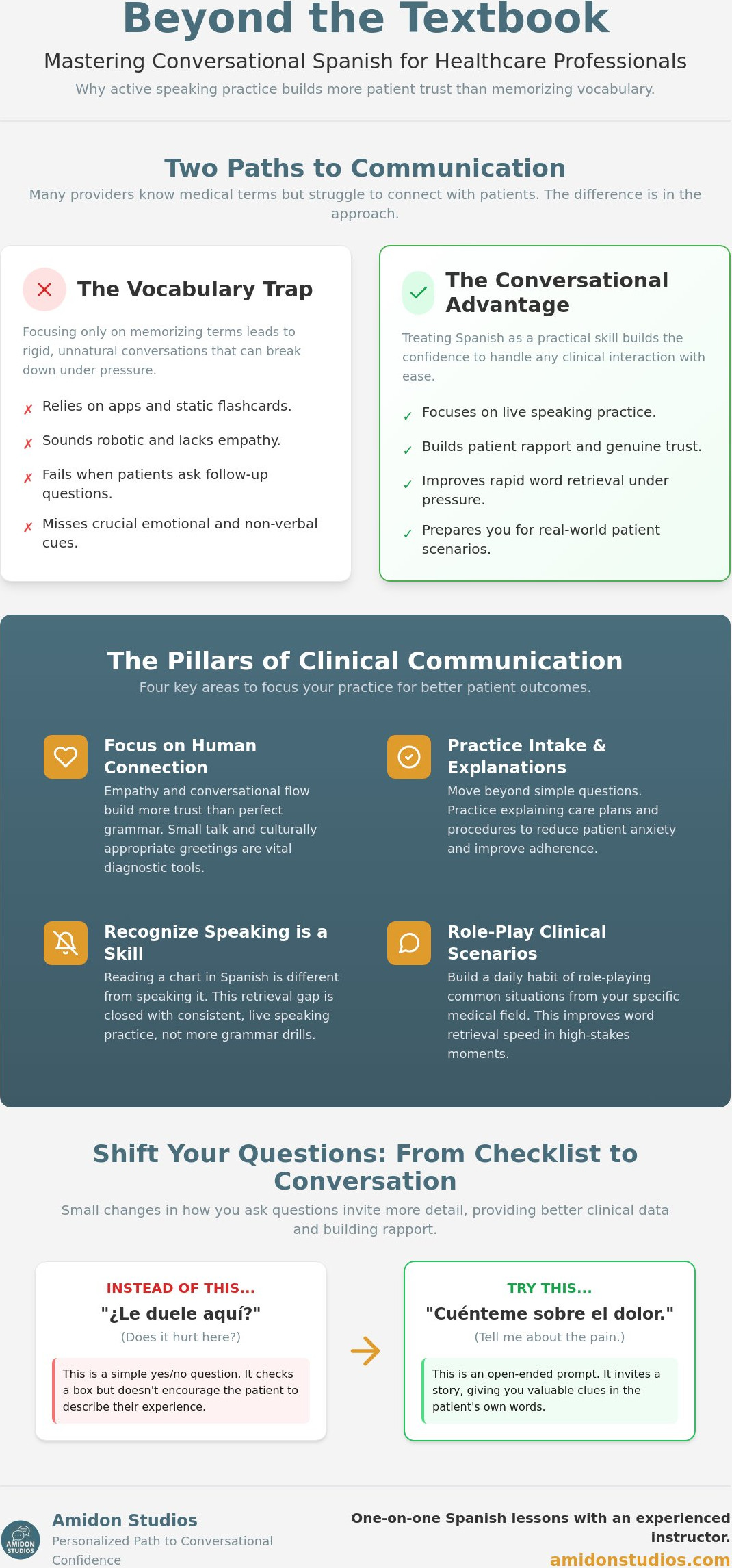
Successful Spanish for healthcare conversations depend on your ability to use flexible sentence starters that invite the patient to share more detail. Instead of focusing on a checklist of yes or no questions, you should aim for phrases that encourage the patient to describe their experience in their own words.
This approach not only provides better clinical data but also builds the rapport necessary for a successful provider-patient relationship.
Greetings and Patient Intake
Your first interaction sets the tone for the entire visit. Start with a professional introduction that clearly states your name and your role in the clinic. Use open-ended questions to begin the intake process.
For example, rather than asking if a specific body part hurts, ask the patient to tell you the story of when their symptoms started. This allows you to hear the vocabulary they use to describe their pain, which can be a valuable diagnostic clue.
If the patient begins speaking too quickly for your current level of understanding, it is perfectly professional to ask them to speak more slowly or to repeat a specific detail. Asking for clarification shows you are listening intently and prioritize their safety over your own speed.
Explaining Procedures and Next Steps
When you transition from the intake to the care plan, use clear and simple transitions. Tell the patient exactly what will happen first, what will follow, and what the final step involves. This structured approach reduces anxiety and helps the patient feel more in control of their care.
Avoid technical jargon that can confuse even native speakers. Instead of using complex medical terms for a procedure, describe the physical action you will take in plain language. Reassurance is also vital during uncomfortable exams. Use short, calming phrases to let the patient know they are doing well and that the procedure will be over shortly.
To ensure the patient has fully understood your instructions, use the teach-back method. Ask the patient to explain the care plan back to you in their own words. This is a critical step in preventing miscommunication in high-stakes environments. For additional resources you can share with your patients, the NIH Spanish Health Information portal provides reliable documents written in plain language that are easy for families to understand.
Building this level of comfort requires more than just reading a list of phrases. It takes active speaking practice and the ability to retrieve those phrases when you are under pressure. If you are ready to see how a personalized speaking assessment can help you identify your specific needs, we can help you move toward more natural interactions in the clinic.
Overcoming the Speaking Barrier in Clinical Environments
You have likely spent hours with grammar books, language apps, or vocabulary lists. You know the words on the page. Yet, when you walk into an exam room and a patient describes a sharp pain in their abdomen, your brain seems to lock up.
This is the gap between passive knowledge and active retrieval. It's a common struggle for healthcare professionals who understand the language but haven't yet mastered the skill of speaking it under pressure. In high-stakes clinical settings, your brain is already working overtime to process medical data. This leaves less room for the complex task of translating thoughts into speech.
Managing the pressure of getting it right is one of the biggest hurdles in Spanish for healthcare conversations. Many providers fear that a small mistake will damage their professional credibility. In reality, patients usually appreciate the effort to communicate directly.
If you make a mistake, simply correct it and move on. The goal is clear communication, not linguistic perfection. Handling a slip-up with a smile and a quick correction often does more to build trust than staying silent or relying on a screen.
The Retrieval Challenge in Medicine
The reason you struggle to find words during a shift isn't a lack of intelligence; it's a lack of speaking practice. Your brain needs to build the habit of retrieving Spanish words as quickly as it retrieves English ones. When you hit a block, you can use a technique called circumlocution.
This involves describing a concept when you cannot remember the specific word. For example, if you forget the word for a syringe, you might say "el instrumento para la inyección." It keeps the conversation moving and ensures the patient understands the next step without a long silence.
This is where the Amidon Method becomes essential. By engaging in one-on-one Spanish lessons, you practice these retrieval skills in a safe environment. You learn to navigate the specific clinical scenarios you face every day, receiving personalized feedback from a teacher who understands the nuances of medical interactions.
Moving Beyond Translation Apps
Translation apps are useful for a quick word check, but they can actually hinder your long-term confidence. Relying on a phone creates a physical barrier between you and your patient. It breaks eye contact and interrupts the natural rhythm of Spanish for healthcare conversations.
Patients need to feel your presence and your care, which a machine cannot replicate. While a qualified interpreter is necessary for complex legal or surgical discussions, speaking directly to your patient for daily interactions is much more effective for building rapport.
Instead of reaching for your phone, start building a personal toolkit of phrases you use in every shift. These should be high-frequency sentences that become second nature through consistent conversation practice. Over time, these phrases become the foundation of your clinical Spanish, allowing you to focus on the patient rather than the translation.
How to Practice Spanish for Real-Life Healthcare Scenarios
Moving from passive recognition to active confidence in Spanish for healthcare conversations doesn't require hours of study every night. It requires a specific type of practice.
Many providers fall into the trap of taking quizzes or using flashcards; while these help with vocabulary, they don't simulate a patient talking back to you. To see real progress
this year, you should build a 15-minute daily habit focused entirely on speaking out loud.
This simple shift helps your brain prioritize language retrieval over silent recognition. Even if you are just narrating your clinical actions to yourself, you are building the vocal habits needed for a busy shift.
Active listening is another vital part of this process. When you are in the clinic, pay attention to the specific phrases your patients use to describe their symptoms. Don't just listen for the medical terms. Listen for the rhythm and the way they transition between ideas. This practice improves your response time because you begin to anticipate the natural flow of a clinical dialogue rather than being surprised by every sentence.
Role-Playing Real Interactions
Role-playing is one of the most effective ways to build muscle memory. When you practice a difficult discharge conversation or a complex intake with an instructor, you are preparing your brain for the stress of the real event.
You should focus on high-frequency scenarios that occur in your specific department. If you work in pediatrics, your practice should look very different from someone in the emergency room. By simulating these interactions, you reduce the hesitation that often occurs when you search for words in front of a patient. It's about making the interaction feel like second nature before you ever walk into the exam room.
Developing a Personalized Learning Plan
Every healthcare professional has a unique set of needs. You don't need to be fluent in every topic to be effective; you need to master the 20% of vocabulary that covers 80% of your shifts. This is the core of a personalized learning plan. By identifying the phrases you use most often, you can streamline your study time and see immediate results in your clinical performance. Confidence comes from knowing you can handle your most common patient interactions without reaching for a phone.
Choosing the right path is essential for busy adults. You can learn more about the benefits of personalized instruction and how it helps you move past the limitations of self-paced apps. Working with a teacher who understands healthcare-specific needs ensures that your practice time is always relevant to your professional life. This targeted approach is what builds the conversational confidence needed to truly connect with those in your care.
Developing Your Personalized Path to Healthcare Fluency
Building the ability to handle Spanish for healthcare conversations is not about reaching a generic level of fluency. It is about becoming effective and confident in your specific clinical environment. While you may already understand much of what you hear, the transition from passive understanding to active interaction requires a structured approach.
The Amidon Method serves as this bridge, focusing specifically on the needs of busy professionals who cannot afford to spend years in a classroom. By prioritizing speaking practice over repetitive grammar drills, you can begin to see a significant shift in your ability to communicate with patients in as little as 90 days.
This transformation happens through live Spanish lessons that simulate the high-pressure environment of a clinic. Unlike a self-paced app, a teacher provides immediate, personalized feedback on your pronunciation and the natural flow of your speech. This nuance is critical in healthcare, where a slight change in tone or word choice can impact how a patient perceives your care and authority. You aren't just learning words; you're learning how to project empathy and professional competence in a second language.
The Spanish Star Program for Healthcare Professionals
We recognize that a surgeon, a pediatric nurse, and a physical therapist all face very different Spanish for healthcare conversations. That is why we customize our one-on-one Spanish lessons to target your specific clinical specialty.
Through the Spanish Star Program, we focus on the active retrieval of the vocabulary you use most often. We move past the anatomy lists and dive into the specific discharge instructions, consent forms, and patient histories that make up your daily shift. This personalized instruction ensures that every minute you spend practicing is directly applicable to the next patient you see.
Next Steps for Your Career
The best way to begin your journey toward conversational confidence is with a professional speaking assessment. This allows us to identify your current strengths and the specific gaps in your retrieval skills. From there, we create a personalized learning plan that fits into your existing schedule.
Consistent conversation practice with a dedicated instructor is the only way to move past the hesitation that often hinders healthcare providers. You can read more about how The Amidon Method helps you move from understanding Spanish to speaking it with ease.
When you are ready to communicate more confidently during appropriate everyday patient interactions and build deeper connections with your patients, we are here to provide the strategic path forward.
If you'd like to see where you stand, we invite you to schedule a free speaking assessment or a trial lesson. It is a low-pressure way to experience how personalized instruction can transform your clinical practice and improve patient outcomes.
Transform Your Patient Interactions Through Speaking Practice
Transitioning from passive understanding to active speaking is the most significant step you can take for your patients. You've learned that clinical accuracy matters, but the human connection built through Spanish for healthcare conversations is what truly drives patient satisfaction and health outcomes.
By moving away from translation apps and focusing on active retrieval, you ensure that your medical expertise is never lost in translation. This shift allows you to lead with empathy while maintaining your professional authority in every exam room.
Our instructors are experienced with adult language learners and provide the one-on-one Spanish lessons necessary to build muscle memory. Using the Amidon Method, we help you bridge the gap between knowing the language and using it in high-stakes environments.
You don't need to memorize a dictionary to be effective; you just need a personalized learning plan that focuses on your real-world clinical needs. Consistent practice and personalized feedback will help you move toward the conversational confidence your patients deserve.
We look forward to helping you build the skills you need to connect with your patients on a deeper level. Your journey to more meaningful medical interactions starts with a single conversation.
Frequently Asked Questions
Do I need to be completely fluent to speak Spanish with my patients?
You do not need total fluency to provide excellent care and build a strong connection with your patients. Most clinical interactions rely on a specific set of conversational tools rather than a mastery of the entire language. By focusing on the high-frequency phrases used in your specific specialty, you can handle basic intake and explain care plans effectively without the pressure of being perfect.
How long does it take to become comfortable with healthcare conversations?
Many healthcare professionals see a significant shift in their conversational confidence within 90 days. This timeframe assumes you are engaging in consistent speaking practice with an instructor rather than just passive study. While total mastery takes years, being able to navigate a standard patient encounter becomes much more manageable once you move past the initial retrieval barrier through regular interaction.
Can I learn medical Spanish using only mobile apps?
Apps are useful for building a basic vocabulary, but they cannot teach you how to handle real-life Spanish for healthcare conversations. Speaking is a distinct skill that requires a live partner who can provide personalized feedback on your flow and pronunciation. To truly connect with patients, you need the experience of a natural dialogue that an algorithm simply cannot simulate.
What should I do if a patient uses a slang term I don't understand?
Simply ask for clarification using a professional phrase like, "¿Qué quiere decir con eso?" Patients are usually happy to explain their symptoms in simpler terms if they see you are listening intently to their concerns. Using these moments as a learning opportunity shows the patient that you are committed to understanding their specific experience, which actually strengthens the provider-patient bond.
Is healthcare Spanish different from regular conversational Spanish?
The primary difference lies in the context and specific terminology rather than the structure of the language itself. While the grammar remains the same, healthcare Spanish prioritizes the vocabulary of symptoms, treatment plans, and empathetic reassurance. A personalized learning plan helps you focus on these professional nuances while still building a foundation in the everyday conversational skills needed for rapport.
What if I make a mistake and say the wrong medical term?
If you realize the error, correct it immediately and continue with the conversation. If the mistake involves critical diagnostic information, it is best to bring in a qualified interpreter to ensure the patient has the correct details. Most minor linguistic slips do not hurt your credibility; showing that you are making a genuine effort often makes a patient feel more comfortable.
How can I improve my Spanish listening skills for fast-talking patients?
Practice active listening during one-on-one Spanish lessons where your teacher can gradually increase their speaking speed as you improve. You can also listen to Spanish-language health news or podcasts to get used to different regional accents. The more you hear the language in a professional context, the easier it becomes to pick out key details during a busy clinical shift.
Is it better to take a group class or 1:1 lessons for medical Spanish?
Private 1:1 lessons are generally more effective for healthcare providers because the instruction is tailored to your specific department and schedule. In a group setting, you may spend time on topics that are not relevant to your daily work. Personalized instruction provides the intensive speaking practice and direct feedback needed to handle Spanish for healthcare conversations with professional confidence.


Comments