
How to Know If Your Spanish Lessons Are Working


You have been showing up for your Spanish lessons, completing the activities, and trying to use more Spanish between sessions. But progress can be difficult to recognize when you are the person experiencing it one conversation at a time.
You may still forget familiar words. You may still make grammar mistakes. Some days, Spanish may feel easier than it did the week before, while other days it feels like you have forgotten everything.
That does not necessarily mean your lessons are not working. Language progress rarely feels like a steady climb. The clearest signs often appear in how you handle real conversations, not in the number of words you have memorized or the number of lessons you have completed.
If your goal is conversational Spanish, your lessons should gradually help you:
Respond more easily
Speak for longer
Recover when you get stuck
Use Spanish in less predictable situations
Communicate with less mental effort
Here is how to tell whether that is actually happening.
Start With the Goal of Your Spanish Lessons
You can't determine whether your lessons are working until you know what they are supposed to help you accomplish. “Become fluent” is usually too broad to measure.
A useful goal describes something you want to be able to do in Spanish. For example:
Participate in conversations with Spanish-speaking relatives
Speak with patients or clients at work
Travel without depending entirely on English
Respond without translating every sentence first
Understand and contribute to group conversations
Maintain Spanish you previously studied
Feel more comfortable speaking with native speakers
Two people can take the same number of lessons and need completely different measures of progress. Someone learning Spanish for travel may need to practice asking questions, understanding likely responses, and solving common problems. A heritage speaker may already understand family conversations but need help retrieving words quickly enough to participate.
Your lessons are working when they move you closer to your own communication goals, not when they make you look successful according to someone else’s checklist.
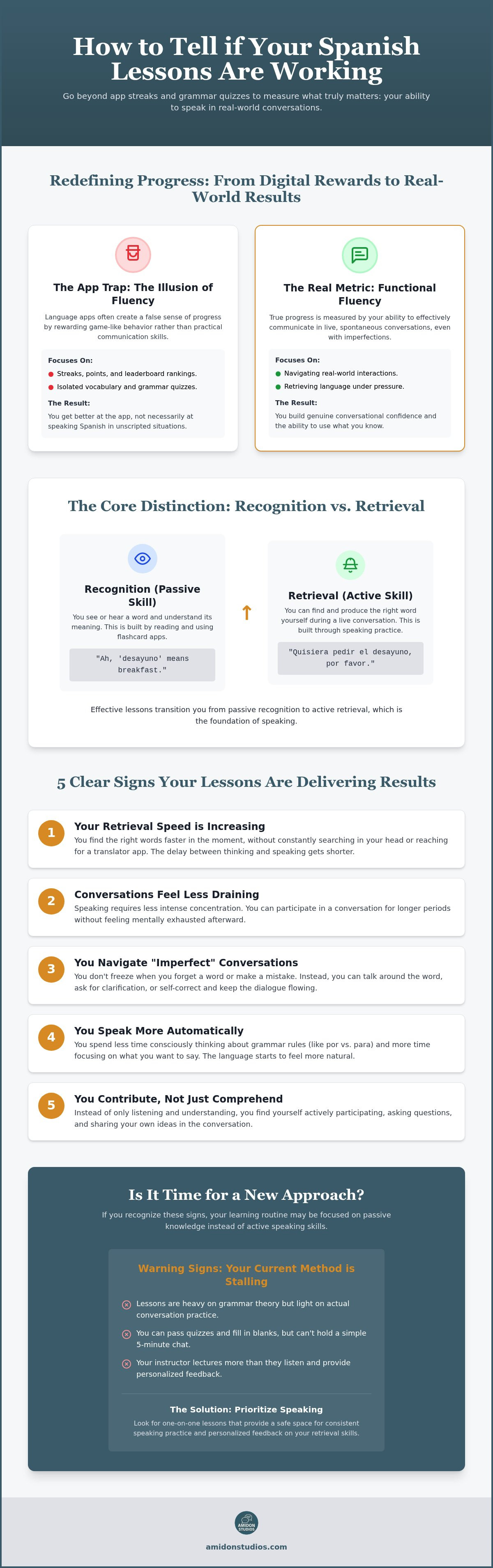
Five Signs Your Spanish Lessons Are Working
The most useful signs of progress are changes in what you can do during real or realistic conversations.
1. You Respond With Less Delay
When you begin speaking Spanish, even a simple question can trigger a long internal process.
You hear the question, translate it into English, decide what you want to say, build the sentence, check the grammar, and finally speak. By the time you are ready, the conversation may have moved on.
As your Spanish becomes easier to retrieve, that process begins to shorten. You may notice that:
Familiar responses come to mind more quickly
You begin answering before constructing the entire sentence
You rely less on translating from English
You use common phrases automatically
You spend less time mentally checking every verb
You do not need to respond instantly for this to count as progress. A shorter or less stressful pause is still meaningful.
2. Your Responses Become Longer
At first, you may answer questions with one word or one short sentence. Over time, you may begin adding an explanation, example or follow-up question without being prompted. That expansion shows that you are doing more than recalling isolated vocabulary. You are beginning to connect ideas in Spanish.
For example, instead of saying: “Sí, me gustó,” you may find yourself saying: “Sí, me gustó porque era muy tranquilo. Fui con mi hermana y pasamos toda la tarde allí.”
The response does not need to be grammatically perfect. The important change is that you can remain with the idea and communicate more of what you mean.
3. You Can Keep Going When You Forget a Word
Forgetting words is a normal part of speaking any language. Progress is not reaching a point where you never forget anything.
Progress is becoming better at handling the moment when you do. You may begin to:
Describe the word you cannot remember
Use a simpler word
Give an example
Rephrase the sentence
Ask for the word in Spanish
Continue the conversation instead of stopping completely
If you forget nevera but can say “la cosa en la cocina donde guardamos la leche,” you have successfully maintained communication.
This ability to talk around a missing word is called circumlocution. It is one of the clearest signs that you are becoming a more independent speaker.
4. You Can Speak About Less Familiar Topics
Early progress often appears within subjects you have practiced repeatedly, such as your family, work, daily routine, or weekend plans.
Eventually, you should begin transferring your Spanish into situations you did not rehearse word for word.
You may notice that you can:
Answer an unexpected follow-up question
Express an opinion about a new topic
Tell a story without preparing it first
Explain something that happened recently
Ask for clarification when you do not understand
Apply familiar grammar or vocabulary in a different context
This transfer matters because real conversations are unpredictable. Memorizing a dialogue may help you begin, but conversational ability requires adjusting when the other person says something you did not expect.
5. Speaking Spanish Requires Less Mental Energy
Spanish may still require concentration, but it should gradually become less exhausting.
When every sentence has to be translated and checked, even a short conversation can leave you mentally depleted. As familiar language becomes easier to retrieve, your brain has more capacity to focus on the person, the topic, and your response.
You may be able to:
Stay in Spanish for longer
Follow the conversation without losing track of the main idea
Listen while preparing your response
Make a mistake without becoming completely distracted by it
Finish a conversation without feeling mentally drained
This change can be subtle. You may not suddenly feel fluent, but you may realize that a 20-minute conversation no longer feels as difficult as it once did.
Other Forms of Progress You May Be Missing
Not every improvement is immediately visible in the amount of Spanish you can produce.
You Notice Your Own Mistakes
Self-correction is often interpreted as evidence that you are making more mistakes. In reality, you may simply be hearing them more clearly.
If you say a sentence, recognize that something sounds wrong, and correct it, your awareness of Spanish patterns is becoming stronger.
The goal is not to monitor every sentence so intensely that you cannot speak. However, noticing and correcting some errors without losing the conversation is a useful sign of development.
You Understand More Varieties of Spanish
You may begin understanding people with different accents, speech patterns or vocabulary choices.
This does not mean every speaker will suddenly become easy to understand. It means your listening skills are becoming more flexible. You are relying less on hearing one exact version of a familiar phrase.
You Ask Better Questions
At first, you may depend on English whenever you do not understand something. As your Spanish develops, you may begin asking questions such as:
¿Qué significa?
¿Cómo se dice?
¿Puedes repetirlo?
¿Puedes hablar más despacio?
¿Es lo mismo que…?
¿Me puedes dar un ejemplo?
Knowing how to manage confusion allows you to remain in the conversation instead of abandoning it.
You Use Spanish Outside Your Lesson
Another sign of progress is becoming more willing to use Spanish when a teacher is not guiding the interaction.
You might send a message, speak to someone at work, ask a question while traveling or participate more actively in a family conversation.
The interaction may not feel smooth. Choosing to use Spanish anyway shows that the language is becoming something you communicate with rather than something you only study.
What Does Not Always Mean Your Lessons Are Failing?
Some experiences feel discouraging without necessarily indicating a problem.
You Still Make Mistakes
Speaking more often creates more opportunities to make mistakes. That is not the same as losing progress.
If you are producing longer and more complex thoughts, you may temporarily notice more errors because you are attempting more difficult communication.
The better question is whether your mistakes consistently prevent other people from understanding you.
You Have Uneven Days
Sleep, stress, familiarity with the topic and the person you are speaking with can all affect language retrieval.
You may speak comfortably during one lesson and struggle during the next. One difficult session does not erase previous progress.
Look for patterns across several weeks or months rather than judging your ability according to one conversation.
You Understand More Than You Can Say
Comprehension and speaking do not develop at exactly the same rate.
You can recognize vocabulary and understand complex ideas before you can retrieve the same language quickly enough to use it. That gap is common, especially for adults who have spent more time reading, listening, or completing grammar exercises than speaking.
Your lessons should help close the gap by giving you repeated opportunities to retrieve and use what you already understand.
When to Reconsider Your Spanish Lessons
Slow or uneven progress is normal. However, there are situations in which the lesson structure may need to change.
Your Lessons Do Not Match Your Goal
If you want to speak with family but spend most of every lesson completing unrelated grammar exercises, the connection between the lesson and your goal may be too weak.
Grammar can support communication, but it should be practiced in situations where you are likely to use it.
You Rarely Speak During the Lesson
Your teacher will need to explain some concepts and provide examples. Still, if your goal is speaking and you spend most of the lesson listening, you may not be getting enough opportunity to practice language retrieval.
You should regularly be answering questions, explaining ideas, telling stories, solving communication problems or participating in guided conversations.
Every Lesson Feels Disconnected
A personalized learning plan should build from one lesson to the next. Your teacher should be able to identify recurring patterns, revisit language that has not become accessible yet, and connect new material with what you have already practiced.
If every session feels like a completely separate activity, it may be difficult to recognize or maintain progress.
You Do Not Receive Useful Feedback
Useful feedback is more than being told that a sentence is wrong. Your teacher should help you understand:
Which mistakes interfere with communication
Which patterns appear repeatedly
What you should focus on next
How to express an idea more naturally
What has improved since earlier lessons
Not every error needs to be corrected immediately. Constant interruption can make it difficult to communicate. The feedback should support your speaking rather than prevent it.
You Cannot Identify Any Change Over Time
If you have attended consistently for several months and cannot identify any change in what you can do, it is reasonable to review the plan with your teacher.
That conversation should include:
Your original goal
What you have practiced
What has improved
Where you continue to struggle
Whether your current activities match the skill you want to build
What needs to change during the next stage
A good teacher should be able to explain the purpose behind the lessons and show how the work connects with your goals.
How to Track Your Spanish Progress
You do not need a complicated tracking system. You need a few specific reference points that reflect how you actually want to use Spanish.
Record a Short Speaking Sample
Every month or two, record yourself answering the same open-ended question.
For example:
What did you do last weekend?
What is something you want to accomplish this year?
Tell me about a place that is important to you.
Describe a recent problem and how you solved it.
When you compare the recordings, listen for changes in:
Response length
Pause length
Use of connecting words
Ability to explain details
Frequency of switching to English
Ability to recover after losing a word
You may hear progress that was difficult to notice while it was happening.
Keep a Can-Do List
Write down specific things you can now do in Spanish.
Examples include:
I can make an appointment by phone.
I can describe my work responsibilities.
I can tell a story about something that happened.
I can ask follow-up questions during a conversation.
I can explain an unfamiliar word using simpler Spanish.
I can participate in a family conversation for 15 minutes.
Add to the list whenever you notice a new ability. This creates a clearer record than relying on the general feeling that you are either fluent or not fluent.
Revisit Your Goals With Your Teacher
Your goals may change as your Spanish improves.
Something that felt urgent three months ago may now be manageable, while a new obstacle becomes more noticeable. Revisiting your goals allows the lessons to evolve with you.
Ask your teacher:
What changes have you noticed in my speaking?
Which recurring problem should I focus on next?
What can I do now that I could not do when we started?
Are the lesson activities still aligned with my goal?
What would meaningful progress look like during the next few months?
Your Lessons Should Help You Use Spanish
The clearest evidence that your Spanish lessons are working is not a perfect quiz score or a long list of completed activities.
It is a growing ability to use Spanish when you need it. You respond with less delay. You speak for longer. You recover more easily. You understand a wider range of responses. You remain in the conversation even when the sentence does not come together perfectly. Those changes may happen gradually, but they are meaningful.
At Amidon Studios, the first 1:1 Spanish Star session includes an assessment of your current speaking ability, goals, and communication needs. We use that information to create a personalized curriculum and action plan focused on what you want to do with Spanish.
If you have been studying Spanish but still do not know whether your lessons are moving you forward, a speaking assessment can help you identify what is working, what is missing, and what your next stage of progress should look like.
Frequently Asked Questions
How long should it take to notice progress in Spanish lessons?
There is no universal timeline. Your starting level, goals, lesson structure, attendance, and use of Spanish between sessions all affect how quickly progress becomes noticeable. Look for changes across several weeks or months rather than expecting every lesson to produce an obvious breakthrough.
What are the clearest signs that my Spanish is improving?
Useful signs include responding with less delay, giving longer answers, recovering when you forget a word, speaking about less familiar topics and remaining in Spanish for longer without becoming mentally exhausted.
Does making mistakes mean my Spanish lessons are not working?
No. You may make more noticeable mistakes as you begin expressing longer or more complex ideas. Progress includes communicating more effectively, recognizing recurring errors, and recovering without abandoning the conversation.
How much should I be speaking during a Spanish lesson?
There is no percentage that applies to every learner or every lesson. If speaking is your primary goal, you should have substantial opportunities to answer questions, explain ideas, practice conversations, and receive useful feedback.
What should I do if I am not making progress in my Spanish lessons?
Review your original goals, the activities used during lessons, and the changes you expected to see. Ask your teacher what has improved, which patterns still need attention, and how the lesson plan will address them. If the instruction consistently does not match your goals, the approach may need to change.
How can I measure conversational Spanish progress?
Track specific abilities rather than relying only on grammar scores or vocabulary totals. Record periodic speaking samples, maintain a can-do list and note changes in response time, conversation length, recovery strategies and your ability to handle unfamiliar questions.


Comments