
Affordable Online Spanish Lessons: How to Find Quality Without Overpaying


Affordable online Spanish lessons can support real-world communication and personal learning goals.
Most people searching for affordable online Spanish lessons aren't starting from zero. They've tried an app, worked through a textbook, maybe even taken a class or two. They can read a menu, follow along with a slow podcast, and recognize words when they hear them. But the moment someone asks them a question in Spanish, the words don't come. Sound familiar?
That's actually a very common place to get stuck, and it has less to do with how much Spanish you know than with how you've been practicing it. Reading and listening are passive skills. Speaking is something else entirely. It requires retrieval, timing, and the kind of real-time practice that no app can fully replicate.
The good news is that finding a prjogram that prioritizes speaking practice doesn't have to mean paying premium prices. In this article, you'll learn exactly what to look for in affordable online Spanish lessons, why live conversation and personalized feedback matter more than most learners realize, and how a structured, one-on-one learning plan can get you speaking with genuine confidence in real situations. Whether you're a busy adult, a heritage learner, or a parent exploring options for your family, this guide gives you the practical criteria to choose well.
Table of Contents
Why Affordable Online Spanish Lessons Matter
There's a persistent assumption in language learning that quality instruction has to be expensive. It doesn't. What matters far more than price is whether a program actually gets you speaking. Many learners spend months with premium apps or self-paced courses and still can't hold a real conversation. The issue isn't the budget. It's the method.
Affordable online Spanish lessons work when they're built around live interaction and personalized instruction, not passive repetition. The format matters as much as the content.
The Challenge of Speaking Spanish
Most intermediate learners aren't short on vocabulary. They can read a sentence, recognize verb conjugations, and understand what's being said. The difficulty shows up the moment they need to produce language in real time. A native speaker asks a question, and instead of answering, the learner pauses, second-guesses the grammar, and loses the thread of the conversation entirely.
This is a retrieval problem, not a knowledge problem. And it's one that reading exercises and fill-in-the-blank drills simply don't address. Speaking is its own skill, and it only improves through practice that actually requires you to speak. That means live conversation with a qualified instructor who can hear what you're doing, respond naturally, and give you specific, useful feedback in the moment.
Consider a practical example: a heritage learner who grew up hearing Spanish at home can follow a family dinner conversation without difficulty. But ask them to introduce themselves professionally in Spanish, and the words don't come as easily. That's not a fluency problem. It's a practice problem. One-on-one speaking practice with a teacher who understands that distinction changes the trajectory quickly.
Making Learning Accessible
Online instruction removes two of the biggest barriers to consistent practice: scheduling and geography. You don't need to live near a language school or carve out commute time. A 30-minute live Spanish lesson can fit into a lunch break, an early morning, or the hour after the kids go to bed.
Accessibility also means finding a program that fits where you actually are in your learning, not a generic curriculum designed for absolute beginners. A personalized learning plan built around your current level, your goals, and the specific situations where you need to use Spanish makes every lesson count.
When evaluating your options, look for programs that prioritize:
Live, one-on-one instruction with a qualified teacher, not pre-recorded modules
Personalized feedback based on what you specifically say and how you say it
Conversation practice built around real scenarios, not scripted dialogues
Flexible scheduling that fits your actual life
Programs like the Spanish Star Program are designed with exactly these priorities in mind, offering structured, personalized instruction without the overhead costs of traditional classroom settings. That's what makes quality and affordability compatible, not competing.
Personalized Instruction: The Key to Speaking Success
Generic courses treat all learners the same. That's a problem, because no two learners are the same. Someone who grew up hearing Spanish at home has completely different gaps than someone who studied it in high school a decade ago. A one-size-fits-all curriculum can't address what either of them actually needs, which is why so many learners plateau despite putting in real time and effort.
Personalized instruction works differently. When a qualified teacher listens to you speak, they hear exactly where the breakdown happens. Is it verb tense? Word order? The habit of translating from English before you speak? A good instructor identifies the specific pattern that's slowing you down and adjusts the lesson accordingly. That kind of targeted feedback is simply not available in a pre-recorded module or an app-based drill.
Creating Your Personalized Learning Plan
A useful learning plan starts with an honest assessment of where you are right now, not where a placement quiz thinks you are. At Amidon Studios, that means looking at your current speaking level, your specific goals, and the real-life situations where you need Spanish to work. Are you preparing for travel? Communicating with Spanish-speaking family members? Using the language professionally? Each of those contexts calls for a different focus, and your lessons should reflect that from day one.
From there, milestones are set in practical terms. Not "reach B2 level," but "hold a five-minute conversation about your work without stopping to search for words." That kind of concrete, situational target keeps progress visible and keeps practice purposeful. Small, consistent wins build the kind of confidence that holds up outside the lesson.
Integrating practice into daily life matters just as much as the lessons themselves. Your instructor can help you identify low-stakes moments in your week where you can use Spanish actively, whether that's narrating a task out loud, texting a family member, or listening to a short podcast and then summarizing it in your own words. These habits reinforce what you're building in each session.
The Amidon Method
The Amidon Method is built on a straightforward premise: understanding Spanish and speaking Spanish are two different skills, and they require two different kinds of practice. Most learners have invested heavily in the first. The method focuses on the second.
Each lesson is structured so that you're producing language, not just receiving it. That means real conversation practice, immediate feedback on what you actually said, and adjustments made in the moment rather than at the end of a unit. Over time, the gap between what you know and what you can say closes because you're practicing the right thing consistently.
Students who've worked through this approach describe a shift that's hard to quantify but easy to recognize: they stop rehearsing sentences before they say them. The response starts coming before the second-guessing does. That's not a coincidence. It's the result of structured, one-on-one speaking practice done repeatedly in a setting where the feedback is specific and the stakes are low.
If you're looking for affordable online Spanish lessons that actually prioritize this kind of instruction, the difference shows up quickly when you try it directly. A speaking assessment with an Amidon Studios instructor is a practical first step to see exactly where your Spanish stands and what a personalized plan would look like for you.
Your Path to Conversational Confidence in 90 Days
Ninety days is a realistic window to see meaningful progress in your speaking ability, provided you're practicing the right things consistently. Not ninety days to fluency. But ninety days to the point where you can hold a real conversation without losing your place, answer a question without rehearsing it first, and feel like Spanish is something you can actually use. That shift is achievable, and it comes down to how you structure your practice time.
Daily Practices for Improvement
The most effective daily habits are short, active, and connected to your real life. You don't need hours. You need consistency and the right kind of output practice. Here's what that looks like in practical terms:
Narrate a task out loud in Spanish. Making breakfast, commuting, sorting emails: describe what you're doing as you do it. This builds retrieval speed without any prep time required.
Respond to your last lesson prompt. After each one-on-one Spanish lesson, your instructor will often leave you with a question or scenario to revisit. Answering it out loud the next day reinforces what you practiced in real time.
Use real scenarios, not textbook ones. Practice ordering at a restaurant, explaining your job to a new acquaintance, or asking for directions in a neighborhood you know. Situational practice transfers directly to actual conversations.
Stay in contact with your instructor between sessions. A quick voice message or written summary of a conversation you had keeps the momentum going between live lessons.
The common thread here is production, not consumption. Reading about Spanish and listening to Spanish are useful, but they don't build the reflex you need when someone is waiting for your answer.
Measuring Your Progress
Progress in speaking is harder to measure than progress on a written test, which is exactly why many learners underestimate how far they've come. Setting clear, situational benchmarks makes the improvement visible.
Start with a specific target for week one: introduce yourself and describe your work or daily routine without stopping mid-sentence. By week four, aim to sustain a five-minute conversation on a familiar topic. By week twelve, you should be able to handle an unexpected question, one you haven't prepared for, and respond with reasonable fluency.
Your instructor is the most reliable source of feedback on where you actually stand. In affordable online Spanish lessons built around live, one-on-one instruction, your teacher hears every hesitation, every self-correction, and every moment where retrieval is getting faster. They can tell you when you're ready to raise the difficulty and when a particular pattern still needs work.
Don't overlook the small wins. The first time you answer a question without translating it mentally first is worth noticing. So is the first time you catch your own error and correct it mid-sentence. These aren't minor flukes. They're evidence that consistent practice is working.
If you're not sure where your speaking currently stands, a Spanish speaking assessment with an Amidon Studios instructor gives you a clear, honest starting point and a practical picture of what the next ninety days could look like for you.
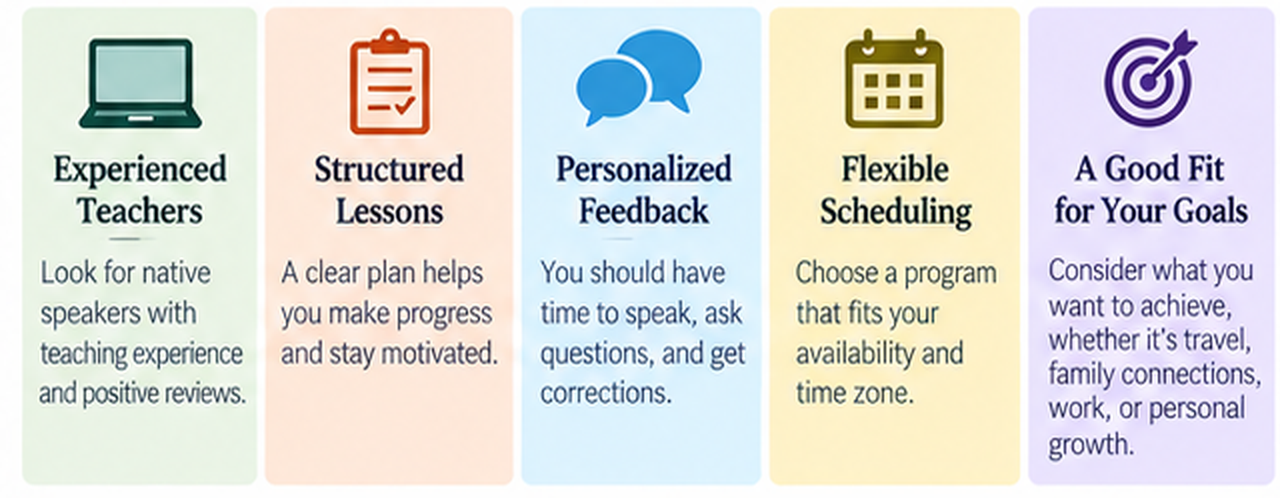
Five things to look for when comparing affordable online Spanish lessons.
Choosing Affordable Online Spanish Lessons for Your Goals
With so many options available, picking the wrong program is a real risk. Not because learners aren't thoughtful, but because most programs market themselves in similar ways. "Personalized," "effective," and "flexible" appear on nearly every landing page. The actual differences show up in the structure of the lessons themselves, and knowing what to look for makes the decision much clearer.
Live Lessons vs. Digital Toolkits
Self-paced digital courses have genuine value for vocabulary building, grammar review, and learning at your own schedule. If you want to study verb conjugations at midnight, a digital course lets you do that. What it can't do is respond to what you actually say, adjust in the moment, or give you the experience of producing language while someone is listening. That's a meaningful limitation for anyone whose primary goal is to speak with confidence.
Live, one-on-one Spanish lessons fill that gap directly. A qualified instructor hears your hesitations, catches patterns you're not aware of, and asks follow-up questions that push you to retrieve language in real time. Digital tools work well as a supplement to live instruction, not as a replacement for it. Think of them as preparation for the conversation, not the conversation itself.
When deciding between formats, ask one practical question: does this program require me to actually speak? If the answer is no, it won't build the skill you're after.
Evaluating Instructor Quality
Credentials matter, but they're not the whole picture. A qualified Spanish instructor should have documented teaching experience, not just native fluency. Speaking a language and teaching it are separate abilities. The best instructors can identify exactly what's slowing a learner down and explain it in plain terms, without defaulting to grammar lectures.
Look for specific indicators of quality:
Teaching experience with adult learners at the intermediate level, not just beginners
A clear feedback process during lessons, not just at the end
Testimonials that describe specific outcomes, such as holding a conversation at work or speaking with extended family
A structured approach with defined goals, not open-ended conversation sessions with no direction
Affordable online Spanish lessons can absolutely deliver this level of instruction. Price doesn't determine quality. Structure does. Before committing to any program, ask how progress is tracked and how lessons are adjusted when something isn't working. A straightforward answer tells you a lot about how the program actually operates.
Amidon Studios provides a speaking assessment before lessons begin, so both you and your instructor have a clear picture of your current level and what a personalized learning plan should focus on. You can read more about the full range of programs available at Amidon Studios programs.
Get Started with Your Spanish Journey Today
You've read about what makes affordable online Spanish lessons worth your time. Now the practical question is: what does starting actually look like?
It's simpler than most people expect. There's no placement exam to study for, no textbook to buy in advance, and no pressure to perform at a level you haven't reached yet. The first step is a speaking assessment with an Amidon Studios instructor, a real conversation designed to show you exactly where your Spanish stands right now and what a personalized learning plan would focus on for you specifically.
That assessment matters because it replaces guesswork with a clear picture. Instead of signing up for a program and hoping it fits, you start with direct feedback from a qualified instructor who has listened to you speak. From there, the lessons are built around your actual level, your goals, and the situations where you need Spanish to work.
How to Prepare for Your First Live Lesson
You don't need to prepare extensively. But a few practical steps will help you get more out of your first session:
Think of two or three situations where you want to use Spanish. At work, with family, while traveling, in a specific neighborhood. The more concrete, the better. Your instructor will use these as a starting point.
Note where your speaking tends to slow down. Is it verb tenses? Specific vocabulary? The habit of pausing to mentally translate? You don't need to diagnose it yourself, but having a sense of where things feel uncertain helps the conversation go further.
Have a quiet space and a reliable internet connection. One-on-one Spanish lessons work best when you can speak freely without distraction.
Be ready to speak, not just listen. The assessment is a conversation, not a quiz. There are no wrong answers, only useful information for your instructor.
Next Steps
Getting started takes one action. Visit the Amidon Studios contact page to schedule your speaking assessment and connect with an instructor. If you'd like to explore the full range of programs before reaching out, the Amidon Studios programs page gives you a clear overview of what's available, including private one-on-one lessons, the Spanish Star Program, and options designed specifically for families.
Consistent speaking practice with a qualified instructor is what actually moves the needle. The assessment is where that process begins, and it costs you nothing but a conversation.
The Right Lessons Make the Difference
Affordable online Spanish lessons can absolutely deliver real results. The key is knowing what to look for: live, one-on-one instruction, personalized feedback based on what you actually say, and a structured learning plan built around your specific goals. Those three things, more than any app or self-paced course, are what move you from understanding Spanish to speaking it.
You already know more than you think. What most intermediate learners need isn't more vocabulary or another grammar review. It's consistent speaking practice with a qualified instructor who can hear exactly where the breakdown happens and help you work through it directly.
Amidon Studios offers a free speaking assessment to give you a clear, honest picture of where your Spanish stands right now and what a personalized learning plan would look like for you. It's a practical first step with no pressure attached.
The conversation you've been wanting to have in Spanish is closer than you think. You just need the right practice to get there.
If you want structured speaking practice, explore Spanish Star or start with a free speaking assessment to find the best fit for your goals.
Frequently Asked Questions About Affordable Online Spanish Lessons
What can I expect from affordable online Spanish lessons?
Affordable online Spanish lessons, when structured well, deliver live instruction, personalized feedback, and real conversation practice. What you won't get from a low-cost program that's worth your time is a generic curriculum or pre-recorded videos with no interaction. The best programs pair you with a qualified instructor who builds lessons around your current level and specific goals, whether that's speaking with family, traveling, or using Spanish at work.
How do one-on-one lessons differ from group classes?
In a group class, your speaking time is divided among all participants, which means you might produce language for only a few minutes per session. In one-on-one Spanish lessons, every minute is spent on your specific gaps. Your instructor hears every hesitation, adjusts the difficulty in real time, and gives you feedback that's directly relevant to what you said, not a generalized comment meant for a room of learners at different levels.
Can I really become conversational in Spanish in 90 days?
That depends on what you mean by conversational. Reaching the point where you can hold a real exchange on familiar topics, answer unexpected questions without stopping, and correct yourself mid-sentence is achievable in 90 days with consistent one-on-one speaking practice. Full fluency across all contexts takes longer. The 90-day window is realistic for building the kind of practical confidence that holds up in actual conversations, not just structured exercises.
What materials do I need for online Spanish lessons?
Very little. A reliable internet connection, a device with a camera and microphone, and a quiet space to speak freely are the essentials. Your instructor will provide lesson materials, conversation prompts, and any supplementary resources based on your personalized learning plan. You don't need to buy a textbook or download a specific app before your first session.
Are online lessons effective for learning Spanish?
Yes, provided they involve live interaction. The format itself isn't the limiting factor; the structure is. A live online lesson with a qualified instructor who listens to you speak and responds in real time is genuinely effective. What doesn't work as well for speaking development is self-paced digital content with no live component. Online delivery removes scheduling and geography barriers without reducing the quality of personalized instruction.
How do I know which program is right for me?
Start with a speaking assessment. That's the most direct way to find out where your Spanish actually stands and which program structure fits your level and goals. Amidon Studios offers a speaking assessment before lessons begin so both you and your instructor have a clear, specific picture of what to focus on. Choosing a program without that baseline often means starting at the wrong level or working on the wrong things.
What if I have prior knowledge of Spanish but struggle to speak?
This is one of the most common situations instructors work with. You likely understand more Spanish than you can produce, which is a retrieval issue, not a knowledge gap. The solution isn't more grammar review or vocabulary lists. It's structured speaking practice with an instructor who can identify exactly where your output breaks down and give you targeted feedback in the moment. Programs like the Spanish Star Program are specifically designed for learners at this stage.


Comments