
Are 1:1 Spanish Lessons Worth It?

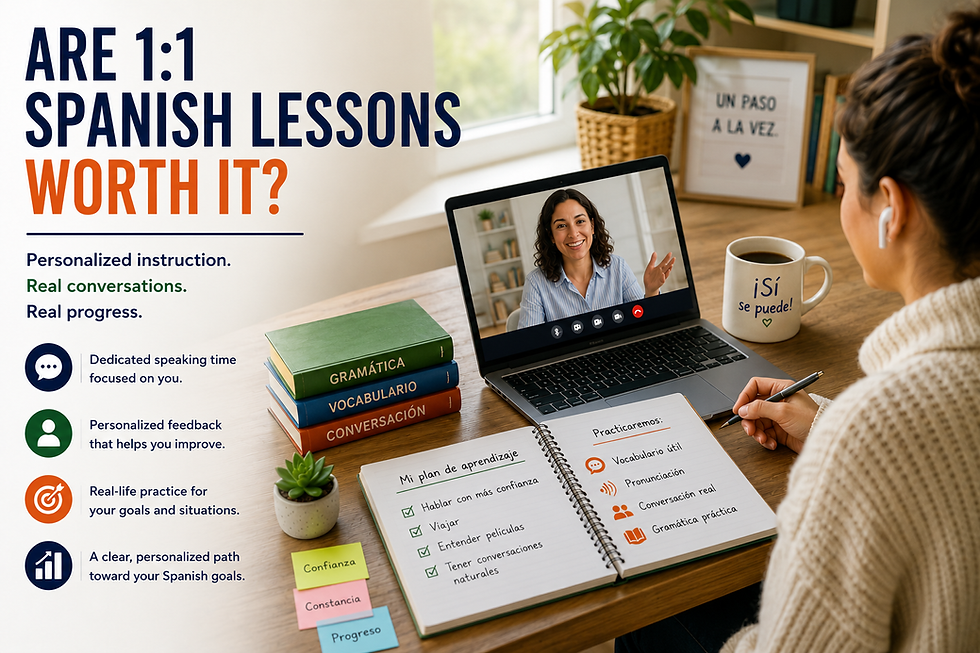
If you understand a lot of Spanish but struggle to use it during real conversations, you may wonder whether private instruction would actually make a difference. You might already listen to podcasts, read in Spanish, study grammar, or practice independently, yet still hesitate when someone asks you an unexpected question.
That's where 1:1 Spanish lessons can offer something different. Instead of following the same curriculum as everyone else, you get dedicated time to use Spanish with another person while receiving feedback based on what actually happens when you speak.
But private lessons aren't automatically the right choice for every learner. Whether they're worth it depends on your goals, how you prefer to learn, and what you're trying to accomplish with your Spanish.
What Do 1:1 Spanish Lessons Give You?
The biggest difference between private instruction and many other forms of Spanish practice is personalization. In a 1:1 lesson, the instructor doesn't have to divide attention among several students or follow a predetermined lesson at the same pace for everyone.
That means your lessons can focus on the Spanish you actually need. Someone who wants to communicate more comfortably with Spanish-speaking family members may need very different conversation practice from someone preparing for travel, using Spanish professionally, or simply wanting to participate more easily in everyday conversations.
More Time to Actually Speak
If conversation is one of your goals, dedicated speaking time matters. During a 1:1 lesson, you can spend much of the session actively participating in conversation rather than waiting for other students to take their turns.
Your instructor can also adjust the conversation as it happens. If you handle one topic easily, you can move on instead of spending additional time practicing something you already know, while areas where you consistently hesitate can receive more attention.
This is particularly useful for learners who understand quite a bit of Spanish but have trouble retrieving and using that Spanish spontaneously.
As we discuss in Why You Understand Spanish but Can't Speak It, recognizing language and producing your own response aren't exactly the same experience.
Feedback Based on Your Spanish
Independent practice can help you learn vocabulary, review grammar, improve listening comprehension, and get more comfortable speaking out loud. Recording yourself on video can also help you identify pronunciation issues, hesitation, grammar patterns, and words that consistently trip you up.
There are still things another person may notice that you don't. During 1:1 Spanish lessons, an instructor can identify recurring patterns in your speech and help you decide which ones are worth focusing on.
The goal isn't to interrupt and correct every mistake you make. Too much correction can make it difficult to maintain an actual conversation, so useful feedback should help you communicate more effectively without turning every sentence into a grammar exercise.
1:1 Spanish Lessons vs. Group Classes
Group classes can be a good choice for learners who enjoy learning socially and want opportunities to interact with several people. They can also work particularly well for siblings, family members, or students who enjoy learning together.
One-to-one lessons serve a different purpose. Because you're the only student, the instructor can tailor the pace, topics, feedback, and activities specifically to you.
That can be especially helpful if your Spanish doesn't fit neatly into a traditional level. You may have strong listening comprehension but weaker speaking skills, know advanced vocabulary in some areas but have surprising gaps in others, or have learned Spanish through family and life experience rather than a textbook sequence.
Neither format is inherently better for everyone. The question is whether you would benefit from having an instructor focus exclusively on your individual Spanish and goals.
1:1 Spanish Lessons vs. Self-Study
Private lessons don't have to replace independent learning. In fact, the two can work especially well together.
Self-study gives you flexibility and additional time with Spanish. You can review vocabulary, listen to podcasts, read, study grammar, practice pronunciation, shadow Spanish audio, record yourself speaking, or prepare for conversations you expect to have.
Live lessons give you something different: another person whose response you don't control. You have to listen, interpret what they mean, decide how you want to respond, and communicate your own ideas in real time.
That's why we don't see this as an either-or decision at Amidon Studios. In Live Online Spanish Classes vs. Self-Study: Which Is Better?, we look more closely at what each type of practice does well and how they can complement each other.
A Spanish Teacher vs. a Conversation Partner
If your primary goal is simply getting more opportunities to speak Spanish, a conversation partner can be valuable. You're using the language with another person, responding naturally, and getting experience with a real conversation.
A professional instructor should provide something beyond conversation alone. Your teacher should be able to identify patterns, explain language when necessary, adapt your practice to your level, and keep track of what you're working toward over time.
For example, maybe you consistently avoid telling stories in the past because you're unsure which tense to use. A conversation partner may understand you and simply continue the conversation, while an instructor can recognize the pattern and incorporate more opportunities to practice talking about past experiences.
That doesn't mean every lesson needs to follow a rigid curriculum. Meaningful conversation can still be at the center of the lesson while your instructor uses what happens during that conversation to guide your learning.
What Should You Look for in a 1:1 Spanish Teacher?
A good fit involves more than finding someone who speaks Spanish. You want an instructor whose approach matches what you're trying to accomplish and who can explain how your lessons will support those goals.
Ask how much of the lesson you'll actually spend speaking, how feedback is handled, and whether lessons are adapted to individual students. If you're an intermediate learner, you may also want to know whether you'll be required to work through material you've already mastered or whether the instructor can focus on your specific gaps.
Your teacher should also be interested in why you're learning Spanish. The conversations you want to have should influence what you're practicing.

How to Get More From Your 1:1 Spanish Lessons
Showing up for your lesson is important, but you can make that time more useful by connecting it to the Spanish you're using and practicing outside class. Bring your real life into the lesson rather than treating Spanish as something that exists only during your scheduled session.
If you have an upcoming trip, family gathering, work meeting, appointment, or other situation where you expect to use Spanish, tell your instructor. You can practice some of the language you're likely to need without trying to memorize an entire scripted conversation.
You can also bring in situations that already happened. If you recently tried to say something in Spanish and couldn't figure out how to express it, that's excellent material for your next lesson.
Stay in Spanish When You Can
When you don't know a word, try to work around it instead of immediately switching to English or reaching for a translation tool. Describe the object, explain what it's used for, give an example, or ask ¿Cómo se dice...?
This skill is called circumlocution, and it's extremely useful outside the classroom because you won't always know the exact word you need. We cover more strategies like this in Practical Spanish for Everyday Conversations You'll Actually Have.
That doesn't mean English can never be used during a lesson. There are times when a quick explanation in English may be useful, particularly when it prevents confusion and allows you to get back to communicating in Spanish.
Pay Attention to Where You Get Stuck
Your mistakes aren't the only useful information that comes out of a lesson. Pay attention to hesitation, words you repeatedly forget, ideas you have difficulty expressing, pronunciation that slows you down, and situations where you automatically switch back to English.
Those patterns can guide your independent practice. Instead of reviewing random material between lessons, you now have specific things to work on.
Practice Between Lessons
You don't need complicated assignments to continue working on your Spanish. If something was difficult during class, practice it again while the experience is still relatively fresh.
Record yourself speaking about the same topic, ideally on video so you can hear your pronunciation and pauses while also watching how your mouth moves. You can also repeat difficult words, practice a grammar pattern that came up during conversation, or try explaining the same idea in a few different ways.
For more ideas, How to Practice Speaking Spanish Alone includes activities you can use when you don't have another Spanish speaker available.
When Are 1:1 Spanish Lessons Worth It?
Private lessons can be particularly useful when you want instruction that responds to your individual Spanish rather than a standardized curriculum. They can also make sense when speaking is a priority and you want dedicated conversation time with personalized feedback.
You may get particular value from 1:1 lessons if you:
Understand more Spanish than you can comfortably speak
Have specific personal, professional, family, or travel goals
Want substantial speaking time during your lessons
Have uneven skills that don't fit neatly into a standard course level
Want feedback on recurring speaking patterns
Prefer lessons that can adapt to your interests and progress
Want your independent practice to connect to what happens during live conversations
If those things aren't priorities for you, another format may suit you just as well. The value of private instruction depends on what you want your Spanish learning experience to accomplish.
How Spanish Star Uses 1:1 Instruction
Our Spanish Star Program is designed for adults who want personalized Spanish instruction with an emphasis on using the language in conversation. Your lessons focus on your individual speaking skills, goals, interests, and the situations where you actually want to use Spanish.
Rather than assuming every intermediate learner needs the same material, your instructor can use what happens during your conversations to decide what deserves more attention. Independent practice between lessons can then reinforce the vocabulary, pronunciation, grammar, or speaking patterns that are most relevant to you.
You can also explore our Spanish programs to compare the different ways we work with adults, kids, and families. Different learners need different formats, so the goal is to find the approach that fits how you actually want to use Spanish.
So, Are 1:1 Spanish Lessons Worth It?
If you primarily want an inexpensive way to learn vocabulary, review grammar, or get more exposure to Spanish, you may be able to accomplish much of that independently. Self-study offers a huge range of ways to continue learning without private instruction.
If you want dedicated conversation practice, individualized feedback, and lessons built around your own Spanish rather than a generic curriculum, 1:1 instruction offers something different. You're paying not simply for access to the language, but for another person to listen to how you use it and adjust your learning accordingly.
If you're not sure what you need, our free Spanish speaking assessment and personalized learning plan gives you a chance to use your Spanish in conversation and identify what you're already doing well and where additional practice may help.
Frequently Asked Questions
How are 1:1 Spanish lessons different from group classes?
In 1:1 Spanish lessons, the instructor can devote the entire lesson to one student's goals, speaking patterns, questions, and areas that need additional practice. Group classes provide a different experience because you interact with other learners and share the instructor's attention, which can be a good fit for students who enjoy learning socially.
How many 1:1 Spanish lessons do I need before I feel more comfortable speaking?
There isn't a specific number of lessons that applies to everyone. Your progress depends on your current Spanish, your goals, how consistently you practice, and how much you use the language outside of lessons, so it's more useful to evaluate changes in the kinds of conversations you're able to handle than to promise results within a certain number of sessions.
Can complete beginners take 1:1 Spanish lessons?
Yes. A beginner's lessons can be adapted to foundational vocabulary, pronunciation, basic sentence structures, and simple conversations rather than expecting the student to arrive with previous Spanish knowledge. As your Spanish develops, the lessons can change with you. The instructor can gradually introduce more complex language and conversation based on what you're ready to use.
What should I do before a 1:1 Spanish lesson?
You don't need to complete a special routine before every lesson. It can be useful to think about questions you have, Spanish you've struggled to use recently, or situations you want to practice so you can bring those things into your session. You can also spend a few minutes listening to or reading Spanish beforehand if you find that helpful. The important thing is to arrive ready to participate rather than worrying about preparing perfectly.
Can 1:1 lessons help if I understand Spanish but have trouble speaking it?
Yes. A private lesson gives you dedicated opportunities to retrieve and use the Spanish you already understand while responding to another person in real time. Your instructor can also notice where you consistently hesitate or simplify what you're trying to say. Those patterns can then become specific areas for practice rather than leaving you to guess what you should work on.
Are online 1:1 Spanish lessons as effective as in-person lessons?
Both formats can provide live conversation and personalized instruction. Online lessons also eliminate travel time and allow students and teachers to work together regardless of location, which can make consistent scheduling easier. What matters most is the quality of the interaction and instruction. A live online lesson still allows your teacher to hear your Spanish, respond to you in real time, and provide individualized feedback.
What happens if I forget a word during a lesson?
You don't necessarily need to stop the conversation or switch immediately to English. Your instructor can help you describe the idea using Spanish you already know, ask for the word in Spanish, or find another way to communicate what you mean.
Those moments are useful practice because missing vocabulary is part of real conversation. Learning how to keep communicating when you don't have the perfect word can make you a more flexible Spanish speaker.
How does the Spanish Star Program personalize 1:1 lessons?
The Spanish Star Program uses your current speaking skills, goals, interests, and real-life communication needs to help guide your instruction. Rather than assuming every learner needs the same sequence of material, your teacher can focus on the areas that are most relevant to your Spanish.
Your live conversations also provide information about what you may want to practice independently between lessons. That creates a connection between what happens during class and the Spanish you're working on outside it.


Comments