
How Much Should a Spanish Teacher Cost? What You’re Actually Paying For


You found a Spanish teacher listing that looks reasonable. The rate is $18/hour. Another listing says $65/hour. A third says $40/hour. All three claim to be qualified Spanish teachers. So how much does a Spanish teacher cost? And more importantly, what does the price actually tell you about what you are getting?
Most adults shopping for a Spanish teacher or tutor focus on the hourly rate and the profile photo. That is understandable, but it leaves out the most important variables: who is setting the rate, what that rate means for the teacher's livelihood, and whether the lesson structure will actually move you forward.
How Much Does a Spanish Teacher Cost? What Drives the Price
Walk into any tutoring marketplace and you will find Spanish teachers and tutors listed anywhere from $8/hour to $80/hour or more. That range is not random, but it is not purely a reflection of quality either. Several factors drive what a teacher charges.
First, though, let's break down the difference between a teacher and tutor. While the terms are often used interchangeably, we make a distinction here at Amidon Studios.
A tutor typically helps students work through an existing curriculum, such as school assignments, a textbook, or an app-based program. A teacher designs the learning experience itself.
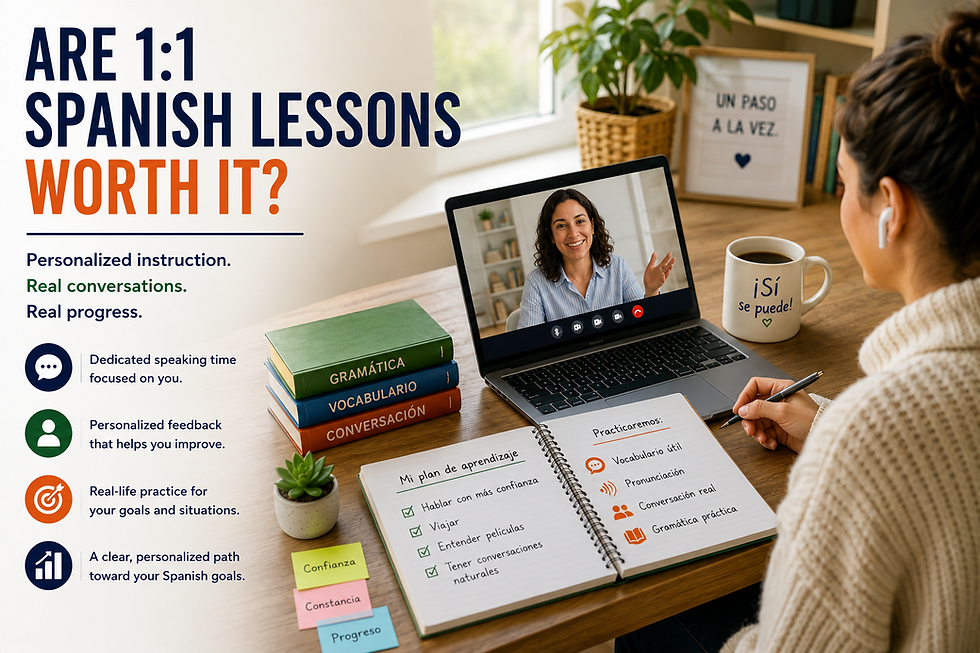
Instead of following a one-size-fits-all curriculum, we create a personalized learning plan based on your goals, interests, current abilities, and the situations where you want to use Spanish.
As your confidence and skills grow, your lessons evolve with you. That personalized approach is one of the reasons our students develop real conversational ability instead of simply completing a course.
Now on to the specifics about Spanish teachers.
Where the Teacher Is Based
The single biggest driver of low rates on global marketplaces is geography. A teacher charging $10/hour from a country where the average monthly wage is $400 is pricing competitively for their local market. That does not make them unqualified, but it does mean the rate comparison is not apples-to-apples when you are also looking at a US-based teacher charging $55/hour.
Credentials and Training
Teachers with formal teaching credentials, ACTFL certification, or years of structured classroom experience typically charge more. That premium reflects real investment in training and a demonstrable understanding of how adults acquire language, not just how to speak it.
Lesson Structure and Preparation
A tutor who shows up and chats is very different from a teacher who builds a personalized curriculum, tracks your progress, and prepares materials between sessions. Structured, prepared lessons take time outside the session itself. That time is reflected in the rate.
Platform or Independent
Tutors and teachers on large marketplaces often charge less because the platform handles marketing and client acquisition for them. Independent teachers and schools charge more because they carry that overhead themselves and typically invest more in the quality of the experience.
Price range | What it typically reflects |
Under $20/hour | Geography-based pricing, newer tutors, or minimal lesson structure |
$20-$40/hour | Mid-range marketplace tutors, some credentials, variable structure |
$40-$65/hour | Trained teachers, structured lessons, US or equivalent rates |
$65+/hour | Specialized expertise, niche audiences, premium programs |
These are generalizations, not rules. But they give you a starting framework for evaluating what you are actually comparing.
The Marketplace Economics Most Learners Never Think About
Here is something most people shopping for a Spanish teacher do not know: on many large tutoring platforms, the teacher keeps only a fraction of what you pay.
Platform commission rates vary, but cuts of 20–33% are common. On some platforms, new teachers are encouraged to set low introductory rates to build reviews, which can mean a teacher charging $15/hour is taking home $10-12 after the platform's cut. At that rate, teaching is not a sustainable profession. It is a side gig.
This matters for you as a learner because of what it means for the teacher on the other end of the call.
A teacher earning $10–12 per session needs volume to survive. That means more students, less preparation per student, and less investment in tracking your individual progress. It is not a character flaw. It is the math of the model.
Compare that to a teacher employed by a school or working independently at a professional rate. Professional rates make it more feasible for teachers to devote time to lesson preparation, ongoing professional development, and long-term relationships with their students.
That teacher can afford to prepare for your specific lesson, remember where you left off last week, and build a curriculum around your goals rather than running a generic conversation session for every student.
Fair pay creates better learning
One factor many learners never consider is how their teacher is paid. At Amidon Studios, our teachers are compensated at rates that reflect the value of their work rather than the average wages in their home countries. We believe teaching is a profession, not a gig.
Paying professional rates allows experienced teachers to stay with us long-term, prepare thoughtfully for each lesson, and invest in their students' progress. Instead of rushing from one lesson to the next to make ends meet, they have the time to personalize instruction, track their students' growth, and build meaningful relationships with the learners they teach.
Fair compensation isn't just good for teachers. It's one of the reasons students receive consistent, high-quality instruction year after year.
The real question is not just "what does this cost me?" It's "what does this rate mean for the person teaching me, and how does that affect my progress?"

What You Should Actually Be Paying For
Price alone does not tell you whether a Spanish teacher is worth it. What matters is what the price includes. Here is what qualified, structured instruction should actually deliver.
A Lesson Built Around Your Goals, Not a Generic Template
A qualified teacher does not run the same lesson for every student. Before or during the first session, they should ask about your goals, your background with Spanish, how you use or want to use the language, and what has not worked before.
That information shapes everything: the vocabulary they prioritize, the scenarios they practice with you, and the pace they set.
If a teacher never asks about your goals and jumps straight into a generic lesson plan, that is a signal about how the rest of the sessions will go.
An Assessment of Where You Actually Are
Many adult learners have a distorted picture of their own Spanish level. They underestimate their comprehension and overestimate their speaking ability, or vice versa. A qualified teacher will assess your actual level early and use that as the baseline for tracking progress.
Speaking Time That Belongs to You
ACTFL's core teaching principles recommend that 90% of class time be conducted in the target language, with the learner doing a significant share of the speaking. A lesson where the teacher talks for 40 minutes and you respond for 20 is not a good use of your money, regardless of the rate.
Feedback That Is Specific and Actionable
Vague encouragement ("good job, keep going") is not instruction. A qualified teacher corrects errors in real time, explains why something is wrong, and gives you a better pattern to replace it. That feedback loop is what separates a structured lesson from a conversation partner.
Continuity Between Sessions
A teacher who remembers what you worked on last week, follows up on vocabulary you struggled with, and builds each lesson on the previous one is providing a fundamentally different service than one who treats every session as a standalone event. That continuity is part of what you are paying for at the higher end of the market.
For more on what to look for when evaluating a teacher before you commit, the Amidon Studios guide on how to know if a Spanish teacher is qualified covers credentials, green flags, red flags, and the questions worth asking before your first session.
The Rate Is a Starting Point, Not the Answer
The right question when evaluating a Spanish teacher is not "is this cheap enough?" or "is this too expensive?" It is "what am I actually getting for this, and will it move me toward my goal?"
A low rate from a marketplace tutor earning a fraction of your fee after platform cuts is a different product than a structured lesson from a professional teacher paid at a rate that makes teaching a real career. Neither is automatically right or wrong. But understanding the difference helps you make a decision you won't regret six months from now.
The adults who make the fastest progress are not the ones who found the cheapest option. They are the ones who found a teacher who assessed their level honestly, built a plan around their specific goals, and showed up prepared every week.
If you want to see what that looks like in practice, the Amidon Studios trial lesson is a good starting point. The first session includes a free assessment where your teacher evaluates your current Spanish level, discusses your goals and how you use the language in your daily life, and builds a personalized curriculum and action plan from there. You leave with a clear picture of where you are, where you are going, and what it will actually take to get there.
For adults who already understand Spanish but struggle to speak it, the post on why you understand Spanish but cannot speak it explains why that gap exists and what kind of instruction actually closes it.
If you want structured speaking practice, explore Spanish Star or start with a free speaking assessment to find the best fit for your goals.
Frequently Asked Questions
What's the difference between a Spanish teacher and a Spanish tutor?
For many learners, there isn't a strict difference, and many professionals use the terms interchangeably. Traditionally, a teacher provides structured instruction with a long-term learning plan, while a tutor offers additional support for specific goals, schoolwork, or areas of difficulty. When choosing someone to help you learn Spanish, it's more important to ask how they teach than what they call themselves. A qualified instructor should be able to explain their teaching approach, personalize lessons to your goals, and help you make steady progress toward using Spanish confidently in real life.
Is a cheaper Spanish teacher ever worth it?
Yes, in specific situations. If you are a complete beginner who wants low-stakes exposure before committing to structured lessons, a lower-rate conversation partner can be a useful starting point. The risk is treating it as a substitute for structured instruction when your goal is actually conversational confidence. Casual conversation practice and skill-building instruction are different things, and the price difference often reflects that.
Why do some Spanish teachers charge so much more than others?
The gap usually comes down to three things: credentials and training, lesson structure and preparation, and geography. A trained teacher based in the US who builds personalized curricula and tracks your progress week over week is delivering a fundamentally different service than a native speaker who chats with students for an hour. Both have value, but they are not the same product.
Why don't you charge the lowest prices online?
There are certainly less expensive options available, especially on large tutoring marketplaces. Our pricing reflects the fact that every lesson includes personalized planning, ongoing communication, and teachers who are paid professional rates for their expertise. We believe students benefit most when teaching is a sustainable career rather than a high-volume side job. That investment allows us to retain excellent teachers and provide consistent, personalized instruction over the long term.
How do I know if I am getting good value from my current teacher?
Ask yourself three questions: Is most of the speaking time mine? Does my teacher remember what we covered last week and build on it? Am I noticeably more confident or capable than I was three months ago? If the answer to any of these is no, it is worth having a direct conversation with your teacher or evaluating other options.
Is it worth paying more for a 1:1 lesson vs. a group class?
For adults focused on speaking confidence, yes. Group classes spread the speaking time across multiple students, which means you might get 5–10 minutes of actual output practice in a 60-minute session. A 1:1 lesson means every minute is available for your speaking practice, your error correction, and your specific gaps. The research on language anxiety also consistently shows that adults perform better and take more risks in lower-pressure settings, which 1:1 instruction provides in a way group classes rarely can.


Comments