
Conversational Spanish Classes for Adults: How to Choose the Right Fit


You can understand a Spanish podcast, recognize familiar words in a conversation, and still freeze when someone asks you a simple question. That gap between knowing Spanish and speaking it is exactly why conversational Spanish classes appeal to so many learners. But not every class gives you the same amount of time to talk.
The best conversational Spanish classes for adults are the ones that fit your goals, give you meaningful speaking practice, and help you use what you learn outside the lesson. Here’s how to compare four common options without getting distracted by promises of effortless fluency.
What should a conversational Spanish class actually help you do?
A useful class makes room for real exchanges, not just repeating phrases after an instructor. You should be able to ask follow-up questions, explain what you mean when you forget a word, and get feedback you can apply in your next conversation.
Speak for a meaningful portion of each lesson, rather than mostly listen.
Practice situations relevant to your life, such as family visits, travel, work, or everyday errands.
Receive specific feedback on clarity, pronunciation, and useful expressions.
Build confidence recovering when a conversation takes an unexpected turn.
Grammar still matters. The difference is that it supports your communication instead of becoming the whole lesson.
Four options for conversational Spanish classes for adults
There isn’t one best format for everyone. Think about your budget, schedule, current level, and whether you need structure, social practice, or individual feedback.
1. Community college and continuing education classes
Community colleges can be a practical starting point if you like a predictable schedule and learning alongside other people. Some courses emphasize conversation, while others spend more time on grammar and written exercises. Check the syllabus and ask how often students speak in pairs or small groups.
Best fit: learners who want an established course schedule and a classroom community. Trade-off: you may get less individual speaking time, especially in a larger class.
2. Live online small-group classes
Online group classes offer live interaction without commuting. The experience depends heavily on group size and the instructor’s approach. A small group where everyone contributes is very different from a large video call where only a few people speak.
Best fit: learners who enjoy interacting with peers and want scheduled accountability. Trade-off: the class pace and conversation topics may not match your personal goals every week.
3. Language exchanges and conversation meetups
Meetups and language exchanges can give you practice responding to people you haven’t rehearsed with. They’re often inexpensive, and the conversations can be wonderfully unpredictable. But they may not provide a clear progression or corrections when you need them.
Best fit: learners who already know some Spanish and want more informal practice. Trade-off: you may need to organize your own learning and ask explicitly for feedback.
4. One-on-one conversational Spanish lessons
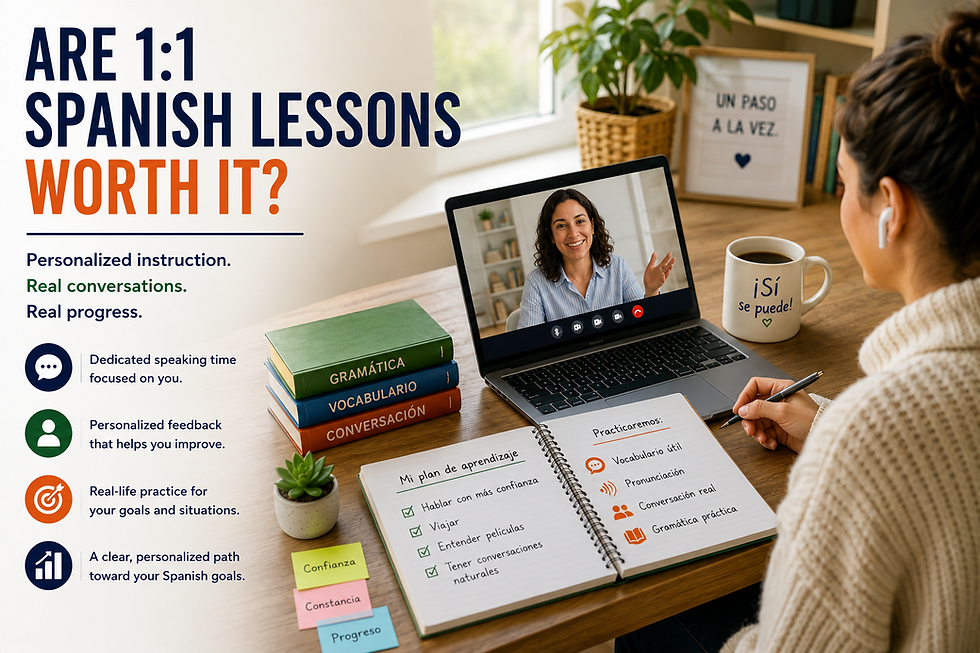
Individual lessons give you the most opportunity to shape the conversation around your needs. If you want to talk with relatives, prepare for travel, or become more comfortable speaking at work, a teacher can adapt scenarios and feedback to those situations.
Best fit: learners who want targeted practice and a personalized plan. Trade-off: one-on-one instruction can cost more than group options, so it’s worth checking what assessment, preparation, and feedback are included.

Five questions to ask before enrolling
How much of each lesson will I actually spend speaking Spanish?
Will the instructor adapt topics to my level and real-life goals?
How will I receive corrections without losing the flow of conversation?
What should I practice between lessons, and how will we track progress?
Can I try a lesson or assessment before committing to a longer program?
If a program advertises conversational fluency but cannot explain how learners practice speaking, keep looking. A useful trial lesson should help you understand the teaching style, not simply deliver a sales pitch.
How to make progress between Spanish lessons
You don’t need to turn every evening into homework. Choose a small task connected to the conversations you want to have. For example, after a lesson about food, record yourself describing what you cooked, then note one phrase you want to ask your teacher about next time.
Repeat one short exchange aloud, then change the details to make it your own.
Send a brief voice note to a language partner or record one for yourself.
Keep a short list of expressions you needed but couldn’t retrieve during a conversation.
Bring one real question or experience to your next lesson.
The goal is to make speaking familiar, not to collect an endless list of vocabulary words. Consistent, relevant practice is more useful than chasing a perfect streak.
Which conversational Spanish class should you choose?
If you enjoy a classroom community, start by comparing local or online groups. If you mainly need opportunities to talk, a meetup can complement formal lessons. If you have specific goals and want focused feedback, individual lessons may be the better fit. You can also combine formats: structured instruction for guidance and informal conversation for variety.
At Amidon Studios, our conversational Spanish lessons begin with an assessment of what you can already do and where you want to go. We focus on the conversations you actually want to have, with individual guidance and speaking practice tailored to your goals. You can explore the program and decide whether that approach is right for you.
Frequently asked questions
Are conversational Spanish classes suitable for beginners?
Yes. Beginners can practice simple exchanges from the start, as long as the instructor adjusts the vocabulary, pace, and expectations to their level.
Are group or private Spanish lessons better for speaking practice?
Both can help. Small groups provide interaction with different classmates, while private lessons generally give you more individual speaking time and targeted feedback.
How often should I take conversational Spanish lessons?
Choose a schedule you can maintain. One well-structured weekly lesson combined with short speaking practice between sessions can be a practical starting point.
Can I improve my Spanish speaking without memorizing long vocabulary lists?
Yes. Practice using familiar words in real situations, asking follow-up questions, and explaining ideas when a word does not come to mind. Add new vocabulary as you need it.


Comments