
Choosing the Best Online Spanish for Homeschoolers: A Speaking-First Guide
- Jackie Amidon Donaldson

- 6 days ago
- 10 min read

Choosing the right online Spanish program for your homeschool can feel overwhelming. Some programs focus heavily on grammar and memorization, while others promise quick results without much real conversation practice.
If your goal is for your child to actually speak Spanish with confidence, it's important to choose a program that develops communication skills from the very beginning.
In this guide, we'll explain what to look for in an online homeschool Spanish program, compare different learning formats, and help you find the best fit for your family's goals.
Table of Contents
Beyond the Textbook: Why Traditional Spanish Instruction Often Fails
Many homeschooling parents discover that their child can recognize Spanish words, complete worksheets, and even pass vocabulary quizzes, yet struggles to speak in a real conversation.
When asked a basic question like, “¿Cómo estás?” (How are you?), their mind goes blank. The vocabulary and grammar rules they spent months, or even years, studying seem to vanish.
This experience isn’t a personal failure; it’s a systemic one. Traditional language education often treats Spanish as an academic subject to be studied, not a communication skill to be used. It operates on the flawed assumption that if you learn about the language—its rules, its vocabulary, its structure—you will eventually be able to speak it.
But understanding and speaking are two fundamentally different neurological processes. One is about passive recognition, while the other is about active, on-demand production.
This guide explains why that gap exists and introduces a methodology designed specifically to close it. We will explore the core principles of a conversation-first approach, how it differs from conventional methods, and how it provides a structured path for homeschoolers to move from passive knowledge to active, confident speaking.
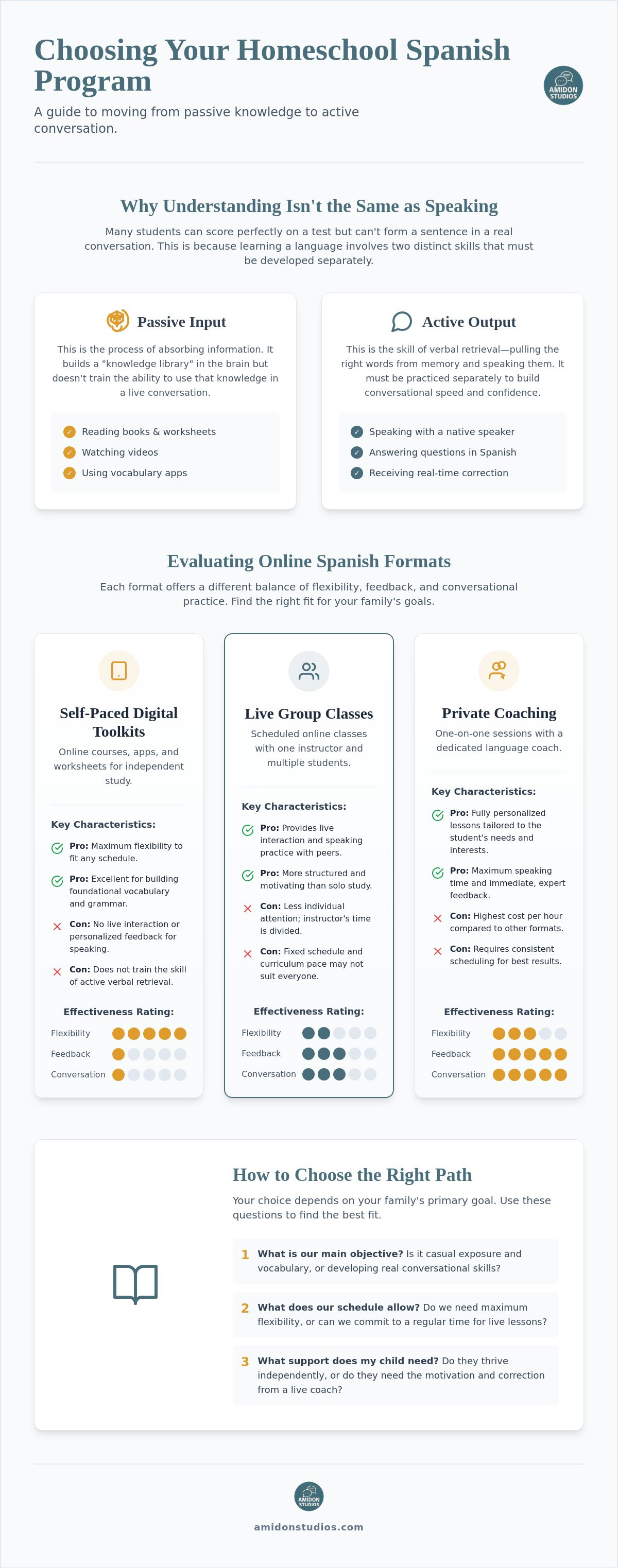
The Difference Between Passive Input and Active Learning
At the heart of the speaking problem lies the distinction between learning.
Passive learning is everything you take in: listening to podcasts, watching videos, reading articles, and completing workbook exercises. These activities build your passive vocabulary and your understanding of how the language is structured. You learn to recognize correct Spanish when you see or hear it.
Active learning, however, is the skill of speaking the language yourself. It requires your brain to search for the right words, assemble them into a coherent sentence with correct grammar, and articulate them with proper pronunciation—all within a few seconds. This process, known as active retrieval, is the biggest hurdle for most learners.
A student might easily recognize the word manzana when they see it, but that is very different from retrieving that same word from memory when they want to ask for an apple at a market.
Why Vocabulary Apps Are Not Enough for Conversational Confidence
Language apps like Duolingo, Babbel, and Rosetta Stone are excellent for building a foundation of vocabulary and basic sentence patterns. They use spaced repetition to help you memorize words in isolation.
However, this is where their utility often ends. This approach can lead to what we call the "app trap," where students collect hundreds of disconnected words but lack the ability to string them together in a meaningful conversation.
True conversation is not a multiple-choice quiz. It requires navigating unexpected questions, paraphrasing when you forget a word, and understanding cultural context.
Apps cannot provide the live, nuanced feedback necessary to correct pronunciation, suggest more natural phrasing, or adapt a lesson to a student’s immediate questions. Without a live conversational partner, a student is only practicing one half of the language equation: passive learning.
Evaluating Online Spanish Formats: From Self-Paced Kits to Live Private Lessons
When choosing an online Spanish program for a homeschool curriculum, parents are faced with a wide spectrum of formats. Understanding the strengths and weaknesses of each is crucial for aligning the program with your child’s goal of actually speaking the language.
The three primary formats are:
Self-Paced Digital Toolkits: These include pre-recorded video lessons, downloadable worksheets, and app-based modules.
Live Group Classes: These involve one instructor teaching multiple students simultaneously via video conference.
Live 1:1 Lessons: This format provides a dedicated instructor for a single student in each session.
Each format serves a different purpose, and the best choice depends on whether the goal is to learn about Spanish or to learn to speak Spanish.
Self-Paced Digital Toolkits for Independent Learners
A self-paced digital toolkit can be an effective and flexible resource, particularly for families needing to supplement another curriculum or for highly motivated, independent learners. They allow students to work at their own pace and on their own schedule. High-quality toolkits should include extensive audio and video components to develop listening skills, which are a prerequisite for speaking.
When it’s the right choice:
As a supplement to a conversation-based program for extra vocabulary and grammar practice.
For foundational ear training and learning basic phrases before beginning live instruction.
For families on a tight budget who need a starting point for their language studies.
For example, our Spanish Digital Courses & Toolkits are designed to provide this flexible foundation, helping students build passive knowledge that can later be activated in live conversation.
The Role of Live Instruction in Homeschooling
While digital tools build knowledge, live instruction builds skill. Live instruction gives students opportunities for immediate feedback and real conversation that are difficult to replicate with self-paced programs alone.
A live Spanish instructor can do what no app or video can: provide instant, personalized feedback. They can correct a mispronounced word on the spot, re-explain a grammar concept in a new way, and tailor the conversation to a child’s specific interests, whether it’s video games, art, or science.
This personalized interaction is what turns passive vocabulary into active use. In a one-on-one setting, a student is required to produce language constantly, strengthening their active retrieval pathways. This consistent practice in a supportive environment is the single most important factor in building genuine conversational confidence.
Matching Your Homeschool Spanish Choice to Your Family’s Needs
A successful homeschool Spanish program fits your family’s unique circumstances, including the parent’s own language proficiency, the child’s age, and your scheduling needs. A one-size-fits-all curriculum rarely works because every family’s goals and dynamics are different.
HOPE Scholarship Families in West Virginia
If your family participates in West Virginia's HOPE Scholarship program, Amidon Studios is an approved vendor. Eligible families can use their HOPE Scholarship funds toward our live online Spanish lessons, making it easier to add personalized language instruction to your homeschool curriculum.
Choosing Programs Based on the Parent’s Spanish Proficiency
Your own comfort level with Spanish will significantly influence the type of program that will work best for your homeschooled family.
For "Zero-Spanish" Parents: If you do not speak Spanish, look for a comprehensive program where the instructor handles all teaching, practice, and feedback. Your role is to be the facilitator and encourager, not the teacher. A structured program with a clear roadmap is essential, as it provides a reliable path for your child’s progress that doesn’t depend on your expertise.
For Bilingual or Heritage Spanish-Speaking Parents: If you already speak Spanish, your child may have strong listening comprehension but struggle with speaking or formal grammar. The goal here is often activation and formalization. Look for a program that can assess their specific gaps and focus on turning passive understanding into active, grammatically sound speech. Sometimes, families want to learn together to create a more immersive home environment. Programs like our Spanish for Family Program are designed for this purpose, helping the whole family build conversational habits together.
Age-Appropriate Spanish Learning for Kids and Teens
The approach to teaching Spanish should evolve as a child matures. What engages a seven-year-old will not be effective for a fifteen-year-old preparing for college applications.
Elementary Schoolers: Learn best when Spanish feels like communication instead of another school subject. Short conversations, interactive games, and meaningful speaking practice help children build confidence naturally.The focus is on positive exposure and building a foundational vocabulary related to their world: family, animals, food, and colors. The goal is to make Spanish a fun and natural part of their day.
Middle and High Schoolers: Teens are more goal-oriented and need to see the real-world value of what they are learning. Instruction should connect Spanish to their interests, such as travel, culture, music, or future career opportunities. For high schoolers seeking credit, it's important to find a program that balances conversational practice with the structured grammar and vocabulary required for transcripts. The best instructors for this age group treat them as intelligent conversational partners, challenging them to express complex thoughts and opinions in Spanish.
How to Build a Conversational Spanish Environment at Home
Formal lessons are just one piece of the puzzle. Creating a home environment where Spanish is a normal part of daily life is essential for reinforcing what is learned in class and building lasting confidence. This doesn't mean you have to be fluent; it means fostering a culture of consistent, low-pressure practice.
The "Amidon Method" prioritizes this principle. Successful communication is more important than grammatical perfection, especially in the beginning. The goal is to make speaking a daily habit, not a stressful performance.
Prioritizing Verbal Interaction Over Grammar Drills
Language is a tool for connection. A child should learn how to say "Tengo hambre" (I am hungry) long before they are asked to conjugate the verb "comer" (to eat) in all six past-tense forms. The practical application must come first, with formal grammar introduced later to refine and explain what they are already using.
As a parent, you can support this by celebrating communicative success. If your child says, “Yo quere agua” instead of the grammatically perfect “Yo quiero agua,” the correct response is to give them water and praise them for asking in Spanish. The correction can come later from their instructor in a formal lesson. This approach encourages risk-taking and reduces the fear of making mistakes, which is a major barrier to speaking.
A simple way to start is by creating a 15-minute daily speaking habit. This could be a "Spanish only" rule during snack time or while getting ready in the morning. Consistency is far more powerful than intensity.
Integrating Spanish into Daily Homeschool Routines
Weaving Spanish into your existing routines is the easiest way to ensure consistent practice. Here are a few practical ideas:
Use Spanish for Common Commands: Incorporate simple, repetitive phrases into your day, such as “Lávate las manos” (Wash your hands), “Es hora de leer” (It’s time to read), or “¿Dónde está tu libro?” (Where is your book?).
Create "Spanish Zones": Designate a specific time or place, like the kitchen or the car, where the family agrees to only speak Spanish. Even if you only know a few words, the act of trying builds a positive association with the language.
Leverage Audio for Immersion: Play Spanish music or children’s audiobooks in the background while doing chores or art projects. This passive listening helps train the ear to the sounds and rhythm of the language, even if the child isn't actively paying attention.
The Amidon Method: Personalized Spanish for Homeschool Families
At Amidon Studios, our entire approach is built on the principle that speaking is a skill that must be actively and consistently practiced. We developed the Spanish for Kids Program to provide a structured, supportive path for homeschoolers to achieve genuine conversational ability.
Our methodology focuses on building real-life communication skills through a personalized roadmap that evolves with your child. We don't use a generic, one-size-fits-all curriculum. Instead, every student’s journey begins with a free speaking assessment to identify their precise level—not just what they understand, but what they can actually say.
The Spanish for Kids Program: Personalized Path to Conversational Spanish
The Spanish for Kids Program is designed to guide students in activating their passive knowledge. The goal is not just to know more Spanish words, but to use the Spanish they already know with speed and confidence. Each session is live, one-on-one, and online, making it easy to fit into a flexible national homeschool schedule.
The program emphasizes active participation. Students are speaking for the majority of every lesson, practicing retrieval, receiving immediate feedback, and breaking through the common hesitation that holds them back. This structured immersion within a supportive 1:1 environment is what allows students to make measurable progress in their speaking ability in a relatively short time.
For West Virginia homeschool families: Amidon Studios is an approved HOPE Scholarship vendor, so eligible families may use their HOPE Scholarship funds for our live online Spanish lessons. If you're looking for a conversation-focused Spanish program that fits your homeschool plan, we'd be happy to help you get started.
Starting with a Speaking Assessment
The first step is understanding your child’s true starting point. A multiple-choice test can show what vocabulary a student recognizes, but it reveals nothing about their ability to produce language in a conversation. An online Spanish speaking assessment identifies the specific gap between their passive knowledge and their active skills.
This assessment allows us to create a truly personalized learning plan that targets their unique challenges and goals. It also gives you and your child a clear picture of their abilities and a benchmark to measure progress.
We invite you to book a free speaking assessment and trial lesson to experience this conversation-first approach firsthand. It’s an opportunity to see how personalized, live instruction can help your child finally move from simply understanding Spanish to speaking it with confidence.
Frequently Asked Questions
Can homeschool students learn Spanish online?
Yes. Live online Spanish lessons allow homeschool students to practice speaking from home while receiving personalized feedback from an experienced instructor. Many families appreciate the flexibility of scheduling lessons around their homeschool routine.
Do parents need to speak Spanish?
Not at all. Many homeschool parents have little or no Spanish experience. A structured live program allows students to receive instruction directly from their teacher while parents simply provide encouragement and help maintain a consistent schedule.
How often should homeschoolers practice Spanish?
Consistency matters more than long study sessions. Even 10–15 minutes of speaking or listening practice on most days, combined with a weekly live lesson, can help students build confidence and retain what they learn.
Can homeschool students earn high school Spanish credit?
Many homeschool families use online Spanish as part of their high school curriculum. Requirements vary by state and homeschool organization, so it's important to check your state's homeschool guidelines when awarding credit.
Is live instruction better than language apps?
Language apps are useful for learning vocabulary and reviewing grammar, but they don't replace real conversation. Live instruction gives students opportunities to ask questions, receive immediate feedback, and practice speaking with another person—skills that are essential for becoming conversational.
Can West Virginia HOPE Scholarship families use your program?
Yes. Amidon Studios is an approved West Virginia HOPE Scholarship vendor. Eligible families can use HOPE Scholarship funds toward our live online Spanish lessons as part of their homeschool curriculum.


Comments