
Why Personalized Spanish Lessons Produce Better Results


Why can you understand a Spanish podcast or read a news article with ease, yet feel completely paralyzed when a barista asks you a simple question? It’s a common experience for many intelligent adults who have spent months on language apps. You have the vocabulary stored in your head, but the bridge to actually speaking it feels broken.
This happens because speaking is a distinct skill that requires more than just memorization. When you invest in personalized Spanish lessons, you shift the focus from passive listening to active language retrieval.
We understand how exhausting it is to feel like an intermediate learner in your head while sounding like a beginner out loud. This article explains how personalized instruction identifies your specific sticking points and provides the exact feedback needed to stop the speaking freeze.
You’ll learn how a tailored learning plan helps you transition from passive understanding to confident conversation. We’ll also explore why live interaction with an instructor is the most effective way to move past grammar mistakes and start using your Spanish in real-world settings.
Table of Contents
Beyond the App: What Real Personalized Spanish Lessons Look Like
Many people assume that hiring any tutor is the same as receiving a truly tailored education. However, what exactly is personalized learning?
In the context of language, it's a curriculum built entirely around your specific life and vocabulary needs. If you're a healthcare professional, you don't need to spend weeks learning how to talk about the zoo. You need to know how to ask a patient about their medical history.
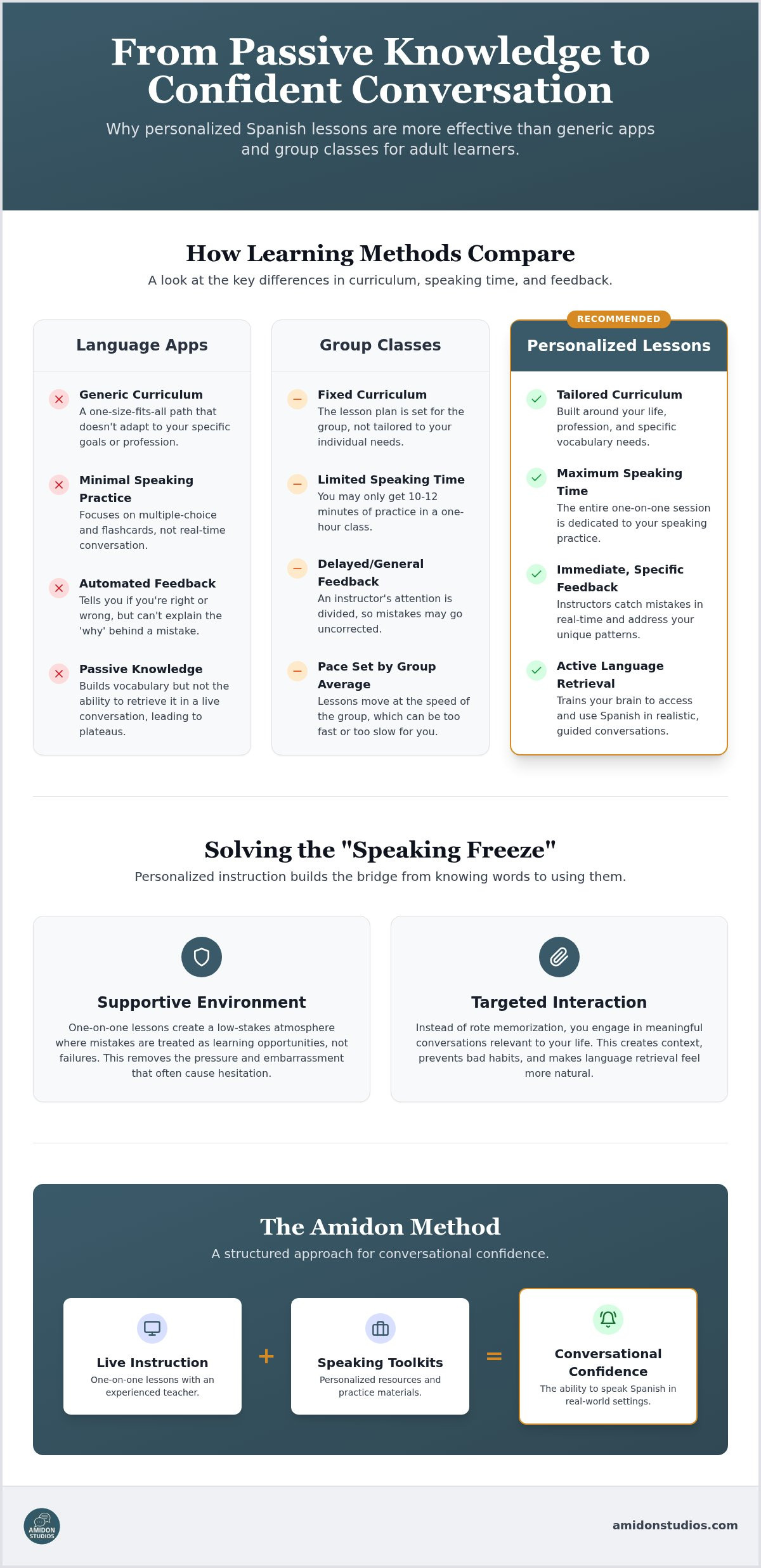
Generic apps provide a sequence that every user follows regardless of their goals. In contrast, personalized Spanish lessons focus on the vocabulary you'll actually use in your daily life.
At Amidon Spanish, an instructor acts as a mentor who identifies your specific language gaps. While an app might tell you that you got a conjugation wrong, it won't explain why you keep making that specific mistake or how it changes the meaning of your sentence in a real conversation.
Our teachers observe your patterns and adjust the lesson plan to strengthen your weak points. This specialized attention ensures you aren't wasting time on concepts you've already mastered while ignoring the hurdles that keep you from speaking clearly.
The Difference Between Vocabulary and Language Retrieval
There is a significant gap between knowing a word and being able to retrieve it during a live conversation. This is the difference between passive and active knowledge. You might recognize the word for napkin on a flashcard, but can you ask for one when you've spilled a drink at a dinner?
An instructor facilitates real-time retrieval practice by putting you in these exact scenarios. Instead of just selecting a multiple-choice answer, you must form the sentence yourself under the guidance of a teacher. This approach is central to the Amidon Method, which treats speaking as a physical skill that requires its own dedicated practice time.
The Benefits of 1:1 Spanish Lessons
One-to-one Spanish lessons give your instructor the ability to focus completely on your individual goals, speaking patterns, and learning pace. If you consistently struggle with the rolling “r” or the difference between “por” and “para,” your teacher can address it as it comes up in conversation. Group classes can also provide valuable opportunities to interact with other learners, but private lessons allow the instructor to tailor the lesson specifically to you and adjust the pace based on what you need.
Solving the Speaking Freeze through Targeted Interaction
That sudden silence when someone asks you a question in Spanish isn't a lack of intelligence. It's often a result of high-pressure environments where the fear of making a grammar mistake outweighs the desire to communicate. In personalized Spanish lessons, we replace that pressure with a low-stakes, supportive atmosphere.
Instead of performing for a grade or a crowd, you're engaging in a one-on-one dialogue where mistakes are viewed as data points rather than failures. This safe environment allows you to test out new phrases and refine your pronunciation without the embarrassment that often comes with public speaking.
Meaningful interaction gives you a chance to use vocabulary and grammar in context. Instead of repeating a sentence from a textbook, you might use a verb to describe your actual weekend plans. This also gives your instructor the opportunity to catch recurring mistakes or awkward phrasing while you're speaking.
Without immediate feedback, it's easy to fossilize incorrect grammar or awkward phrasing. A teacher catches these small slips in real time, ensuring you build a solid foundation for more complex conversations later on.
The Role of the Instructor in Building Confidence
Experienced instructors use a technique called scaffolding to help you move from simple phrases to complex ideas. If you're trying to explain a project at work, your teacher might provide the initial connector words or help you conjugate a difficult irregular verb.
This support allows you to keep the conversation flowing while you're still learning. Over time, the teacher gradually removes these scaffolds as you become more self-reliant. By tracking your progress across multiple sessions, an instructor can show you exactly how much your retrieval speed has improved, which is a powerful motivator for continued practice.
Specialized Support for Heritage Learners
Many adults grew up in homes where Spanish was spoken but never had the chance to develop their own speaking skills. This is known as receptive bilingualism. You might understand your grandmother perfectly, but find yourself responding in English. Personalized instruction is particularly effective for heritage learners because it focuses on reclaiming your voice.
We don't treat you like a beginner who knows nothing; instead, we build on your existing cultural and linguistic intuition. The goal here isn't academic perfection or a specific accent. It's about gaining the conversational confidence to connect with your family and community on your own terms. If you want to see where your current skills stand, you can reach out for a speaking assessment.
Personalized Lessons vs. Generic Marketplaces and Apps
Conversation practice can be incredibly valuable, but conversation alone isn't always the same as personalized instruction. A trained instructor listens for patterns in your Spanish, identifies the areas that are holding you back, and intentionally builds those areas into future lessons. Instead of simply having a different conversation each week, personalized Spanish lessons combine real conversation with a plan for helping you expand what you're able to say.
Standard academic programs often prioritize grammar rules and textbook exercises, assuming that speaking will eventually follow. We take the opposite view.
The Amidon Method focuses on the specific mechanics of language retrieval from day one. While a textbook might spend hours on the history of a specific tense, we focus on how to use that tense to get your point across in a real conversation. This is the difference between studying a language and actually using it.
The Hidden Cost of Unstructured Conversation
The danger of unstructured conversation practice is that you only use the words you already know. You stay in your comfort zone, avoiding the difficult structures that would actually help you grow. A professional teacher identifies these patterns and introduces a curated curriculum designed for adults.
This includes addressing English-Spanish interference, which is when your brain tries to apply English logic or word order to Spanish. For example, many English speakers struggle with the placement of adjectives or the use of object pronouns. An instructor who understands these specific hurdles can provide personalized feedback that a casual tutor might overlook, saving you months of confusion.
Why Apps Cannot Replace Live Spanish Lessons
Apps are excellent tools for building a vocabulary base, but they cannot teach you how to interact with another human being. Speaking is as much a social and physical skill as it is a mental one. It requires reading facial expressions, adjusting your tone, and reacting to unexpected follow-up questions.
Automated platforms lack the nuance and cultural context that a live Spanish lessons provide. An app won't tell you if your phrasing sounds too formal for a family dinner or too blunt for a business meeting. Only a real person can provide the personalized feedback needed to navigate the subtleties of Spanish conversation with confidence.
Creating Your Personalized Learning Plan for Conversational Success
A common reason why adults stop learning Spanish is a lack of direction. You might have a collection of textbooks and a few apps, but without a cohesive strategy, your progress can feel scattered.
While generic marketplaces leave the curriculum up to chance, personalized Spanish lessons provide a structured framework. This framework isn't a rigid academic syllabus. Instead, it's a dynamic personalized learning plan that evolves as you improve. By setting specific, short-term milestones, you can see exactly how your ability to retrieve words is getting faster every week.
Your instructor acts as a strategist who monitors your performance during every session. If a particular grammar concept like the subjunctive is slowing down your speech, the teacher adjusts the plan to provide more targeted speaking practice in that area. This ensures that you aren't just moving through a book, but actually mastering the skills required for fluid conversation. This tailored approach ensures that every hour of personalized Spanish lessons brings you closer to your specific conversational goals.
Step 1: The Initial Speaking Assessment
The process begins with a free speaking assessment at Amidon Spanish. Many learners feel nervous about this step, but it's helpful to remember that this is a conversation, not a high-stakes test. The goal is simply to identify your current level of language retrieval.
We look for the gap between what you understand and what you can actually say. Identifying this starting point prevents the frustration of being placed in a class that is either too simple or too advanced. It allows your teacher to build a personalized instruction path that starts exactly where you are today.
Step 2: Defining Your Personal Speaking Goals
Once we know your starting point, we define what success looks like for you. Success is highly personal. For one student, it might be the ability to handle workplace communication without a translator. For another, it might be the confidence to talk to family members or navigate a solo trip through Mexico.
Within the Spanish Star Program, your teacher selects vocabulary and scenarios that are directly relevant to these objectives. You won't spend time on abstract concepts that don't serve your immediate needs. Instead, your conversation practice will mirror the real-world situations you'll actually encounter.
Starting Your Path with the Amidon Method
The goal of the Amidon Method is to help you move from being a silent observer to an active participant in Spanish conversations. Through consistent interaction and speaking practice, you build the skills you need to retrieve and use the Spanish you already know more easily.
While apps provide a foundation of words, our approach ensures those words are ready for use when you need them. By integrating live Spanish lessons with self-paced speaking toolkits, you create a comprehensive environment for growth.
These toolkits provide the structured materials you need to practice between sessions, ensuring that your time with an instructor is spent on high-value conversation rather than basic vocabulary drills. This transition from passive understanding to active participation is what allows you to finally contribute to a conversation rather than just nodding along.
Following a personalized learning plan means your progress is never left to chance. You move through a sequence that prioritizes the situations you encounter most often, whether that's at a job site, a family gathering, or during international travel.
Because the instruction is tailored to your specific pace, you never feel rushed through a concept you haven't mastered, nor do you feel bored by material that is too simple. This balance is essential for maintaining the momentum needed to reach your conversational goals.
What to Expect in Your First Personalized Lesson
Your first session is designed to be a warm, encouraging introduction to our teaching philosophy. There is no pressure to be perfect or to have every verb tense mastered. Instead, your instructor guides the conversation, providing the necessary prompts to keep you talking.
This immediate feedback loop is a hallmark of personalized Spanish lessons. When you make a mistake, your teacher corrects it gently and in context, ensuring you learn the right way to phrase a thought while the conversation is still fresh in your mind. This real-time adjustment helps you build confidence from the very first hour. You'll find that the instructor focuses on your strengths while identifying the specific areas where your retrieval speed needs a boost.
Frequently Asked Questions
How long does it take to see results with personalized Spanish lessons?
Everyone progresses at a different pace, so there isn't a specific timeframe that applies to every student. With consistent speaking practice, the goal is to gradually make it easier to retrieve the Spanish you already know and use it during real conversations. We focus on your individual progress and conversational goals rather than promising fluency within a set number of weeks or months.
Do I need to know a lot of grammar before I start speaking practice?
You don't need to master complex grammar rules before you begin conversation practice. In fact, learning grammar in isolation often slows down your ability to speak. We introduce specific grammar points as they become relevant to the things you actually want to say. For example, you'll learn how to use the past tense by talking about your actual morning rather than memorizing a chart of endings.
What is the difference between a Spanish teacher and a conversation partner?
A teacher provides a structured framework and professional feedback, whereas a conversation partner usually just chats without a specific plan. While chatting is helpful, an instructor identifies your recurring errors and explains the logic behind them. Our teachers use personalized Spanish lessons to ensure you aren't just repeating the same limited phrases but are actually expanding your ability to express complex thoughts.
Can personalized lessons help if I already understand Spanish but cannot speak it?
Yes, personalized instruction is specifically designed to solve the gap between listening and speaking. This struggle is usually a matter of language retrieval rather than a lack of knowledge. We focus on exercises that force you to pull words from your memory in real time. This practice strengthens the connection between your passive vocabulary and your active speech, helping you overcome the common brain freeze.
How often should I schedule my 1:1 Spanish lessons for the best results?
The right schedule depends on your goals, availability, and how much Spanish practice you're getting outside of your lessons. What's most important is consistency. Regular personalized Spanish lessons give you ongoing opportunities to speak, receive feedback, and continue building on what you've already practiced.
Are online Spanish lessons as effective as in-person instruction?
Online lessons are just as effective as in-person instruction when they are conducted live via video conferencing. The key to success is the real-time interaction and the ability to receive immediate, personalized feedback. Online sessions offer the added benefit of flexibility, allowing you to practice from your home or office. This convenience makes it much easier to maintain the consistent schedule required for conversational growth.
What happens if I get stuck or do not know the word during a lesson?
Your instructor will guide you through those moments by providing the word or helping you describe the concept in a different way. Getting stuck is a natural part of the learning process and a valuable opportunity for growth. Instead of feeling embarrassed, you'll learn strategies for navigating around missing vocabulary. This helps you stay in the conversation and builds the resilience needed for real-world interactions.
How does a personalized learning plan differ from a standard textbook curriculum?
A personalized learning plan focuses on your specific goals and vocabulary needs, while a textbook follows a generic, one-size-fits-all sequence. If you need Spanish for family gatherings, your plan won't waste time on corporate business terminology. We build your curriculum around the scenarios you actually face. This ensures that every lesson is practical and immediately useful, rather than following an abstract academic path.


Comments