
What Makes a Great Online Spanish Class for Kids?
- Jackie Amidon Donaldson

- Aug 26
- 11 min read

If your child can complete 30 minutes on a language app but can't ask for a glass of water in Spanish, the current method likely prioritizes recognition over usage.
It is a frequent occurrence in language learning: a student develops a large passive vocabulary through digital exercises but cannot form original sentences. For parents who do not speak the language, determining why a child isn't progressing toward conversation can be difficult.
Finding effective Spanish classes for kids requires a focus on live interaction and personalized speaking practice. In this article, you will find a framework for selecting a program that emphasizes verbal production.
We'll examine the differences between private and group settings, the qualities of a skilled instructor, and how to maintain a consistent routine at home. By understanding the distinction between studying a language and performing it, you can help your child move toward conversational confidence at Amidon Spanish.
Table of Contents
Why Speaking is a Distinct Skill in Spanish Classes for Kids
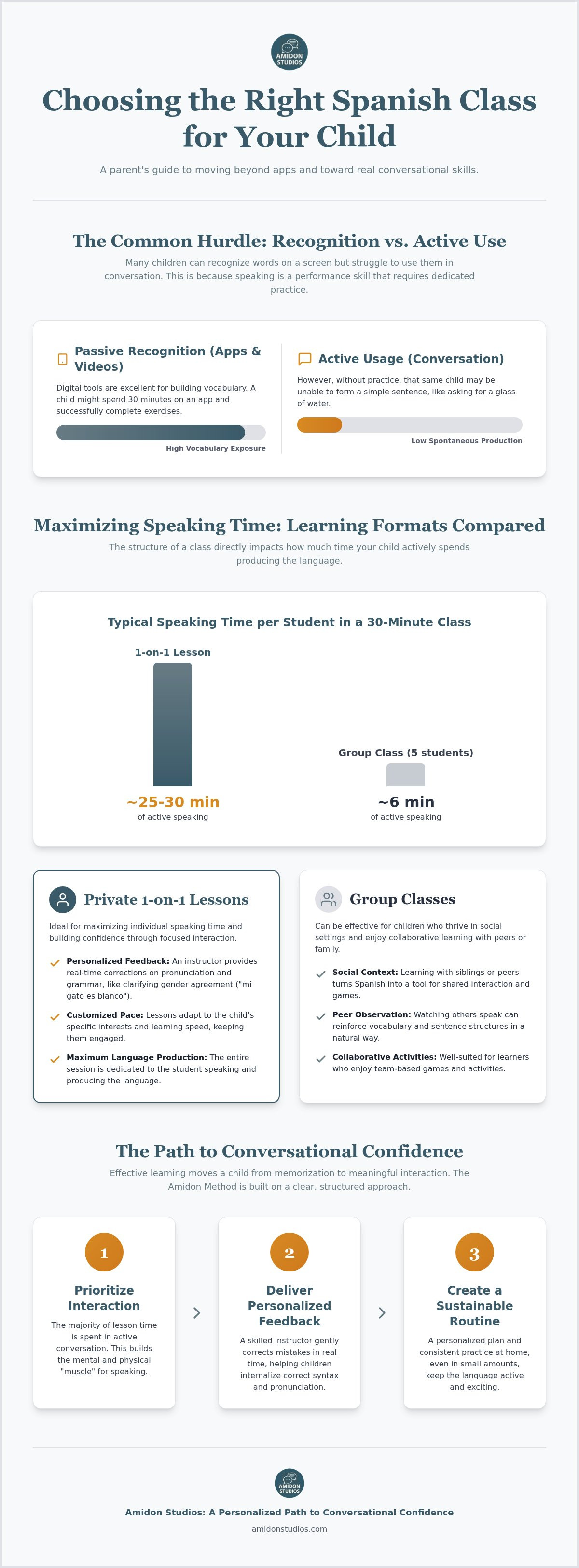
Many children recognize Spanish words on a screen but cannot produce them in a conversation. This occurs because speaking is a performance skill that requires active retrieval.
Effective Spanish classes for kids function as interactive environments where the student spends the majority of the time producing the language. While apps and videos build a foundation of recognition, they do not simulate the real-time demands of a live discussion.
To move beyond passive knowledge, a student must practice the physical and mental act of speaking independently.
The Difference Between Understanding and Speaking
It is common for a student to understand a full sentence but remain silent when asked a question. Listening and speaking involve different cognitive processes. Listening is a decoding task, whereas speaking requires the student to encode their own thoughts into a new structure.
For example, a child might understand a waiter asking, "¿Qué quieres comer?" but struggle to assemble the words for a reply. This transition from passive input to active output is a central part of how children acquire a second language. It requires a teacher who can guide the student through the retrieval process in real time.
Why Grammar-First Approaches Often Stall Progress
Prioritizing conjugation charts and rigid rules can slow down natural speech. When a child focuses heavily on correct verb endings, the rhythm of the conversation is interrupted. We prioritize conversational momentum by encouraging children to use what they know immediately to convey a message.
This approach is fundamental to the Amidon Method at Amidon Spanish. By focusing on meaningful interaction rather than perfect memorization, students develop the ability to navigate real-world situations, such as greeting a neighbor or asking for an item at a store.
Comparing Learning Formats: 1-on-1 Lessons vs. Group Classes
The format of a Spanish class can shape how children practice and interact with the language. One-on-one lessons give the instructor more time to focus on one child’s individual needs, interests, and speaking skills.
Small group or sibling classes offer something different: children can practice communicating with each other and use Spanish together in a shared setting.
Neither format is right for every child or family—the best fit depends on how your child learns and who they’ll be learning with. This gives the child more opportunities to practice retrieving Spanish and responding in real time.
The Benefits of Private 1:1 Spanish Lessons
In live 1:1 Spanish lessons, the instructor adapts the material to the child’s specific interests and pace. This setting is ideal for delivering personalized feedback in real time.
For example, if a child is describing a pet and says, "mi gato es blanca," the teacher can immediately explain gender agreement by pointing out that "gato" is masculine.
This focused interaction allows the child to make frequent attempts at speech without the distractions of a larger group, which leads to more consistent progress in conversation practice.
When Group Classes Make Sense for Families
Group settings provide a social context that some children find useful for learning. Observing peers use the language can reinforce vocabulary and sentence structures through shared experience.
Our Spanish for Family Program at Amidon Spanish allows siblings to learn together, turning the language into a tool for household interaction. This format works well for children who prefer collaborative activities, such as playing a vocabulary-based game or describing a shared image to one another.
A personalized learning plan ensures that your child stays on a productive path regardless of the chosen format. If you are deciding which environment would best support your child's progress, you can reach out for a consultation to discuss their specific learning style.
How to Identify a Quality Spanish Instructor for Your Child
Choosing the right teacher is about more than finding someone who grew up speaking the language. While native fluency is a wonderful asset, it doesn't automatically translate into teaching ability.
When you're researching Spanish classes for kids, look for an instructor who understands how to bridge the gap between two different linguistic structures. A great teacher knows the specific hurdles English-speaking children face, such as the confusion between "ser" and "estar" or the difficulty of rolling an "r." They should be patient, empathetic, and capable of creating a space where your child feels comfortable taking risks.
Native Fluency vs. Teaching Ability
Knowing a language is an intuitive act, but explaining its mechanics to a child is a specialized skill. The best instructors don't just lecture; they facilitate. They prioritize your child’s speaking time, ensuring that the student is the one doing the heavy lifting during live Spanish lessons. This active engagement gives your child the practice they need to become more comfortable using Spanish in real conversations.If a teacher spends the whole session talking while the child just listens, the child isn't actually practicing the skill of speaking.
The Importance of Personalized Feedback
Generic praise like "very good" or "well done" is nice for morale, but it doesn't help a child grow. Effective Spanish classes for kids rely on personalized feedback that is immediate and constructive.
If your child says "La gato es negro," a skilled instructor will gently guide them toward the correct gender agreement without making them feel discouraged. This targeted approach helps children stop translating word-for-word in their heads and start forming thoughts directly in Spanish.
The Amidon Method emphasizes this type of interaction to build conversational confidence rather than just memorizing lists.
Finally, consider the value of consistency. A child who works with the same teacher every week develops a sense of trust that makes them more willing to try new phrases. This relationship allows the instructor to refine a personalized learning plan based on the child's progress, strengths, and interests.
When a teacher knows your child loves space or soccer, they can weave those topics into the conversation practice, making the experience feel less like a school subject and more like a genuine connection.
How to Create a Sustainable Spanish Speaking Routine at Home
Many parents worry that they can't support their child's language journey because they don't speak Spanish themselves. This is a common concern, but you don't need to be fluent to be an effective partner in your child's learning.
Your role isn't to be a second instructor. Instead, you're creating an environment where the language feels natural and useful. When children see that Spanish exists outside of their Spanish classes for kids, they begin to view it as a living tool rather than just a school subject. This shift in perspective is what helps them move from passive learning to active participation.
Incorporating Spanish into Daily Activities
Start with small, low-pressure changes that don't feel like extra homework. One of the simplest methods is labeling common household items. Placing a sticky note that says "la puerta" on the door or "la mesa" on the kitchen table provides a constant visual cue.
You can also implement a 15-minute rule where you listen to your child describe their snack or a favorite toy using the words they've learned.
Even if you only respond with "¡Qué bien!" or "¡Excelente!", you're validating their effort and showing that their new skill has real-world value.
Another great strategy is watching familiar cartoons in Spanish. Since your child already knows the plot of their favorite show, they can focus on the sounds and rhythms of the language without getting lost in the story.
It's important to set realistic expectations for progress. Fluency is a long-distance run, not a sprint. Some weeks your child will be eager to talk, and other weeks they might be tired or less communicative.
That's okay. Consistency matters more than intensity. By keeping the routine light and integrated into things they already enjoy, you prevent burnout and keep their excitement alive. This steady approach ensures that the language becomes a permanent part of their life rather than a temporary phase.
Spanish for Kids and Families at Amidon Spanish
At Amidon Spanish, speaking is the priority. Many kids come to us already knowing quite a bit of Spanish. They may recognize vocabulary, understand grammar, or do well on written assignments, but still struggle to answer a question when someone speaks to them in Spanish. Our lessons focus on closing that gap by giving kids consistent opportunities to actually use what they know in conversation.
The Amidon Method for Families
The core of our approach is the Amidon Method. This isn't about rote memorization or repetitive drills. Instead, we move kids from passive understanding to active speaking by focusing on real-life conversational scenarios. Whether your child is enrolled in our Spanish for Kids, Mommy & Me Spanish, or the Spanish for Family Program, our experienced teacher acts as an empathetic guide.
They provide the personalized feedback necessary to build confidence without the pressure of a traditional classroom. We want your child to feel that they can express their thoughts and personality in Spanish, just as they do in English. By focusing on the human side of communication, we help children overcome the language retrieval hurdles we discussed earlier.
Starting with a Personalized Learning Plan
Every child’s path to fluency looks different. That’s why we start every journey with a free speaking assessment. This isn’t a stressful exam; it’s a friendly 15-minute conversation with one of our instructors.
During this time, we look at what your child already knows and identify where they need the most support. From there, we create a personalized learning plan that tailors the lessons to their current level, interests, and long-term goals. This plan serves as a roadmap that evolves as your child grows, ensuring that the material remains challenging but accessible.
Our live online lessons offer the flexibility that busy modern families need. Whether you're balancing soccer practice or school projects, our Spanish classes for kids fit into your schedule, providing consistent practice without the commute. We handle the strategy and the instruction, so you can focus on cheering your child on as they gain conversational confidence.
This steady, personalized path ensures that the language becomes a permanent skill rather than a fleeting school requirement. The first step toward seeing your child hold a real conversation is understanding where they are starting.
Ready to help your child start speaking more Spanish? Schedule a free speaking assessment so we can learn what they already know, where they're getting stuck, and what kind of support would help them move forward.
Building a Future of Conversational Confidence
Choosing the right environment for your child means looking past the flashiness of digital apps and focusing on real human interaction. We've seen that when children engage in consistent conversation practice, they stop viewing Spanish as a subject and start seeing it as a way to connect with others.
By prioritizing speaking and providing a personalized learning plan, you give your child the tools they need to actually use the language in the real world rather than just recognizing words on a screen.
Our approach at Amidon Spanish is built on over a decade of teaching experience. We understand that every student's path is unique, which is why we focus on individual progress and real-life conversational confidence rather than a rigid, one-size-fits-all curriculum.
Finding the right Spanish classes for kids is the first step toward a lifetime of bilingual possibilities and meaningful connections.
We are here to help your family find a rhythm that works for your schedule and your child's personality. It's a joy to see a child realize they can truly be understood in a second language, and we look forward to helping them take that next step.
Frequently Asked Questions
How do I choose the best Spanish classes for my child?
Focus on programs that prioritize live interaction and verbal production over passive listening. You should look for one-on-one Spanish lessons where your child is encouraged to do most of the talking. A quality program will offer a personalized learning plan that adapts to your child’s specific interests and current level. Avoid classes that rely heavily on repetitive grammar worksheets or recorded videos without a live teacher.
Are online Spanish classes effective for young children?
Yes, online lessons are highly effective when they are live and interactive. Digital platforms allow for a level of focused, individual attention that is often lost in a physical classroom with many students. When your child participates in Spanish classes for kids online, they interact with an instructor in real time. This direct engagement is essential for developing the distinct skill of speaking and building conversational confidence.
What is the best age for a child to start learning Spanish?
Children can start learning at any age, but starting early allows them to absorb the sounds and rhythms of the language more naturally. Many families begin with short, engaging sessions for children as young as four or five. The goal at a young age is to build a positive association with the language through conversation practice and meaningful interaction rather than through formal academic study or rigid testing.
Do I need to speak Spanish for my child to succeed in classes?
No, you do not need to be a Spanish speaker yourself for your child to find success. Your primary role is to provide encouragement and help them maintain a consistent routine. By showing interest in what they learn during their live Spanish lessons, you validate their effort. This support helps them see the language as a valuable tool for connection rather than just another school assignment.
How long does it take for a child to speak Spanish fluently?
Fluency is a long-term goal that depends on the frequency of practice and each child’s individual pace. It is more helpful to focus on conversational milestones, such as being able to introduce themselves or describe a favorite toy. Consistent speaking practice over several months leads to a noticeable increase in confidence. We prioritize steady progress through a personalized path rather than making unrealistic promises about a specific timeframe.
What is the difference between immersion and traditional Spanish classes?
Immersion focuses on using the language to communicate in real-life situations, while traditional classes often prioritize memorizing grammar rules and vocabulary lists. In an immersion style setting, the teacher uses Spanish as the primary tool for interaction. This approach helps children stop translating word for word in their heads. Instead, they learn to form thoughts directly in Spanish through consistent practice and personalized feedback.
Can my child learn Spanish if we do not live in a Spanish-speaking area?
Absolutely, because live online lessons make high quality instruction accessible from anywhere. You don't need to live in a bilingual community to provide your child with an immersive experience. By engaging in regular Spanish classes for kids, your child gets the necessary interaction that might be missing locally. This consistent exposure to a live instructor ensures they develop strong speaking skills regardless of your physical location.
What should I look for in a trial Spanish lesson?
Look for how much your child actually speaks during the session. A good trial lesson should feel like a natural conversation rather than a lecture. Pay attention to whether the instructor provides personalized feedback and if they adapt to your child’s personality. This initial interaction is a great way to see if the teacher’s style and the personalized learning plan will keep your child engaged and excited about learning.


Comments