
Spanish Speaking Strategies for Adults: How to Break the Silent Period in 2026


Why is it that you can lead a complex project at work, yet you feel like a nervous child when trying to order dinner in Spanish?
If you can understand the news but freeze during a simple chat with a neighbor, you aren't alone. Many of the 59 million Spanish speakers in the United States today are adults navigating this exact plateau.
Finding the right Spanish-speaking strategies isn't about grinding through more vocabulary lists. It's about overcoming the psychological hurdles of receptive bilingualism and learning to trust your voice in real-time social interactions.
It’s exhausting to feel like your professional, adult personality disappears the moment you open your mouth. We understand that frustration. In this article, you'll discover empathetic, science-backed strategies to move from passive understanding to confident, real-life Spanish conversation.
We'll break down how to manage performance anxiety, use retrieval practice to speed up your response time, and provide a clear roadmap to help you connect with family and friends in their native tongue with ease.
Table of Contents
Why Adults Understand Spanish but Struggle to Speak It
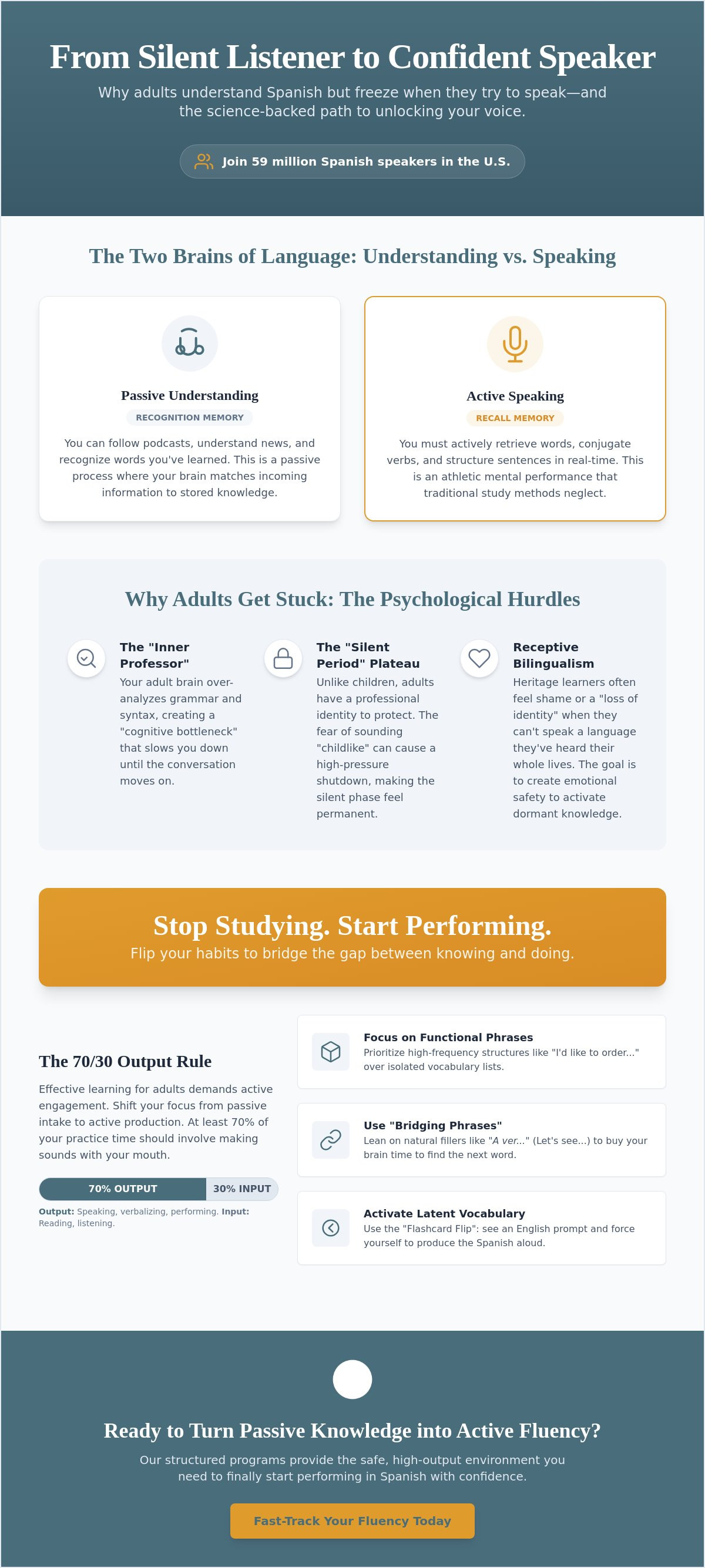
Have you ever listened to a Spanish podcast and understood every word, only to freeze when a barista asks you a simple question? It’s a common, frustrating gap. This happens because your brain uses two completely different systems for language.
Recognition memory allows you to understand what you hear; it’s a passive process. Recall memory, however, requires you to actively pull words from your brain and assemble them in real time. Most traditional education systems focus almost entirely on recognition. They bury you in grammar workbooks and reading exercises that don't translate to verbal speed. While these methods help you pass a written test, they fail to provide effective Spanish speaking strategies for adults who need to function in the real world.
The "Silent Period" is a documented phase in second-language acquisition where learners internalize the language before they are ready to produce it. For adults, this phase often feels like a permanent plateau.
Unlike children, we have a sophisticated professional identity to protect. When we can't express our complex thoughts in Spanish, we feel childlike or less than. This perceived threat triggers a stress response. In high-pressure social situations, your brain’s language center can actually shut down as it prioritizes survival over syntax.
The Science of the 'Brain Freeze'
Your brain isn't broken; it's simply over-functioning. While children have high neuroplasticity that allows them to mimic sounds without fear, adults rely more on logic and existing patterns. When you try to speak, your Inner Professor starts checking every grammar rule. This overthinking creates a cognitive bottleneck.
By the time you've verified the correct verb ending, the conversation has already moved on. Shifting your Spanish speaking strategies for adults toward flow over perfection is the only way to bypass this logic gate and reduce the amygdala's interference.
Receptive Bilingualism and Heritage Learners
Many adults grew up in homes where Spanish was the background music of their lives, yet they never spoke it themselves. This is known as receptive bilingualism. It carries a unique emotional weight that traditional learners don't always face. You might feel a deep sense of shame or a loss of identity when you can't respond to a family member in their native tongue.
Reclaiming your language isn't just about vocabulary; it’s about emotional safety. You already have the sounds and rhythms stored in your subconscious. The goal is to move those dormant memories into your active speech by creating low-stakes environments where your personality can finally translate into Spanish.
Bridging the Gap: Transitioning from Passive to Active Spanish
Stop studying Spanish. Start performing it. Most adults spend years as collectors of grammar rules and vocabulary lists, yet they remain silent when it’s time to speak. This happens because studying is a passive intake of data, while speaking is an athletic performance of the mouth and mind. To break the silent period, you must flip your current habit on its head.
Research into effective teaching strategies for adult learners shows that active engagement is the only way to move information from short-term recognition to long-term recall. You need an input-to-output ratio where at least 70% of your practice time involves making sounds with your mouth, not just reading with your eyes.
One of the most powerful Spanish speaking strategies for adults is to prioritize functional phrases over isolated word lists. Don't waste time memorizing 50 types of fruit if you can't yet say "Me trae un..." (I'd like a...) or "Me puedes ayudar?" (Can you help me?).
These high-frequency structures act as the skeleton of your speech. To buy your brain time during a real conversation, lean on bridging phrases.
Using fillers like "Lo que pasa es que..." (The thing is...) or "A ver..." (Let’s see...) makes you sound more natural while giving your neurons a second to find the next word.
If you feel stuck in the "study" phase, exploring private 1:1 Spanish lessons can provide the safe, high-output environment you need to start performing.
Activating Your Latent Vocabulary
You likely know more Spanish than you think; it’s just dormant.
Use the "flashcard flip" to wake it up. Instead of looking at a Spanish word and translating it to English, look at an English prompt and force yourself to produce the Spanish equivalent aloud. Verbalize your daily routine as you do it.
Say "Tomo un cafecito" while you enjoy your morning cup. This builds muscle memory and uses "sentence starters" to reduce the cognitive load of starting a thought from scratch.
Thinking in Spanish: The Internal Monologue
To stop translating in your head, you must bring Spanish into your private thoughts. Try the narrator strategy. Spend five minutes a day describing your surroundings out loud like a documentary filmmaker. Start simple with nouns and colors: "El gato es blanco." As you get comfortable, increase the complexity to include feelings or abstract thoughts. This habit trains your brain to bypass the English "middleman," which is one of the most effective Spanish speaking strategies for adults looking for true fluency.
5 Daily Spanish Speaking Habits for Busy Adults
How do you fit language learning into a calendar that’s already bursting at the seams? You don't need a three-hour block of time to see progress. You need consistency. Successful Spanish-speaking strategies for adults thrive on small, intentional bursts of activity rather than marathon study sessions once a week. By habit stacking your Spanish practice onto existing routines, you can transform your commute or your morning coffee into a powerful learning lab.
The 15-Minute Rule is your best friend here. It’s better to speak for 15 minutes every single day than to study for two hours on a Sunday. This frequency keeps your neural pathways primed for retrieval.
During this time, try shadowing. This involves listening to a native speaker and repeating exactly what they say as they say it. You aren't just learning words; you’re training your mouth to move at the right speed and rhythm. Integrating this into your household chores or commute makes the practice feel less like a chore and more like a natural part of your day.
Another game-changer is the Voice Memo feedback loop. Record yourself talking about your day for 60 seconds. Listen back. You’ll notice patterns you didn't catch in the moment, like hesitating before certain verb tenses. It’s not about self-criticism. It’s about data. Analyzing your own speech helps you identify exactly where your passive knowledge is failing to become active output.
This is one of the most effective Spanish speaking strategies for adults because it builds self-awareness without the pressure of a live audience.
The Power of Rehearsed Role-Play
Think about the situations that cause you the most anxiety. Is it the grocery store? A client meeting? A family dinner? Create "survival scripts" for these exact moments.
Memorizing whole chunks of language is much more effective than trying to conjugate on the fly when you're under pressure. If you forget a word, practice your "recovery" phrases. Saying "¿Cómo se dice...?" {how do you say...?) or "Se me fue la palabra" (the word escaped me) keeps the conversation moving and prevents the dreaded brain freeze.
Leveraging Digital Toolkits for Independence
While live interaction is vital, you also need tools for those moments between sessions. See how our Spanish Digital Courses & Toolkits provide the structure you need to practice independently.
These audio-based drills sharpen your ear-to-mouth connection, ensuring you're ready for your next live conversation.
Using a toolkit allows you to repeat difficult sounds as many times as you need without judgment, building the confidence required for real-world interactions.
Overcoming Speaking Anxiety: Psychological Strategies
Why is it that a successful professional can lead a high-stakes boardroom meeting but feels paralyzed when saying "hola" to a neighbor?
Speaking anxiety isn't a sign of weakness; it’s a sign that your brain is trying to protect your adult identity. When you speak a new language, you lose the nuance and sophistication you've spent decades building in English. This vulnerability is the biggest barrier to progress. To move forward, your Spanish-speaking strategies for adults must address the mind as much as the mouth.
The first step is identifying your Inner Professor. This is the internal voice that demands perfect grammar before you’ve even finished a sentence. It’s the critic that makes you pause to check a subjunctive conjugation while the conversation moves past you. You have to fire the professor.
Instead, start treating every mistake as a data point. If you use the wrong gender for a noun, you haven't failed. You’ve simply identified a specific area for future adjustment. Reframing errors as neutral feedback lowers the stakes and allows you to stay present in the interaction.
Setting micro-goals is another essential tool. Don't aim for a deep philosophical debate on your first day. Instead, set a goal to simply use one new phrase or to ask one follow-up question. These tiny wins build a track record of success that eventually outweighs the fear.
If you want to overcome your fear of speaking Spanish, you need to practice in a safe space first. This is where a non-judgmental coach comes in, acting as a buffer between your current level and the high-pressure real world.
The Perfectionism Trap in Adult Learners
High-achieving adults often struggle the most with the beginner phase because they aren't used to being bad at things. You have to give yourself permission to have a B-conversation.
Aiming for an A+ on day one is a recipe for silence. In fact, some of the most effective Spanish-speaking strategies for adults involve making intentional mistakes. Try saying something slightly wrong on purpose in a low-stakes setting. You’ll quickly realize that the world doesn't end and people still understand you. This habit desensitizes the fear of being imperfect.
Building Social Confidence Through Live Coaching
Think of 1:1 Spanish sessions as a fluency lab. This is your chance to test new phrases and explore your personality in Spanish without any social consequences.
A great coach doesn't just correct your grammar; they provide the empathy needed to help you feel seen and supported. When you feel safe, your brain stays out of survival mode and remains in learning mode.
Ready to trade your anxiety for action? You can book private 1:1 Spanish lessons today to start building the confidence you deserve.
Fast-Tracking Fluency with the Spanish Star Program
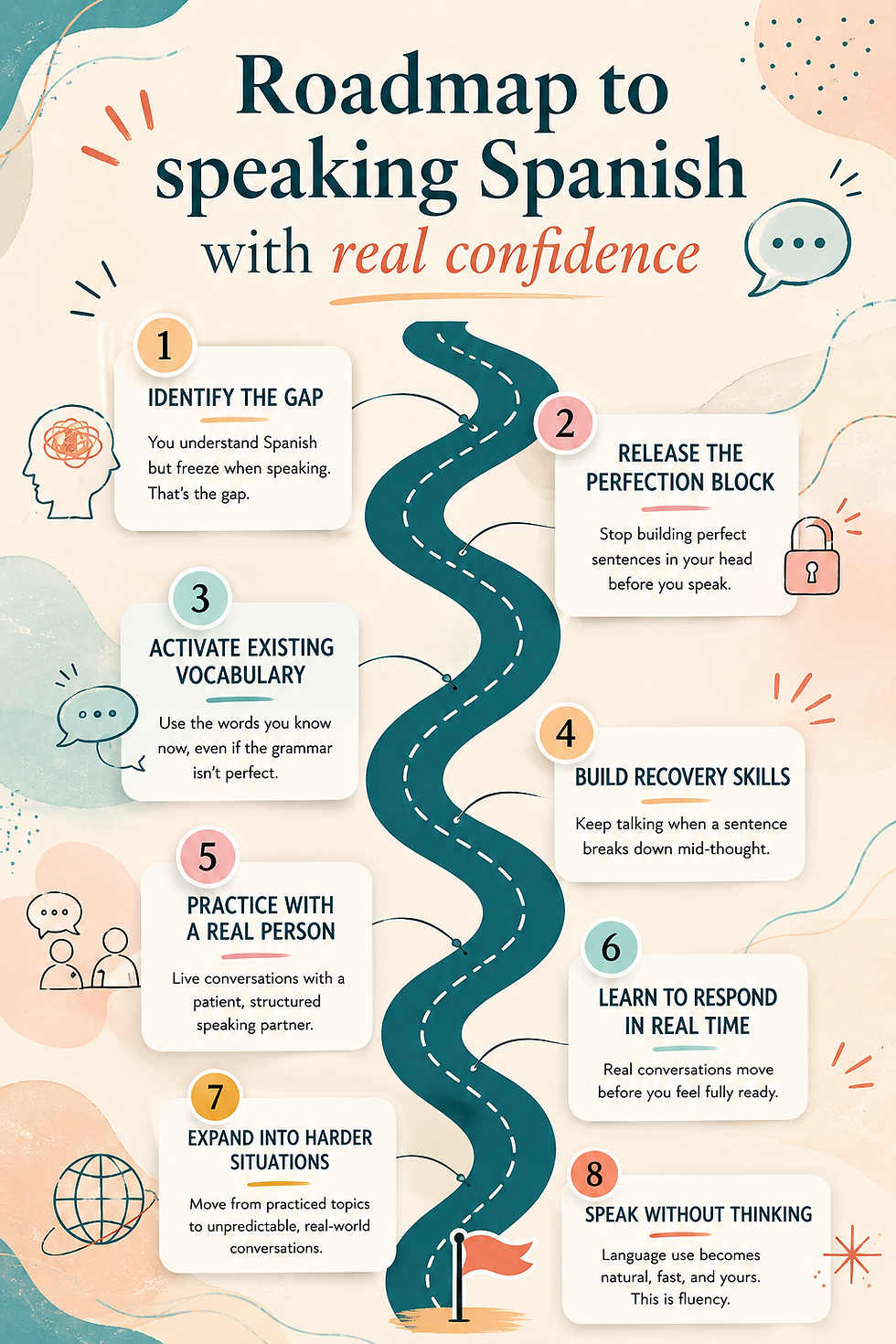
You’ve learned the science behind the "brain freeze" and the daily habits needed to build muscle memory. Now, you need a map. While solo study and apps are helpful for building a foundation, they often leave you stranded in the Silent Period. Apps don't talk back. They can't sense your hesitation or help you navigate the unique emotional hurdles of adult learning.
The Spanish Star Program is designed to change that. It is a structured, 90-day roadmap created to turn your passive knowledge into active, real-world conversational confidence. By utilizing targeted Spanish-speaking strategies for adults, we help you stop collecting words and start using them.
The journey begins with a Free Assessment. This isn't a stressful exam; it’s a strategy session. We identify your specific passive gaps and determine exactly where your recognition is high, but your recall is lagging.
From there, we build a success plan tailored to your life. Whether you are looking to connect with heritage roots, lead a bilingual team, or simply travel without panic, having a professional coach ensures you aren't shouting into a void. It’s about moving beyond the screen and into genuine human connection.
A Personalized Plan for Your Unique Goals
Generic tutoring or teaching often feels like a repeat of high school Spanish. You deserve a more strategic approach. Our 1:1 coaching focuses on your specific world. If you need Spanish for your profession, we don't spend time on irrelevant vocabulary.
We build your survival scripts around the conversations you actually have. This personalized focus is one of the most powerful Spanish-speaking strategies for adults because it ensures every minute of practice is relevant.
Unlike group classes where you might only speak for a few minutes, our private sessions are a fluency lab where you are the primary performer.
Real Results: From Silent to Speaking in 90 Days
Transformation doesn't happen overnight, but it does happen with a plan. We've seen countless professionals reclaim their voices and finally feel like their true personalities translate into Spanish.
Here is what you can expect from the 90-day roadmap:
The First 30 Days: We focus on breaking the silence. You’ll master high-frequency bridging phrases and start verbalizing your daily routine to lower speaking anxiety.
The 60-Day Mark: You’ll move into "flow mode." We’ll work on scripted scenarios for your most common real-life interactions, reducing your reliance on mental translation.
The 90-Day Goal: Conversational confidence. You’ll have the tools to navigate social interactions, order at restaurants, and connect with family without the "Inner Professor" holding you back.
You don't have to stay stuck in the plateau of receptive bilingualism. With the right coach and a proven strategy, you can finally speak the language you've worked so hard to understand.
Ready to take the first step? Book your free assessment today and let's start building your voice together.
Step Into Your Next Conversation with Confidence
You’ve spent enough time as a silent observer. You now know that moving from passive understanding to active speech isn't about memorizing more rules; it’s about retuning your brain for performance.
By quieting your Inner Professor and committing to daily output habits, you are finally giving your voice the space it needs to grow.
These Spanish-speaking strategies for adults are the tools you need to stop feeling like a spectator in your own social life.
With 15 years of experience in adult language education, we specialize in helping professionals like you find their flow. Our personalized 1:1 coaching plans are built to take you from hesitation to conversational confidence within 90 days.
You don't have to stay stuck on the plateau of receptive bilingualism any longer. It's time to bridge the gap and start connecting with the people who matter most in their native tongue.
Start your 90-day journey to Spanish fluency; Book your Free Assessment!
Your personality doesn't have to get lost in translation. We're here to help you find it and share it with the world. Let's start talking.
Frequently Asked Questions
Why is it easier to understand Spanish than to speak it?
Understanding is a passive recognition task, while speaking is an active recall task. Your brain can recognize a word it hears without having the neural strength to pull that same word from memory during a fast conversation. This gap exists because most learners spend the majority of their time consuming content rather than producing it. You need to shift your focus to active production to bridge this divide.
How long does it take for an adult to start speaking Spanish confidently?
You can reach a level of conversational confidence in about 90 days with a structured, high-output approach. While total fluency takes longer, three months of consistent practice allows you to handle most daily social interactions. The key is focusing on functional phrases rather than trying to master the entire dictionary at once. Consistency during this period is much more important than the total number of hours studied.
Can I learn to speak Spanish if I don't have anyone to talk to at home?
Yes, you can build speaking skills independently by using techniques like shadowing and verbalizing your daily routine. Narrating your actions out loud as you do them builds the necessary muscle memory for speech. You can also supplement this solo work with targeted coaching to get the live feedback you need for social confidence. Many successful learners build their foundation alone before testing it in the real world.
What are the best Spanish-speaking tips for adults with busy schedules?
The most effective Spanish-speaking strategies for adults with limited time involve habit stacking short sessions into your existing routine. Try shadowing a podcast during your commute or recording 60-second voice memos about your day while doing household chores. These micro-sessions keep your brain primed for retrieval without requiring a dedicated hour of study. Small bursts of daily output are far more effective than one long weekly session.
Is it too late to learn to speak Spanish fluently as an adult?
It is never too late to become fluent; your adult brain actually has advantages in logic and pattern recognition that children lack. While you might not develop a native accent, you can absolutely achieve a high level of professional and social fluency. Success at this age depends more on your strategy and consistency than on your birth date. Many adults find that their life experience makes them more efficient learners.
How can I stop translating from English to Spanish in my head?
You stop translating by learning to associate Spanish words directly with images and actions rather than English equivalents. Practice describing your surroundings out loud using simple sentences without looking for an English bridge. Over time, these direct associations become automatic, allowing your internal monologue to shift into Spanish naturally. It takes practice to bypass the English middleman, but the results are worth the effort.
What is the 'Silent Period' and how do I break out of it?
The Silent Period is a natural phase where you internalize language before you feel ready to produce it. You break out of it by intentionally lowering the stakes and practicing low-pressure output. Start by using rehearsed survival scripts in controlled environments to prove to your brain that it is safe to speak. This transition requires a conscious shift from being a passive listener to being an active performer.
Do I need to master grammar before I start practicing speaking?
No, you should start speaking long before you master grammar to avoid the perfectionism trap. Effective Spanish-speaking strategies for adults prioritize communication over correctness. People will understand you even with a few wrong verb endings; the act of speaking actually helps you internalize those very grammar rules more deeply. Perfection is the enemy of progress when you are trying to build conversational flow.


Comments