
Spanish Speaking Habits: A Routine You Can Keep


You mean to practice Spanish during the week, but it's easy to reach your next lesson and realize you haven't said much aloud since the last one. Maybe you listened to a podcast or reviewed vocabulary. Finding a regular moment to speak was the part that didn't happen.
Spanish speaking habits are easier to fit into your life when you know exactly what you'll do, when you'll do it, and what counts on a busy day. You don't need a complicated schedule. Start with one small speaking task you can return to.
Build Spanish speaking habits around a moment you already have
“I'll practice more” leaves you with another decision to make every day. A specific cue gives you a place to begin: after making tea, after lunch, or before closing your laptop.
Pair that moment with a task you can name in one sentence. For example: “After making tea, I'll say what I have planned for today.” Keep your notes nearby if you need them.
You might say: “Hoy tengo una reunión a las diez. Después voy a sacar a pasear al perro.” That means, “Today I have a meeting at ten. Afterward, I'm going to walk the dog.”
Choose a cue that fits your actual week. If mornings are unpredictable, an evening routine may be easier to keep. The useful habit is the one you can return to.
Decide what counts on a busy day
Give yourself a shorter version before you need it. Your usual practice might take ten minutes, while your busy-day version is answering one question aloud.
For example, answer “¿Qué hiciste hoy?” with two or three sentences about your day. If you have more time, add a detail or explain why something happened. If you don't, you've still used some Spanish.
Missing a day doesn't require a catch-up session. Resume at your next planned moment. If you keep missing the same session, adjust the time or make the task smaller.
Try a flexible 15-minute speaking routine
Fifteen minutes is one possible practice window. You can shorten or expand it to fit your day. The point is to choose the task beforehand so you can spend the time using Spanish.
Minutes 1–3: choose one question
Pick something you could discuss with another person: What did you do this weekend? What are you making for dinner? What would you like to do on your next trip?
Look up a word or phrase you need, then make a short note. Keep the prompt narrow enough that you can answer with the Spanish you know.
Minutes 4–8: answer aloud
Give your answer without writing a complete script first. Pause when you need to, check a useful phrase, and continue. You're practicing expressing a message, so your answer doesn't need to fill all five minutes.
If you get stuck, simplify. “Preparé pollo con arroz” communicates what you cooked even if you don't yet know how to describe every ingredient.
Minutes 9–12: change one detail
Return to the topic with a different question. After describing dinner, explain who you ate with or what you'll make tomorrow. This gives you a reason to adapt your language instead of repeating the same answer from memory.
Minutes 13–15: save something for next time
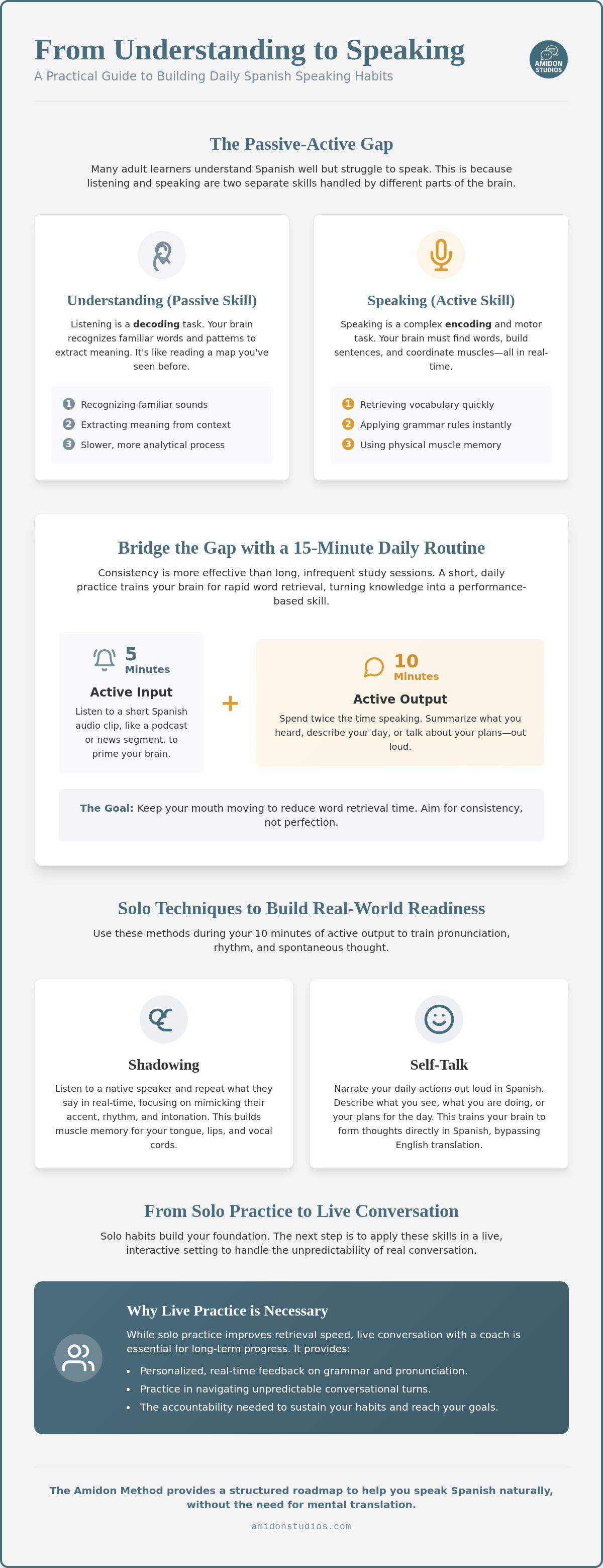
Note one phrase you wanted and one thing you managed to explain. Use the phrase in a new sentence before you finish. It can become your starting point for the next session.
For help choosing a topic that connects with your goals, use our guide to building a Spanish learning plan around your actual goals.
Use listening as a starting point for your own answer
Shadowing means repeating along with a speaker to practice the sounds and rhythm of a short passage. You can include it if it's useful to you, but add a moment to say something of your own.
For example, listen to a short clip about someone's weekend. Repeat a phrase you want to practice, then describe your own weekend using that phrase. Choose a section you understand, and pause the audio when you need to.
Keep the language you'll use again. Our guide to learning Spanish vocabulary without long word lists shows how to save useful phrases with examples from your own life.
Make room for another person's questions
Talking to yourself lets you practice putting an answer together. A conversation adds someone else's questions, reactions, and ideas. Include opportunities for both when you can.
Bring a topic you've practiced to a lesson or language exchange. Ask your partner a related question, listen to their answer, and follow up on something they said.
Suppose you've practiced talking about meals. You could ask, “¿Qué te gusta cocinar?” If they mention a dish you don't know, ask, “¿Qué lleva?” That means, “What ingredients does it have?” Now the exchange has a direction you didn't script.
If you're practicing independently between conversations, our guide to practicing speaking Spanish alone between lessons has more activities you can adapt.
Track what you can do with your Spanish
A checkmark can show that you practiced. Add a brief note about what happened: “I described my weekend without reading,” “I asked a follow-up question,” or “I explained a word I couldn't remember.”
Every few weeks, return to an earlier prompt. Notice what feels easier and what still needs attention. You might give more detail, need your notes less often, or find it easier to continue after a pause.
Use those observations to choose your next task. If describing your weekend is becoming familiar, try telling a longer story or asking someone about theirs.
Frequently asked questions
Do I have to practice speaking Spanish every day?
No. Choose a schedule you can return to. A few planned speaking sessions during the week may fit your life better than a daily commitment you keep missing.
Is 15 minutes enough to practice speaking Spanish?
Fifteen minutes gives you time for a focused task, such as answering a question, changing a detail, and reviewing a phrase. What you practice and how it connects with your goals matter, too. It isn't a guaranteed timeline for fluency.
What should I do if I forget a word?
Try describing it with words you know, asking for help, or checking it and continuing. For example, “Es algo que uso para…” means “It's something I use to…” Save the word afterward if it's useful to you.
Should I correct every mistake while I practice?
Choose a focus for the session. When you're practicing telling a story, you can note questions to check afterward instead of stopping at every uncertainty. In a lesson, ask your teacher to help you choose which corrections to work on.
What if I miss a week of practice?
Return with a small, familiar task. You don't need to make up every missed session. If your schedule has changed, choose a new practice time and a shorter version you can manage.


Comments