
Master Your Voice with Advanced Conversational Spanish Lessons for Intermediate Speakers


Do you understand Spanish but freeze when it's your turn to speak? Many intermediate learners reach a point where listening and reading feel comfortable, but real conversations still seem overwhelming.
In this article, you'll discover why this happens, how to move beyond the intermediate plateau, and practical strategies to turn passive understanding into confident, natural Spanish conversations through consistent speaking practice and personalized coaching.
Understanding the Intermediate Plateau: Why You Understand Spanish but Can’t Speak It Yet
Many intermediate Spanish speakers share a common, frustrating experience: you can follow a movie, understand a podcast, and read an article with relative ease, but when it’s your turn to speak, the words don’t come. You might find yourself searching for basic vocabulary or defaulting to simple sentences, feeling that your speaking ability is years behind your comprehension.
This isn't a sign of failure; it's a well-documented stage in language acquisition often called the intermediate plateau.
The core of the issue is the difference between receptive and active language skills. Understanding spoken or written Spanish is a receptive skill. It involves recognition—your brain matches the sounds and words you hear to the vast library of vocabulary and grammar you've stored.
Speaking, on the other hand, is an active skill. It requires recall and production—your brain must search for the right words, assemble them into a grammatically correct sentence, coordinate the muscles in your mouth to form the sounds, and do it all in real-time. It’s a far more demanding cognitive process.
This gap is normal. It’s not a reflection of your intelligence or your aptitude for languages. It’s a sign that your learning has been heavily weighted toward input, and now it’s time to focus on developing the separate skill of output.
The Science of Passive vs. Active Vocabulary
Think of your vocabulary as two different libraries. Your passive (or receptive) vocabulary is a massive public library where you can easily find and recognize almost any book on the shelf. When a native speaker says a word, your brain quickly locates it.
Your active (or productive) vocabulary is a much smaller, personal bookshelf containing only the books you've written yourself. To speak, you have to "write the book" from memory, a much slower and more difficult task.
Traditional learning methods, like textbook exercises and grammar drills, are excellent for building your passive library. They teach you to recognize correct structures.
However, they don't sufficiently train the neural pathways required for rapid, spontaneous recall. To move words from the passive library to the active bookshelf, you need consistent, targeted speaking practice.
This is where neuroplasticity comes in; every time you successfully retrieve and use a word in conversation, you strengthen the neural connection, making it faster to access the next time.
Why Your Brain "Freezes" in Real Conversations
The sensation of your mind going blank during a conversation is a common experience for intermediate learners. It’s not just about forgetting a word; it’s a temporary cognitive traffic jam.
Beginners often don't experience this as intensely because they have lower expectations and are less aware of their own mistakes. As an intermediate speaker, you are acutely aware of grammar rules, verb conjugations, and the nuances you’re trying to express.
This awareness can trigger a form of performance anxiety. The pressure to speak correctly, combined with the fear of being judged or misunderstood, creates a mental bottleneck.
Your brain is trying to simultaneously:
Listen to and process what the other person is saying.
Formulate your own response.
Search for the precise vocabulary.
Select the correct verb tense and conjugate it.
Monitor your own pronunciation and grammar.
When this cognitive load becomes too high, your brain can effectively short-circuit, leading to that "blank" feeling. The solution isn’t more memorization; it’s developing strategies to manage this cognitive load and keep the conversation moving, even when you can’t find the perfect word.
This is something I see almost every week with new students. They'll stop in the middle of a sentence and apologize because they can't remember one word. I encourage them not to stop the conversation. Describe the word another way, ask a follow-up question, or explain what it does instead.
Real conversations don't stop because of one missing word, and neither should yours. Learning to keep talking is one of the fastest ways to become a more confident Spanish speaker.
The Shift from Learning to Coaching: Why Advanced Conversational Spanish Lessons Matter
At the intermediate stage, your needs as a learner change. You no longer require a teacher to simply present new information—you can find grammar rules and vocabulary lists anywhere. What you need now is a coach.
The difference is critical:
Instruction is about knowledge transfer. A teacher gives you information, like the rules for the subjunctive mood.
Coaching is about skill development. A coach observes your performance in real-time, identifies specific weaknesses (like slow verb retrieval or overuse of filler words), and provides targeted drills and strategies to improve.
A Spanish coach acts as a strategist for your speaking. They help you move beyond the rigid B1/B2 labels and focus on functional fluency—the ability to successfully navigate real-world conversations. This involves personalized feedback that a textbook, an app, or even a standard group class cannot provide.
A coach can pinpoint that you consistently hesitate before using the preterite tense or that you rely on the same three conversational connectors, then build sessions designed to specifically address those habits.
Breaking the Grammar Habit
One of the biggest hurdles for intermediate speakers is an over-reliance on conscious grammar rules. You try to build every sentence from scratch, translating each word and checking it against a mental grammar checklist. This is slow, exhausting, and unnatural. Native speakers don’t think about grammar rules; they think in "chunks" or prefabricated phrases.
A key part of Spanish coaching for intermediate speakers is shifting from an accuracy-first to a communication-first mindset. For example, instead of mentally constructing "I have to go now," you learn to retrieve "me tengo que ir" as a single, automatic unit. This approach dramatically increases your speaking speed and reduces cognitive load, allowing you to focus on the message, not the mechanics.
The Role of Cultural Context
Fluency is more than just correct grammar and vocabulary; it's about understanding cultural nuance. How do you politely interrupt someone in Spanish? What are common ways to express disagreement without sounding aggressive? How does conversational pacing differ in Madrid versus Mexico City? These are things that grammar books don’t teach.
Advanced coaching integrates this cultural context directly into your lessons. For instance, a coach might role-play a scenario where you need to decline an invitation from a coworker. Instead of a blunt "No, gracias," you’d practice more culturally fluid responses like, "Qué pena, pero ya tengo un compromiso, a ver si para la próxima."
Learning to speak Spanish naturally involves mimicking the rhythm, intonation, and social cues of native speakers, turning your technically correct Spanish into something that sounds and feels authentic.
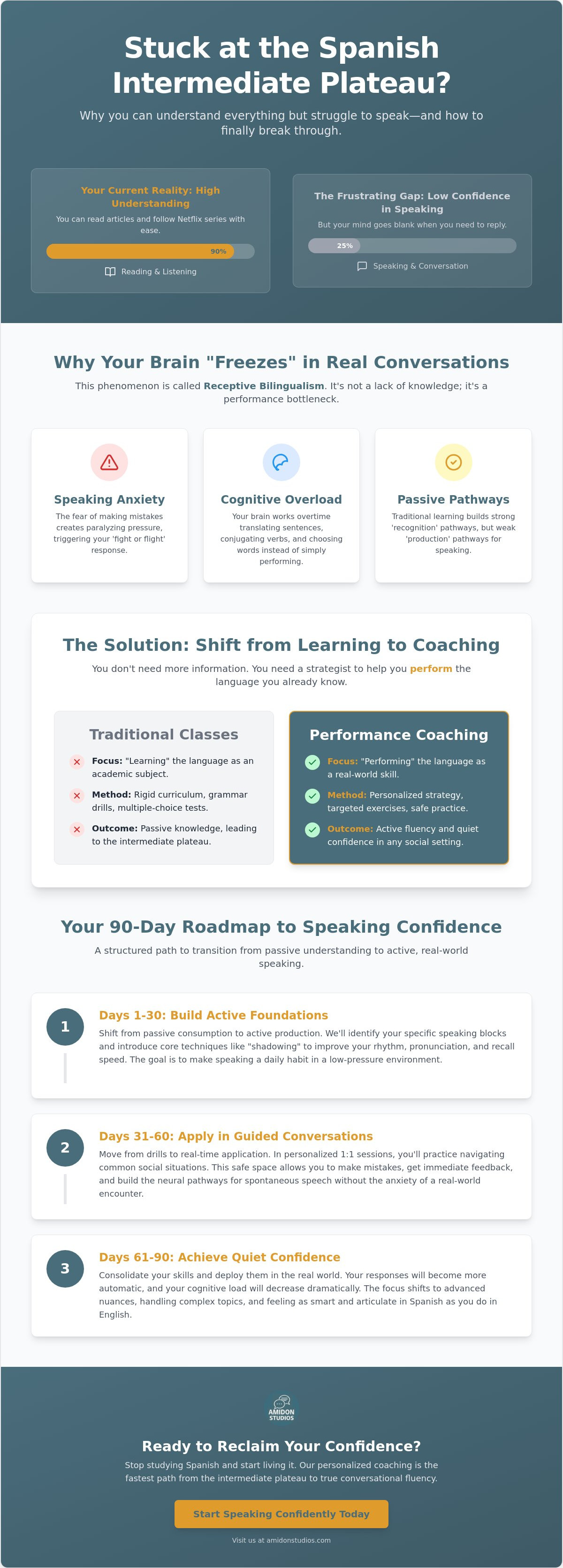
Coaching vs. Traditional Classes: Finding the Right Path to Fluency
As an adult learner with a solid foundation, your time is valuable. It's important to choose a learning method that directly targets your primary goal: improving your speaking. While apps, podcasts, and group classes all have their place, they often fall short for intermediate speakers who need to overcome the speaking plateau.
A one-on-one coaching relationship offers a level of personalization that other methods can't match. In a group class, the teacher must cater to the average level of the students, and you may get only a few minutes of actual speaking time. With a personal coach, every minute of the session is dedicated to your specific challenges and goals.
The cost-to-value ratio is often higher because you are getting targeted, efficient practice that leads to faster, more noticeable improvement in your conversational ability.
Why Apps and Podcasts Aren’t Enough
Language apps and podcasts are fantastic tools for building vocabulary and training your listening comprehension. However, they primarily engage your passive skills and can create an "illusion of competence." You might feel productive after listening to a 30-minute podcast, but you haven't actually practiced retrieving language under the pressure of a live conversation. Speaking is a physical and mental skill, like playing tennis. You can't learn to hit a forehand just by watching videos of professional matches; you have to get on the court and swing the racket.
A coach provides the "court"—a safe, supportive space to practice, make mistakes, and get immediate, constructive feedback. Digital tools are excellent supplements to this live practice, but they cannot replace the spontaneous, unpredictable nature of a real human conversation.
Customized Plans vs. One-Size-Fits-All
A hallmark of effective Spanish coaching is a personalized plan. Your reasons for learning Spanish are unique. Perhaps you need to communicate more effectively with your team in Bogotá, chat with your in-laws from the Dominican Republic, or feel more comfortable making small talk with your neighbors from Guatemala. Each of these goals requires a different vocabulary set, cultural understanding, and conversational style.
The process should begin with a thorough assessment—not a test, but a conversation to diagnose your specific speaking habits, strengths, and weaknesses. From there, a coach can design a curriculum that targets your personal "triggers" for hesitation. This tailored approach is why a focused, 90-day plan can often produce more tangible results than years of unstructured study.
4 Proven Strategies to Transition from Passive Understanding to Active Speaking
While one-on-one coaching is the fastest way to improve, you can also incorporate specific techniques into your daily routine to begin strengthening your active speaking skills.
Here are four strategies that our coaches use with students.
The 15-Minute Daily "Shadowing" Technique: Choose a short audio clip (1-2 minutes) of a native speaker talking at a natural pace. First, listen to it a couple of times to understand the content. Then, play it again and speak along with the recording, trying to match their pronunciation, rhythm, and intonation exactly. Don't worry about understanding every word; the goal is to train your mouth to produce the sounds and flow of Spanish.
Record and Review Your Own Voice: Use your phone's voice memo app to record yourself speaking in Spanish for 2-3 minutes about your day. When you listen back, don't judge yourself harshly. Instead, listen like a coach. Do you notice yourself hesitating at certain points? Are you overusing filler words like "este..." or "ehh..."? This self-awareness is the first step to correcting those patterns.
Prioritize High-Frequency Conversational Connectors: Fluent conversation is built on words that link ideas together. Instead of trying to learn hundreds of new nouns, focus on mastering a dozen connectors that will make your speech sound more natural. Practice using words like: entonces, o sea, pues, bueno, así que, además, and sin embargo. These words buy you time to think and make your sentences flow together smoothly.
Develop Conversational Repair Strategies: Instead of stopping when you don't know a word, learn how to talk around it. This is the single most important skill for maintaining conversational flow. Practice these phrases:
To describe something: "Es una cosa que se usa para..." (It's a thing you use for...)
To ask for a word: "¿Cómo se dice la palabra para...?" (How do you say the word for...?)
To paraphrase your idea: "En otras palabras..." (In other words...)
To buy time to think: "A ver, déjame pensar un momento..." (Let's see, let me think for a moment...)
Activating Latent Spanish: Specialized Support for Heritage Learners
Heritage learners—those who grew up hearing Spanish at home but primarily speak English—face a unique set of challenges. You may have a near-native accent and an intuitive grasp of grammar, but you struggle to express complex thoughts. This can be accompanied by feelings of guilt or pressure to speak the language "perfectly."
Coaching for heritage speakers focuses on activation, not new learning. The goal is to build conscious control over the language that already exists in your mind. The Spanish Star Program, for example, is structured to address these specific needs, helping you organize your linguistic knowledge and build the confidence to use it in professional or family settings.
Building Speaking Habits That Stick
Consistency is more important than intensity. An hour of speaking practice once a week is more effective than a five-hour cram session once a month. The key is to integrate Spanish into your daily life in small, manageable ways.
Narrate your daily commute or chores to yourself in Spanish.
Send a short voice note in Spanish to a language partner or friend each day.
Set a micro-goal for every conversation, such as "I will use three new connecting words" or "I will ask two follow-up questions."
These small habits compound over time, building the automaticity and resilience needed for confident, real-world conversations.
How Personalized Spanish Coaching Works at Amidon Studios
Our approach is built on the principle that speaking is a skill that must be trained separately from listening and reading. We focus on providing a structured, supportive environment for intermediate speakers to do the one thing they need most: speak.
The foundation of our methodology is empathetic, one-on-one coaching that lowers performance anxiety. Jackie Amidon and our team of coaches create a low-stakes atmosphere where mistakes are viewed as valuable data, not failures.
We help you identify the specific habits that are holding you back and give you the tools and practice to build new, more effective ones. Our live video sessions are designed for busy adults, offering the flexibility to fit consistent practice into your schedule.
The Spanish Star Program: More Than Just Lessons
Our core program for adults, the Spanish Star Program, is a 90-day framework designed to systematically build your active speaking skills. It's not just a series of random conversation classes. It combines live coaching sessions for output practice with a digital toolkit of resources for reinforcement.
This integrated approach ensures you are building vocabulary and grammar knowledge outside of your sessions, so your live practice time can be used efficiently to focus on speaking, feedback, and strategy. We also offer specialized programs like online Spanish classes for families to help create a supportive bilingual environment at home.
Your First Steps with a Spanish Coach
Your journey begins with a free assessment. This is not a test to grade your Spanish, but a relaxed, 30-minute conversation with an experienced coach. The goal is twofold: for us to understand your specific speaking patterns, goals, and challenges, and for you to experience our coaching style firsthand. We'll discuss your background, identify your primary obstacles, and outline what a personalized 90-day roadmap would look like for you.
If you're ready to move from passively understanding Spanish to actively and confidently speaking it, this initial conversation is the most important step. It's an opportunity to get expert feedback and see a clear path forward.


Comments